

Car AC Repair: How to Diagnose Problems and Choose the Right Fix
A refrigerant recharge might seem like the obvious fix when your car’s AC blows warm air. But if refrigerant is low, there may be a leak, and topping it off alone won’t address the cause. Effective car ac repair starts with finding out what’s actually wrong.
Weak cooling, reduced airflow, inconsistent temperatures, and unusual noises can point to different issues. A refrigerant leak, compressor malfunction, or failing blower motor can affect comfort in different ways, so one symptom alone can’t confirm the diagnosis. It’s frustrating to pay for a recharge only to have the cabin heat up again.
This guide explains common AC symptoms, what an inspection can reveal, and how recharging differs from repairing a faulty component. You’ll also learn what to expect from professional heating and air conditioning service in Parker, Colorado. A clear diagnosis helps you understand the repair options and choose a practical next step.
Key Takeaways
- Warm air, weak airflow, inconsistent cooling, and unusual sounds can indicate different AC issues, but symptoms alone don’t confirm the cause.
- AC components work together, so a fault in one part can affect cooling or airflow.
- Car ac repair may involve recharging, repairing a refrigerant leak, or fixing a component, depending on inspection findings.
- Note when cooling or airflow changes and which settings affect it. These details can help the technician investigate the problem.
- Eagle Automotive in Parker provides AC inspection, recharging, and repair for concerns including refrigerant leaks, blower motor failures, and compressor malfunctions.
Car AC repair starts with recognizing what has changed
Weak cooling can have several causes, so symptoms alone can’t confirm a fault. Start by identifying what changed: does the air feel warm, move weakly, cool inconsistently, or come with a new sound when the AC is on? These details help describe the problem, but they’re clues, not a diagnosis.
- Warm airflow: Air comes through the vents with normal force but doesn’t feel cool.
- Reduced airflow: Less air comes through the vents, even with the fan turned up.
- Inconsistent cooling: The air shifts between cool and warm during a drive.
- Unusual sounds: A new noise appears when the AC operates.
Air temperature and airflow strength point to different parts of the system. Strong airflow that feels warm is different from weak airflow, which may indicate a problem with the blower motor or air movement. This overview of automotive air conditioning explains how connected components cool the cabin, but symptoms still can’t identify which part has failed. An AC symptom can point toward a problem, but it cannot establish a definitive diagnosis.
What does it mean when the AC blows warm air?
Warm air may be related to refrigerant loss, compressor trouble, or another system fault. Similar symptoms can have different causes, so don’t diagnose the problem by feel or sound alone. Note whether cooling faded over time or stopped suddenly. That timing is useful to report, but it doesn’t prove what needs repair.
Why is airflow weak even when the AC is on?
Weak airflow differs from air that moves strongly but isn’t cool. If little air comes through the vents, the blower motor is one possible source of trouble. Note whether changing the fan setting affects airflow and whether the reduced force happens all the time or only in certain conditions. This helps distinguish an airflow complaint from a cooling complaint.
Before arranging car ac repair, jot down when the symptom happens, whether it changes during a drive, and which fan or AC settings affect it. Include any new noises as observations, not proof of a specific fault. Sharing these details with a technician can help focus the inspection.
How the car AC system works, and where faults can develop
Your car’s AC is a group of connected components that removes heat from cabin air and moves it outside the vehicle. Refrigerant circulates through the system, carrying heat as it changes condition. A fan pushes cabin air across the cooled evaporator and through the vents. If a component can’t do its part, cooling may weaken or airflow may change.
Cabin cooling depends on several components working together, so a fault in one part can affect the whole system. The compressor moves refrigerant through the AC circuit. At the condenser, heat is released outside the cabin. Refrigerant then travels through other parts of the circuit to the evaporator, where it absorbs heat from cabin air. The cycle continues as the compressor circulates it again.
What do the compressor, condenser, and evaporator do?
The compressor circulates refrigerant through the AC circuit. The condenser helps release heat outside the cabin, while the evaporator absorbs heat from air inside the vehicle. The blower motor moves that air across the evaporator and out through the vents. Cooling depends on both heat transfer and air moving through the system.
These roles help explain why similar complaints can have different causes. A compressor malfunction may interfere with refrigerant circulation. A refrigerant leak can reduce the system’s ability to transfer heat. A blower motor failure may limit airflow even if the cooling process is otherwise functioning. The National Institute for Automotive Service Excellence (ASE) provides information about automotive service credentials, separate from how the AC system operates.
How can refrigerant leaks or blower motor problems affect cooling?
Low refrigerant can leave the AC blowing air that isn’t cool enough. Because refrigerant loss may result from a leak, inspection can help locate the underlying issue instead of treating the low level as the whole problem. Recharging may restore refrigerant, but it doesn’t seal a leak or repair a malfunctioning component.
A blower motor issue presents differently: air may come through the vents weakly, even if it feels cool. Compare that with strong airflow that feels warm, which can point toward a cooling-side concern. Neither pattern confirms a specific failure, but describing what you notice can guide the inspection.
That distinction is central to effective car AC repair. Checking both airflow and cooling performance helps narrow down whether attention belongs on the refrigerant circuit, a component such as the compressor, or air movement through the cabin. The right fix follows inspection, not guesswork.
Car AC diagnosis: recharge, component repair, or more testing?
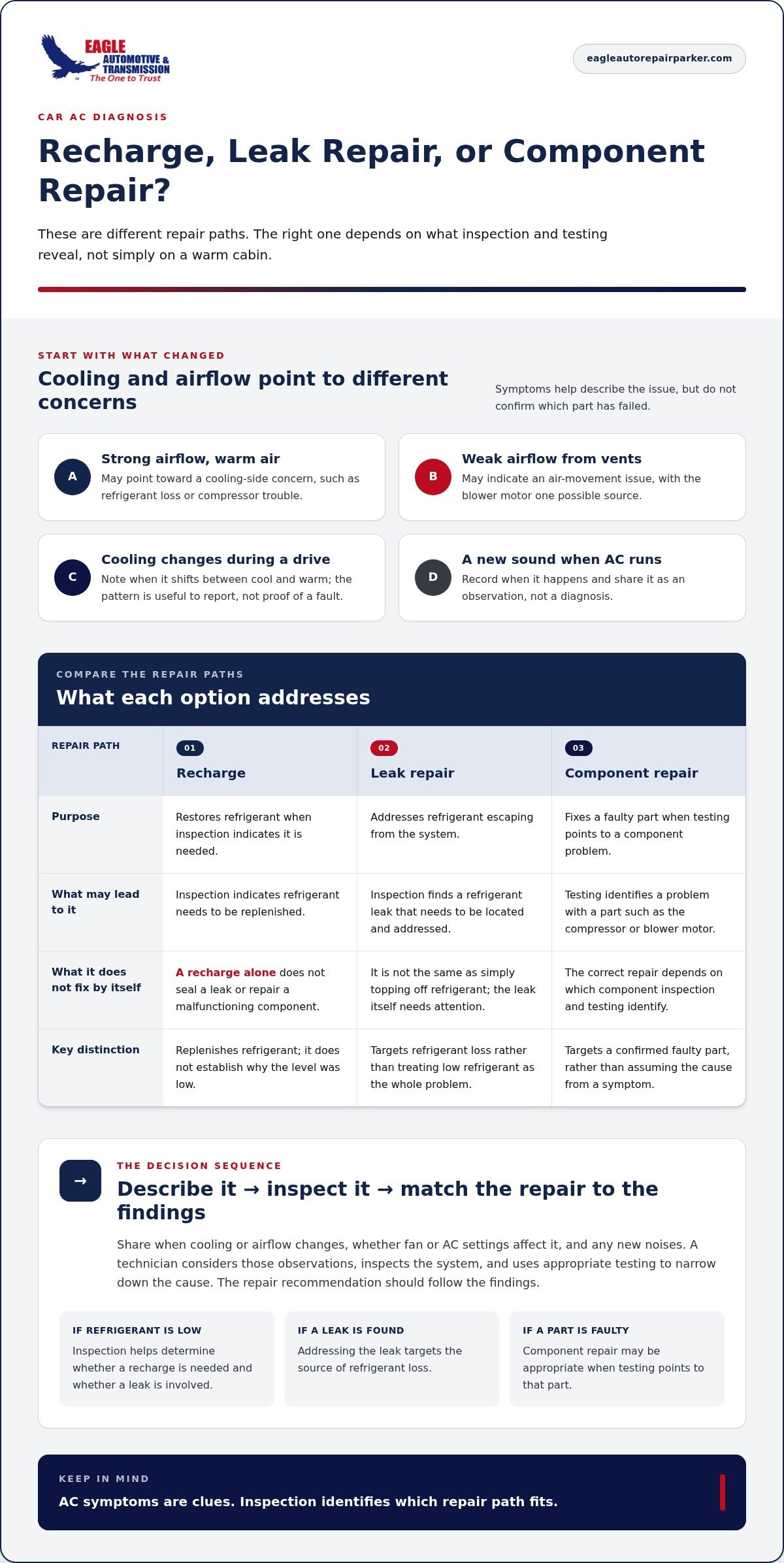
These are different repair paths, not interchangeable fixes. A recharge restores refrigerant when inspection indicates it’s needed. A leak repair addresses refrigerant escaping from the system. Component repair may be appropriate if testing points to a faulty part, such as the compressor or blower motor. The right approach depends on inspection findings, not simply on a warm cabin.
Good car ac repair starts with evidence. A technician considers your description of the symptoms, inspects the system, and uses appropriate testing to narrow down the cause. This helps avoid replacing parts based on a hunch or treating a recurring problem with a temporary measure. Ask how the inspection findings relate to the recommended work so you can understand the proposed repair.
When might recharging be part of car AC repair?
Recharging may be appropriate when inspection indicates that the system needs refrigerant service. It restores refrigerant, but doesn’t repair an unresolved leak. If cooling improves after a recharge and then weakens again, the recurring loss is a reason to investigate where refrigerant may be escaping. Recharging can be part of the solution, but it isn’t the answer to every weak-cooling complaint.
When might a leak, compressor, or blower motor need repair?
If inspection detects a refrigerant leak, the leak may need repair before or alongside recharging. A compressor malfunction can interfere with cooling, but warm air alone doesn’t prove the compressor is at fault. A blower motor problem is more closely associated with reduced airflow from the vents. These faults affect different parts of the AC system, so identifying the affected area matters.
Why might more testing be needed?
Some symptoms overlap. Warm air might lead a technician to check the refrigerant circuit or compressor operation, while weak airflow points toward air movement through the cabin. If initial checks don’t establish the cause, additional testing can help distinguish between possibilities before parts are replaced.
- Recharge: Restores refrigerant when service is indicated.
- Leak repair: Addresses the source of refrigerant loss.
- Component repair: Corrects a diagnosed fault, such as a compressor or blower motor malfunction.
- Further testing: Helps narrow down the cause when symptoms or initial inspection aren’t conclusive.
A clear explanation connects inspection findings to the proposed repair. You can then understand whether the system needs a recharge, leak repair, component work, or more testing before a final fix is chosen.
What to do before scheduling car AC repair in Parker
A few clear observations can make an AC inspection more focused. You don’t need to identify the failed part. Record what the system is doing, when the problem occurs, and whether a setting affects it. For car ac repair, these details are more useful than guessing at a cause.
Which observations help explain an AC problem?
Before arranging service, note what happens during normal use. Is the airflow weak, warm, inconsistent, or absent? Does the issue start as soon as you turn on the AC, or appear later in a drive? Describe any unusual sounds and when they occur, without treating them as proof that a specific component has failed.
Use this short checklist:
- Describe the air: Record whether it feels warm, changes between cool and warm, or stops coming through the vents.
- Note the timing: Write down when the symptom begins and whether it happens consistently or only in certain situations.
- Try the settings: Observe whether changing the fan speed or temperature setting affects airflow or cooling.
- Describe any sounds: Note when a new sound occurs, such as when switching the AC on, without assuming what caused it.
Keep your notes simple. “Airflow drops after I change the fan setting” gives the technician a useful observation to investigate. It doesn’t diagnose the fault, and it doesn’t need to.
What should you expect during a professional inspection?
A professional inspection starts with your description of the problem, then assesses the AC system and how it operates. Testing can help narrow down possible causes rather than selecting parts based on a symptom alone. Your notes about timing, fan settings, and sounds can help direct the process, especially when the issue comes and goes. If the complaint includes both weak airflow and poor cooling, a qualified technician in Parker can assess them as distinct clues during an AC inspection.
Inspection findings guide the repair approach. The issue may call for refrigerant service, attention to a leak, component repair, or further testing. The exact work depends on the system’s condition. A recharge isn’t a universal answer, and weak cooling alone doesn’t establish which repair is needed.
Leave refrigerant-system repairs to technicians with the appropriate training and equipment. Avoid opening or attempting to repair the system yourself. Refrigerant handling and AC components require proper service procedures, and guesswork can complicate diagnosis or lead to additional damage.
Bring your observations to the appointment and describe them plainly. Eagle Automotive provides heating and air conditioning inspection, recharging, and repair in Parker, including service for concerns such as refrigerant leaks, blower motor failures, and compressor malfunctions. Learn about AC service at Eagle Automotive.
Eagle Automotive car AC repair in Parker, Colorado
Persistent warm air or weak airflow can make a drive uncomfortable, but the symptom alone doesn’t tell you which repair is needed. Eagle Automotive provides heating and air conditioning inspection, recharging, and repair in Parker. An inspection helps narrow down what’s affecting cooling or airflow, so the next step can match the issue rather than rely on a guess.
Eagle Automotive serves all makes and models from its Parker, Colorado location. Its AC service addresses concerns including refrigerant leaks, blower motor failures, and compressor malfunctions. Since these problems affect different parts of the system, checking the complaint before choosing a repair matters.
How Eagle Automotive approaches AC inspection and repair
Inspection is the starting point for narrowing down the cause of an AC complaint. Cooling trouble may relate to refrigerant loss or a compressor malfunction, while reduced airflow may involve the blower motor. The appropriate service depends on what inspection identifies. Recharging is an option when refrigerant service is needed, but it doesn’t resolve an unrepaired leak.
This approach ties the repair to the evidence. If your AC has changed, share whether the air is warm, airflow is weak, or the problem comes and goes. Those details help explain the complaint, while inspection and testing help determine which system area needs attention. You don’t need to identify the failed part yourself.
When should Parker drivers arrange AC service?
Arrange an evaluation if cooling or airflow changes persist or make comfortable driving difficult. A symptom can have more than one possible cause, so don’t treat warm air, weak airflow, or an unusual sound as a diagnosis. Describe what happens and when to give the inspection a useful starting point.
Eagle Automotive provides heating and air conditioning inspection, recharging, and repair in Parker for concerns involving refrigerant leaks, blower motor failures, and compressor malfunctions. The findings guide the service, whether that means refrigerant work, repair of an identified fault, or further evaluation.
- Cooling concern: Note whether vent air feels warm or cooling changes during a drive.
- Airflow concern: Describe whether air moves weakly or stops, and whether fan settings make a difference.
- Unusual sound: Report when you hear it, without assuming which component is responsible.
Bring those observations to your appointment so the inspection can guide the next step. Arrange heating and air conditioning service with Eagle Automotive in Parker.
Move from AC uncertainty to a clear next step
You don’t have to know which part has failed before arranging service. Avoid treating a symptom as a verdict. Let an inspection establish what’s happening, then use the findings to understand the repair recommendation. That’s a more useful starting point for car ac repair than choosing a fix based on warm air alone.
If the cooling problem makes drives uncomfortable or keeps returning, describe what you’ve noticed. Eagle Automotive can assess the concern and explain the appropriate path based on the inspection. You’re not expected to diagnose the system yourself.
Schedule AC service with Eagle Automotive in Parker to have the concern assessed.
Frequently Asked Questions
Why is my car AC blowing warm air?
Warm air can result from refrigerant loss, a compressor problem, or another fault in the cooling system. Note whether the air gradually became less cool or changed abruptly, and whether the vents still move air normally. These clues help describe the issue, but they can’t identify the failed part on their own. Inspection is needed to determine the cause.
Does a car AC recharge fix a refrigerant leak?
No. A recharge restores refrigerant, but it doesn’t seal a leak. If cooling returns briefly and then fades again, refrigerant may be escaping and the source needs to be investigated. Recharging again without addressing an unresolved leak can leave the underlying fault in place. Have the system inspected so the next step addresses the condition found.
Can a bad blower motor make a car’s AC stop cooling?
A failing blower motor can reduce or stop airflow from the vents, making the cabin feel as if the AC has quit. It affects air movement, while refrigerant or compressor problems can affect how cool the air gets. If changing fan speed doesn’t noticeably change airflow, mention that during an inspection. A technician can check the blower motor and distinguish an airflow concern from a cooling-system fault.
How does a mechanic diagnose a car AC problem?
A mechanic uses your description of the symptoms as a starting point, then inspects the AC system and checks how it operates. Depending on the complaint, evaluation may look at airflow, cooling performance, refrigerant condition, and components such as the compressor or blower motor. If initial checks don’t point to one cause, further testing can help narrow the possibilities before a repair is selected.
When should I schedule car AC repair in Parker, Colorado?
Arrange car ac repair if the cooling or airflow problem persists, returns, or makes normal drives uncomfortable. You don’t need to wait until the vents stop working completely. Before booking, note when the issue occurs and whether fan or temperature settings change it. Sharing those observations with an automotive shop in Parker that also provides Jeep suspension repair gives the inspection a practical starting point while leaving diagnosis to testing.
1 Comment. Leave new
[…] in Parker, with brake inspection, servicing, and component replacement as part of its broader automotive repair […]