

Honda A/C Repair: Symptoms, Diagnosis, and Repair Options
A refrigerant recharge might seem like the obvious fix when your Honda’s A/C blows warm air. But low refrigerant can point to a leak, and airflow problems or a failed component can cause similar symptoms. Good honda a/c repair starts with finding the cause, not guessing and topping off the system.
It’s frustrating when the cabin stays warm or airflow changes without warning, especially if you’re unsure what the repair should address. Symptoms can offer useful clues, but no single sign confirms which part has failed. This guide explains possible causes of weak or inconsistent cooling, what technicians check during an inspection, and how repair options depend on the findings. It also explains why checking refrigerant levels alone may not be enough. With a clear diagnosis, you can understand the recommended work and avoid a fix that misses the underlying problem.
Key Takeaways
- Warm air, weak airflow, and intermittent cooling can point to different issues, so one symptom alone cannot identify the failed part.
- A methodical honda a/c repair inspection helps distinguish refrigerant concerns from airflow problems or component faults.
- Recharging may be appropriate in some cases, but suspected leaks need investigation rather than repeated top-offs.
- Note when the A/C problem occurs and whether airflow or cooling changes to give the technician useful diagnostic clues.
- Repair options depend on the inspection findings, which can help you understand why a particular fix is recommended.
Honda A/C Repair Symptoms: What the Signs Can and Cannot Tell You
Weak cooling can have several causes, so one symptom cannot identify the failed part. Warm air, low airflow, cooling that comes and goes, and other changes in system behavior each give a technician a clue, not a diagnosis. For background on how vehicle A/C systems work, see Automotive Air Conditioning Systems.
Airflow and cooling performance point to different diagnostic checks. If air moves strongly but feels warm, the concern differs from a fan that barely pushes air through the vents. That distinction helps guide an inspection without assuming the cause is low refrigerant or a particular failed component.
Warm air, weak airflow, or cooling that comes and goes
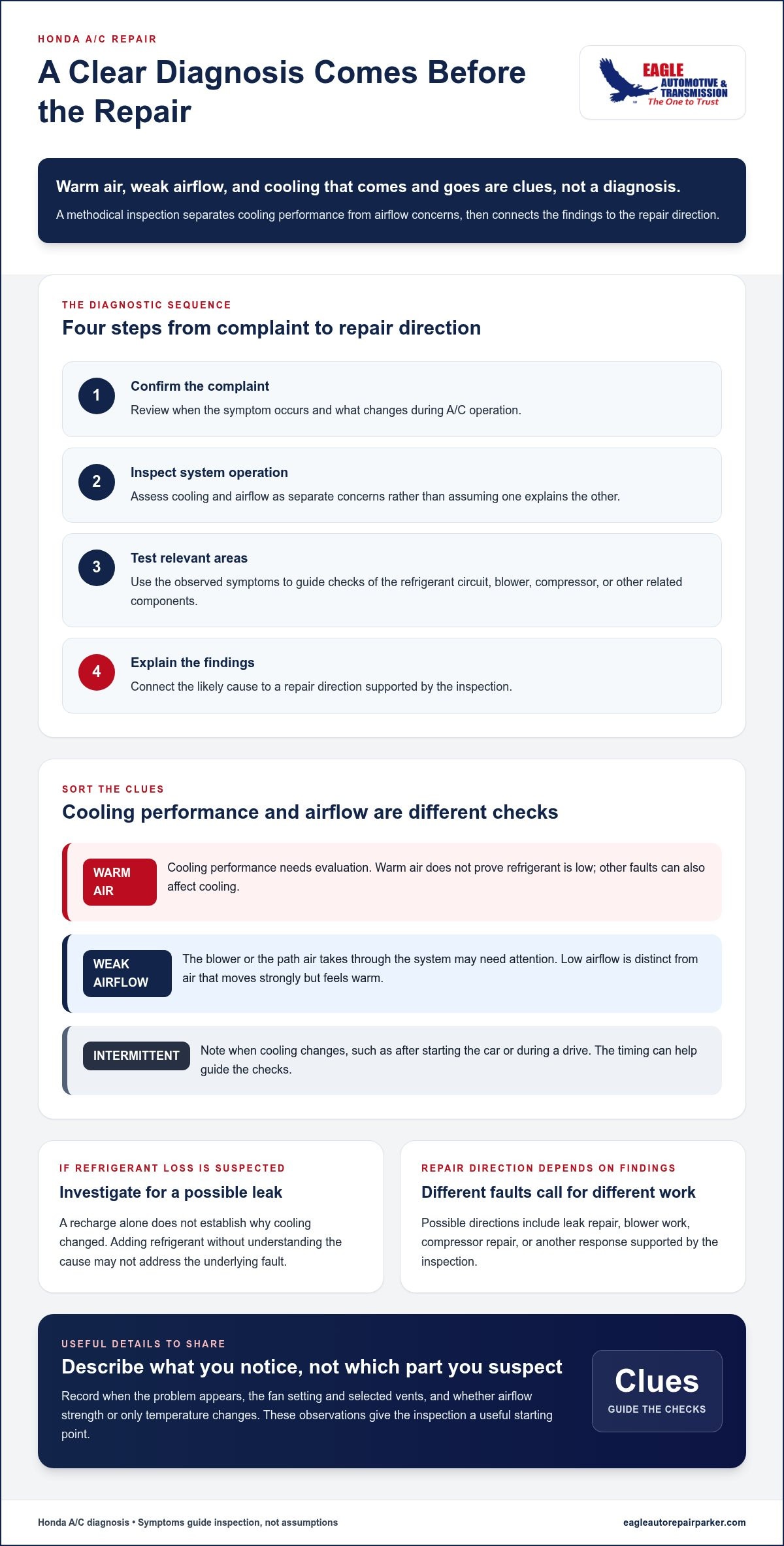
Warm air means the system’s cooling performance needs evaluation. It doesn’t prove the refrigerant is low; other faults can also affect cooling. Weak airflow is a separate complaint and may direct attention to the blower or the path air takes through the system. If cooling is intermittent, note when it changes, such as after starting the car or during a drive. Those details help a technician narrow the checks without treating any one clue as proof.
Describe unusual behavior, too. Does the airflow change when you adjust the controls? Does selecting a different vent change where air comes out, or does the temperature shift while fan strength stays the same? These observations help distinguish an airflow complaint from a cooling-performance complaint. The article Car AC Repair: How to Diagnose Problems and Choose the Right Fix covers the broader diagnostic process.
What to note before arranging Honda A/C repair
Before arranging honda a/c repair, jot down when the problem appears and whether it changes during the drive. Record the fan setting, selected vents, and whether airflow strength changes. Note whether the air feels warm, cools only sometimes, or barely comes through the vents. Share what you observe with the technician rather than trying to identify a failed part yourself. A clear description gives the inspection a useful starting point.
- When does the symptom begin, and does it change as you drive?
- Which fan setting and vents are selected?
- Does airflow strength change, or does only the temperature change?
- Does the issue happen consistently or only under certain conditions?
You don’t need technical terms or a parts diagnosis. Accurate observations help the technician confirm the complaint, assess how the system is operating, and choose the next checks based on what the A/C is doing.
How a Technician Diagnoses a Honda A/C Problem
A sound diagnosis follows the evidence. The technician confirms what you’re experiencing, checks how the A/C operates, tests the areas suggested by your observations, and explains the findings before recommending work. This sequence matters because warm air, weak airflow, and inconsistent cooling can point to different parts of the system.
A recharge alone doesn’t establish why cooling performance changed. If refrigerant loss is suspected, the inspection needs to consider whether there’s a leak. Adding refrigerant without understanding the cause may not address the underlying fault.
- Confirm the complaint. The technician reviews when the symptom occurs and what changes during operation.
- Inspect system operation. They assess cooling and airflow as separate concerns rather than assuming one explains the other.
- Test relevant areas. Your observations guide checks of the refrigerant circuit, blower, compressor, or other related components.
- Explain the findings. The technician describes the likely cause and the repair direction supported by the inspection.
From the owner’s complaint to targeted checks
Details such as whether the A/C cools at first, changes during a drive, or loses airflow can help narrow where the inspection should begin. A technician evaluates how cool the air feels separately from how strongly it comes through the vents. If the symptom doesn’t point clearly to one cause, more than one possibility may need consideration before a repair is recommended.
How technicians assess leaks and major components
If refrigerant loss is suspected, the technician investigates for a possible leak instead of treating a recharge as a complete diagnosis. Weak or absent cabin airflow brings the blower motor and airflow path into consideration. A compressor malfunction is another possible source of poor cooling, but it needs evaluation rather than assumption. These concerns involve different checks, and the right repair depends on what the inspection reveals.
Refrigerant handling is also part of responsible A/C service. The EPA’s guidance for motor vehicle A/C servicing explains applicable requirements for technicians and refrigerant handling. A professional inspection can establish whether the issue calls for leak repair, blower work, compressor repair, or another response. For honda a/c repair, ask for a clear explanation of the observed fault and how the proposed work addresses it. A diagnosis should connect the symptom to evidence, not simply name a part to replace.
Honda A/C Repair Options: Recharge, Leak Repair, or Component Work?
The right repair depends on what an inspection finds. A recharge, leak repair, blower motor work, and compressor repair address different conditions, so none should be treated as the automatic fix for every Honda with poor cooling. A clear diagnosis connects the observed problem to the recommended repair.
Use this comparison to understand the kinds of decisions an inspection may support. It isn’t a way to diagnose the fault yourself.
| Finding | Possible repair direction | Why diagnosis matters |
|---|---|---|
| Refrigerant level needs attention, with no unresolved leak indicated by the assessment | Recharging may be considered | It helps determine whether adding refrigerant fits the system’s condition |
| A refrigerant leak is identified or suspected | Investigate and address the leak, then assess whether recharging is appropriate | A recharge alone won’t fix the source of refrigerant loss |
| Airflow from the vents is weak or absent | Inspect the blower motor and airflow path | Adding refrigerant doesn’t restore air movement through the cabin |
| Testing points to a compressor malfunction | Evaluate the compressor and determine suitable component work | Warm air alone doesn’t establish that the compressor has failed |
When a recharge may be part of the repair
Recharging can be appropriate after the system’s condition has been assessed. Warm air by itself doesn’t prove refrigerant is low, so the symptom shouldn’t trigger an automatic top-off. If cooling improves after service but later fades again, that change deserves further investigation. Restoring refrigerant without addressing a suspected leak may leave the underlying cause in place.
When a leak, blower motor, or compressor needs attention
Each finding calls for a different repair path. A confirmed refrigerant leak means the source of the loss needs attention, not just the resulting weak cooling. A blower motor moves air through the cabin, so a problem there relates to airflow strength or its absence. A compressor concern needs diagnostic support before component repair is recommended.
This is why honda a/c repair should follow the inspection findings, not an assumption based on one symptom. Ask what the technician observed, which system area those findings point to, and how the proposed work addresses it. That explanation helps distinguish a repair aimed at the cause from a temporary response to the symptom. Clear communication about recommended work is also central to Eagle Automotive.
Once the fault is identified, the repair direction becomes clearer: recharge when appropriate, investigate a suspected leak, or address an affected component such as the blower motor or compressor. The technician’s explanation should make that connection understandable before work proceeds.
Preparing for Honda A/C Repair in Parker: What to Share and Expect
A little preparation can make an A/C inspection more focused. You don’t need to identify the failed part or know technical terms. Bring a clear account of what changed, when you noticed it, and how the system behaves. Those observations help the technician compare your complaint with what the A/C does during inspection.
For broader diagnostic context, the parent guide, Car AC Repair: How to Diagnose Problems and Choose the Right Fix, explains how symptoms inform the next steps. The same principle applies here: useful details guide the inspection, but testing supports the repair decision.
How to describe the A/C problem clearly
Keep notes brief and specific. For example, say whether cooling is poor from the moment you start driving or changes later, and whether airflow itself gets weaker. Mention which vents and fan settings you were using. If you noticed a recent change in how the system sounds, responds, or sends air through the cabin, include it without guessing what caused it.
- Describe when the symptom starts and whether it continues or comes and goes.
- Separate air temperature from airflow strength: is the air warm, weak, or both?
- Note whether changing the fan setting or selected vents changes what you feel.
- Share any recent change in system behavior, even if you’re unsure whether it matters.
These details aren’t a substitute for inspection. They give the technician a practical starting point and help clarify whether the concern is mainly about cooling, airflow, or both. If the symptom is inconsistent, explain what you observed when it appeared rather than trying to reproduce it or naming a suspected part.
What a repair recommendation should explain
A useful recommendation connects the reported symptom to the inspection findings and the proposed work. Ask what the inspection showed and how the suggested repair addresses that concern. If the finding involves suspected refrigerant loss, the explanation should address the leak investigation. If airflow is the issue, ask how the recommendation relates to moving air through the cabin. Component work should likewise be tied to diagnostic evidence.
A parts list alone doesn’t explain why a repair is needed or whether it addresses the problem you brought in. In a transparent honda a/c repair process, you should be able to understand what was found, what work is recommended, and how the two relate. An inspection helps determine which repair path fits the observed fault; it doesn’t mean every Honda needs the same fix.
For Honda A/C inspection and repair in Parker, Eagle Automotive serves all makes and models and provides heating and A/C inspection, recharging, and repair. Arrange an A/C inspection for your Honda and share the symptom details you’ve recorded.
Honda A/C Repair in Parker: How Eagle Automotive Can Help
A Honda’s A/C concern deserves a clear path from the symptom you notice to the work recommended. Warm air, reduced airflow, and cooling that changes during a drive don’t all point to the same fault. Sharing what the system is doing gives the inspection a useful starting point. The goal is to identify the cause before choosing a repair, not to assume every climate-control complaint calls for refrigerant.
Eagle Automotive serves all makes and models in Parker, including Honda vehicles. Its heating and A/C service includes system inspection, recharging, and repair. The inspection can consider different parts of the problem, including refrigerant leaks, blower motor failures, and compressor malfunctions, rather than treating every symptom as a recharge issue.
A practical path from inspection to repair
Start by describing what you’ve observed: whether the air feels warm, airflow has weakened, or cooling changes as you drive. Those details help frame the inspection, but they don’t identify a failed part by themselves. The technician evaluates the system and uses the findings to determine which repair direction fits.
The recommendation should connect the inspection result to the work proposed. If refrigerant loss is a concern, the repair discussion should address the leak investigation and any needed repair, not just the reduced cooling. If air movement is weak, attention may turn to a blower motor concern. If findings point toward a compressor malfunction, the recommended component work should reflect that diagnosis.
This distinction helps explain why two vehicles may need different repairs even if both owners report warm air. An inspection may support recharging, repair of a leak, or work on an affected component. The right option depends on what the system needs. Ask for an explanation that ties the finding to the proposed work, so you can make an informed decision without diagnosing the parts yourself.
Get help with Honda A/C repair in Parker
For Honda owners, honda a/c repair begins with checking the system rather than guessing at the cause. Eagle Automotive’s service for all makes and models includes A/C inspection, recharging, and repair, including work that addresses leaks, blower motor failures, and compressor malfunctions. The inspection helps determine which concern, if any, fits the symptoms and what repair path is appropriate.
Bring a concise description of what you’ve noticed, including when cooling changes and whether airflow is affected. Clear observations help focus the conversation and give the technician a practical starting point. From there, the findings can guide a recommendation specific to the problem, rather than a generic parts list or automatic recharge.
If your Honda’s A/C isn’t working as expected, arrange an inspection with Eagle Automotive in Parker. Share the symptoms, review the findings, and discuss the repair option that matches the diagnosed cause.
Make Your Next A/C Decision With Confidence
You don’t need to arrive with a theory about what failed. A short, accurate account of what you noticed is enough to start a useful conversation. Focus on understanding how the inspection findings relate to the recommended work. If something isn’t clear, ask for an explanation in everyday terms before deciding how to proceed.
That keeps the next step practical: move from uncertainty toward a repair decision grounded in your Honda’s condition. For honda a/c repair in Parker, bring your observations to Eagle Automotive and let the inspection guide the discussion. Arrange Honda A/C service with Eagle Automotive and take the first step toward a clear plan. You can move forward without diagnosing the system yourself.
Frequently Asked Questions
Why is my Honda A/C blowing warm air?
Warm air can result from more than one problem, so it doesn’t automatically mean the system needs refrigerant. A leak, compressor malfunction, or another issue affecting cooling may be involved. Notice whether the air stays warm at every fan setting and whether the symptom changes during a drive. These clues can help a technician narrow the inspection, but testing is needed to identify the cause of your honda a/c repair concern.
Can a Honda A/C system need a recharge if it has a refrigerant leak?
Yes, recharging may be part of the repair, but it doesn’t stop refrigerant from escaping through a leak. If cooling returns after refrigerant is added and then fades again, the recurring change needs investigation. A technician can assess whether a leak is present and recommend addressing its source before or along with recharging. Ask what the inspection found so you understand whether the proposed work treats the leak or only restores refrigerant.
How does a technician diagnose a Honda A/C problem?
A technician begins by confirming the complaint, then evaluates how the A/C and airflow behave and tests areas suggested by the findings. If the issue comes and goes, describe the conditions you noticed and whether it changed after adjusting the controls. That context can help focus the inspection. The goal is to connect the observed behavior to a likely fault before recommending repair, rather than replacing a part based on one symptom.
Can a blower motor cause weak airflow from my Honda’s vents?
Yes. The blower motor helps move air through the cabin, so a problem with it can contribute to weak or absent airflow. Notice whether changing the fan setting changes the amount of air you feel. If airflow stays weak across settings, mention that during inspection. Warm air with strong airflow is a different complaint from little air coming through, and a technician can assess the relevant parts without assuming the motor is at fault.
Is a Honda A/C compressor problem the only cause of poor cooling?
No. Poor cooling can have several possible causes, including refrigerant loss from a leak or a compressor malfunction. Airflow problems can also make the cabin feel uncomfortable, although they differ from a lack of cooling. Note whether air moves strongly but feels warm, or whether little air reaches the vents. A technician can assess these clues separately and determine which system area needs attention.
1 Comment. Leave new
[…] is low, there may be a leak, and topping it off alone won’t address the cause. Effective car ac repair starts with finding out what’s actually […]