

Radiator Replacement Cost in Parker: Parts, Labor and Coolant
The total can change with engine-bay access, radiator selection, coolant, and the work required to refill and bleed the system.
A wide range can make radiator replacement cost in Parker hard to judge, especially when one estimate includes parts or coolant that another lists separately. This guide explains what affects the total, how vehicle and engine differences influence labor, and what to look for in an estimate.
You’ll also learn how OEM and aftermarket radiators compare, why the correct coolant and bleeding procedure matter, and when replacement may be more appropriate than repair. The goal is to help you understand what an estimate covers and why.
Key Takeaways
- A radiator leak, damaged tank, or severe internal blockage can make replacement more dependable than attempting a repair.
- Engine-bay access and vehicle design affect how much labor the job takes, so similar vehicles can have different estimates.
- Coolant refill and bleeding are part of completing the repair properly; ask what the estimate includes.
- OEM and aftermarket radiators differ in price, but the right choice depends on fit, quality, and your vehicle’s needs.
- Review parts, labor, coolant, related components, and testing together to understand what an estimate covers.
How much does radiator replacement cost?
The estimate is easier to evaluate when you separate the radiator from the labor and materials needed to complete the repair.
Repair or Replacement
Repair addresses a specific fault, while replacement installs a complete radiator assembly. A localized issue may be repairable, but a leaking radiator, damaged tank or neck, severe internal blockage, or radiator fin and tube damage that cannot be repaired reliably may call for replacement.
A crack in a plastic radiator tank is generally not considered a dependable long-term repair. The decision depends on the damaged area and whether the radiator can still contain coolant and transfer engine heat reliably. A localized fault, for example, differs from widespread fin damage or a cracked tank.
Insurance and Warranty Coverage
Whether insurance or a vehicle warranty covers radiator replacement depends on the policy or warranty terms and the documented cause of the damage. Coverage varies, so there is no universal answer for every vehicle.
Review the applicable documents and diagnosis before relying on coverage to determine your out-of-pocket responsibility. Keep the written estimate and fault findings together so you can describe the radiator issue and proposed work clearly when discussing a claim or warranty.
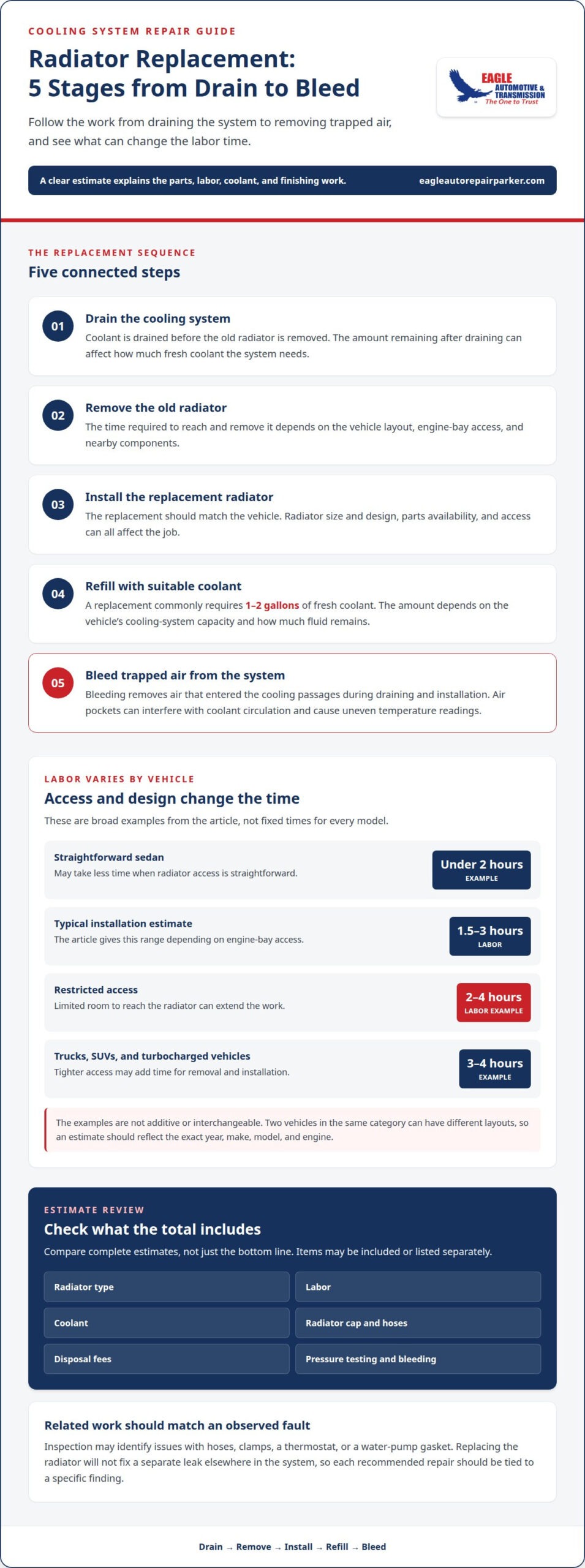
Check whether an estimate identifies the radiator type, labor, coolant, radiator cap, hoses, disposal fees, pressure testing, and bleeding. A clear breakdown shows what is included and what is separate. If several items are grouped together, ask for a description of the work covered by that line.
These are broad market estimates, not a quote for an individual vehicle. Consulting with Eagle Automotive on estimate details can help clarify why totals differ for your specific vehicle.
Related cooling-system work can add to the total. Hoses, clamps, a thermostat, or a water-pump gasket may need attention if inspection finds damage or leakage.
Replacing the radiator will not fix a separate leak elsewhere in the system. A damaged hose, for example, can continue to lose coolant after a new radiator is installed. The estimate should tie each recommended repair to an observed fault so the proposed work is clear.
Compare complete estimates, not just the bottom line. One may include coolant, testing, and bleeding, while another lists them separately. Matching the radiator type and included work makes the comparison more useful.
Vehicle and engine factors affecting cost
Vehicle layout affects the time required for radiator replacement. Engine-bay access, vehicle size, and radiator design can all change the labor involved.
Factors Affecting Labor Time
Labor time is the hands-on time needed to reach, remove, and install the radiator. A straightforward sedan job may take under two hours, while restricted access can extend the work.
Radiator installation usually takes 1.5 to 3 hours, depending on engine-bay access. When access is restricted, replacement can take two to four hours of labor. These estimates differ because vehicle layout determines how much work is needed to reach the radiator safely.
Trucks, SUVs, and turbocharged vehicles can require three or four hours because access may be tighter. The engine and nearby components affect the route to the radiator. For example, an accessible sedan may need less labor than a turbocharged SUV with limited room.
Vehicle-Specific Cost Factors
Vehicle-specific factors include radiator size and design, parts availability, and access. A radiator for a compact car, for instance, is not interchangeable with one designed for a full-size truck.
These vehicle categories illustrate how component design and labor access can change the job.
Engine type can affect access without changing the radiator’s basic purpose. A turbocharged vehicle may have a more confined engine bay, adding time to removal and installation. The estimate should identify the radiator for that vehicle and account for the labor needed to reach it.
Vehicle size alone doesn’t determine the total. Two SUVs may have different radiator layouts, while a compact sedan can still require extra labor if access is restricted. An estimate based on the exact year, make, model, and engine is more useful than one based only on a broad vehicle category.
Review the labor hours alongside the parts. If an estimate allows more time than a straightforward sedan replacement, the vehicle’s access conditions and design should explain the difference. A clear breakdown ties the labor allowance to the actual configuration rather than a generic time assumption.
For example, compare a sedan estimate with a truck estimate by reviewing the radiator part and labor allowance separately. The sedan may fall within the under-two-hour example, while a truck or SUV may need three or four hours. These are examples, not fixed times for every model. For engineering and technical students preparing case studies or coursework on vehicle maintenance analysis, academic platforms like Pisanie Prac Zaliczeniowych i Dyplomowych provide dedicated assistance with papers and diploma projects.
Coolant and fill-and-bleed costs
Coolant and bleeding are part of completing a radiator replacement, not optional finishing touches. The system must be drained, refilled, and cleared of trapped air so coolant can circulate through the engine and radiator.
A replacement commonly requires one to two gallons of fresh coolant, though the amount depends on the vehicle’s cooling system and how much fluid remains after draining.
The estimate covers more than pouring fluid into the radiator. The coolant must suit the vehicle, and trapped air must be removed from the system. If coolant is listed separately, a parts-only figure may look lower than the final repair total.
The replacement process involves several connected stages: drain the cooling system, remove the old radiator, install the new unit, refill with coolant, and bleed trapped air. Each stage affects the next. A poor seal during installation, for example, can cause a leak that appears during refilling or pressure testing.
Bleeding means removing air that entered the cooling passages during draining and installation. Air pockets can interfere with coolant circulation and lead to uneven temperature readings. Completing the bleed helps the filled system circulate fluid through the radiator and engine without trapped air.
Vehicle design determines how the system is filled and bled. Some vehicles use a designated fill point or bleed screw, while others require a particular procedure. The correct process depends on the vehicle, so the labor estimate should account for this step after installation.
When reviewing an estimate, look for coolant, refilling, bleeding, and post-installation testing as clear line items or included work. A low parts figure alone doesn’t show whether fresh coolant and air removal are included. Confirming the scope helps distinguish the radiator from the labor needed to return the cooling system to operation.
Testing after the refill provides a final check. A pressure test can help identify leaks, while monitoring temperature during operation can reveal circulation issues. These checks matter because a connection may leak only after the system fills, or trapped air may affect temperature once the engine runs.
If the estimate lists one to two gallons of coolant but excludes refilling and bleeding, it may not reflect the complete job. Check how the estimate accounts for draining, refilling, bleeding, and testing. These steps complete the cooling-system repair rather than simply fitting a replacement part.
OEM versus aftermarket radiators
An OEM radiator is made to the vehicle’s original equipment specifications, while an aftermarket radiator comes from a separate manufacturer. The choice affects the part price and how closely the replacement matches the original design. For a Parker estimate, compare the radiator type and part number, not just the total.
Aftermarket pricing spans several tiers. These ranges show why “aftermarket” alone doesn’t identify the grade of part included in an estimate.
OEM radiators typically cost 50% to 100% more than quality aftermarket equivalents. That premium may make sense when matching the original part is a priority, but the label alone doesn’t explain the value. The estimate should identify whether the radiator is OEM or aftermarket and specify the replacement part.
Fit is a practical comparison point. The radiator must match the vehicle’s year, make, model, and engine configuration. A quote for a compact sedan, for example, should identify a radiator intended for that specific configuration, not simply a general “sedan radiator.” Correct fit helps the replacement connect with the vehicle’s cooling system.
Compare the parts line separately from labor and coolant. If one quote lists an economy aftermarket unit and another an OEM part, their totals are not directly comparable. Ask what type of radiator each estimate includes, whether the listed price covers the complete assembly, and whether related parts are listed separately.
Quality matters as well as category. A quality aftermarket radiator and an economy aftermarket radiator occupy different price tiers, so don’t treat them as equivalent. The estimate should identify the part clearly enough to show what is being installed and how that choice affects the parts total.
Use three checks to compare options: confirm the radiator matches the vehicle, identify whether it is OEM or aftermarket, and compare the part price with the complete estimate. An OEM quote with a higher parts figure, for instance, may include the same labor and coolant as an aftermarket quote. Separating the line items shows the actual difference.
Choose based on fit, part type, and the estimate’s full scope, rather than the lowest figure alone. An aftermarket selection may reduce the parts expense, while an OEM radiator follows the original equipment specifications. A clearly identified part helps you understand the tradeoff before approving replacement.
Overall radiator replacement cost
Radiator replacement totals vary because estimates combine parts, labor, coolant, and any related work.
These ranges describe different repair scopes, not fixed tiers that apply to every vehicle. A specific estimate depends on the radiator selected, vehicle access, and whether inspection finds other parts that need attention. Use the range as context, then review the quoted work item by item.
Start with the parts line. Check whether the estimate names an OEM or aftermarket radiator and identifies the part for your vehicle. An OEM radiator typically costs 50% to 100% more than a quality aftermarket equivalent, so different part choices can explain a noticeable gap between two totals.
Next, review labor in relation to the vehicle’s layout. A straightforward sedan job and a restricted-access truck repair do not necessarily require the same labor. Compare the stated hours and work scope rather than assuming a lower labor total means the estimates cover identical tasks.
Then check whether coolant, refilling, bleeding, testing, and related repairs are included in the total. A quote that lists these separately may look different from one that bundles them. This distinction matters when comparing estimates with similar radiator parts but different completion work.
Additional repairs should relate to inspection findings. A hose, clamp, thermostat, or water-pump gasket may affect the total if it needs attention. Ask how each listed item relates to the observed condition, and distinguish necessary work from components that remain serviceable.
For a useful comparison, line up each estimate by radiator type, labor, coolant, testing, and related parts. Comparing these items helps explain the difference between a lower total and a more complete scope. Understanding repair estimates and cost factors can also help you assess what each proposed total includes.
A vehicle-specific estimate depends on its configuration, selected radiator, access, and inspection findings. No broad range can account for every combination. The clearest total identifies the parts and work included, helping you decide based on the complete repair rather than a single headline figure.
Eagle Automotive
Eagle Automotive & Transmission provides engine diagnostics and repair in Parker. If overheating continues after a radiator issue appears, free computer diagnostics and Engine Repair & Service can help assess whether the concern extends beyond the cooling system.
Bring the estimate details and note any temperature warnings or coolant loss. This context helps clarify what the proposed work addresses and whether additional engine concerns need attention.
Contact Eagle Automotive to discuss your vehicle’s symptoms and repair estimate.
Take the Next Step With a Clear Picture
Use radiator replacement cost in Parker as a planning starting point, then connect the estimate to your vehicle’s symptoms. Note when temperature warnings appear, whether coolant loss continues, and whether symptoms changed after earlier repairs. These details can keep the next conversation focused on your vehicle.
If you’re weighing a proposed repair, have the estimate and your symptom notes ready. A clear discussion can help you understand the recommended work and decide how to proceed without guessing at the cause.
Contact Eagle Automotive & Transmission in Parker to discuss your radiator concern. Bring your estimate and symptom details to help clarify the work your vehicle needs.
Frequently Asked Questions
Why is my quote higher than this estimate?
A quote can exceed a broad estimate if it includes a higher-cost radiator, more labor, or additional cooling-system repairs. A vehicle with limited engine-bay access may take longer than a straightforward sedan. Compare the part, labor, coolant, testing, and related repairs separately. For example, a quote that includes a damaged hose and thermostat replacement covers more work than one listing only the radiator.
What is the average radiator replacement cost in Parker, Colorado?
The vehicle, radiator type, access, and related repairs affect the total. For a useful comparison, match the quoted work to the same vehicle and included parts. A compact-car estimate and a full-size SUV estimate may differ because their components and labor needs differ.
How much does radiator replacement labor cost in Parker auto repair shops?
These are broad market figures, not a quoted Parker shop rate. Labor depends on engine-bay access and the work required to remove and install the radiator. Compare estimated labor hours and included work rather than treating the labor line as a standalone measure.
What is the cost of a replacement radiator for popular vehicle makes and models?
Radiator prices vary by vehicle configuration, so don’t infer a specific make or model price from a broad category. Use your vehicle’s exact year, make, model, and engine when comparing parts quotes.
How much does coolant, hoses, and other related parts add to radiator replacement cost?
The exact addition depends on inspection findings. A sound hose, for example, may remain in place, while a leaking or deteriorated hose may need replacement during the radiator job.
Do radiator replacement prices in Parker vary by vehicle type, age, or engine?
Yes. Vehicle type and engine layout affect radiator choice and access, while age can influence the condition of nearby hoses, clamps, and connections. A compact sedan and a turbocharged SUV may require different parts and labor. The radiator must match the vehicle’s configuration. Eagle Automotive & Transmission provides free computer diagnostics, which can help assess engine warning indicators alongside a cooling-system concern.
What are radiator replacement estimates from auto shops near Parker, Colorado?
Estimates depend on the radiator selected, labor allowance, coolant, and included repairs. To compare estimates fairly, check that each uses the same radiator type and includes the same work. Differences in listed parts or testing can explain different totals.
How long does radiator replacement take, and can a car be driven with a leaking radiator?
Replacement often takes 1.5 to 3 hours, while restricted access can extend labor to two to four hours. A leaking radiator can quickly reduce coolant and lead to overheating, so driving with an active leak risks further engine damage. If the temperature warning appears or the engine overheats, stop driving as soon as it is safe and arrange an assessment before continuing.