

Jeep Maintenance Near Me: A Practical Parker, CO Checklist
A Jeep maintenance checklist isn’t one-size-fits-all. The right service depends on your model, its maintenance schedule, and how you drive it, whether that means Parker commutes, towing, or time on rough roads. If you’re searching for jeep maintenance near me, it’s reasonable to wonder which items are due and whether a warning sign calls for routine service or a repair diagnosis.
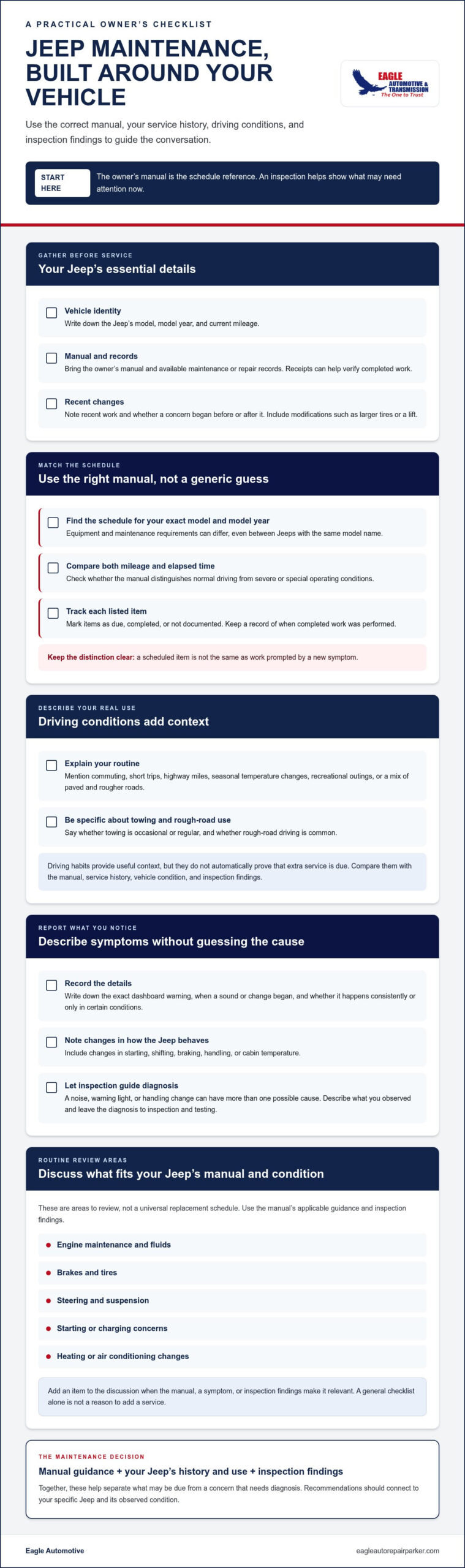
Start with your owner’s manual, then bring the shop useful details: your Jeep’s year and model, current mileage, recent service records, driving conditions, and any changes such as larger tires or a lift. Note symptoms, too, including when they happen and whether they’re getting worse. This checklist will help you sort out what may be due, compare maintenance options, and prepare clear questions before arranging service in Parker. You’ll also see why inspection findings matter: a sound maintenance plan should reflect your Jeep’s requirements and actual condition, while symptoms may point to brakes, suspension, engine, transmission, or another system that needs diagnosis.
Key Takeaways
- Use your Jeep’s owner’s manual for model-specific maintenance guidance instead of relying on a schedule meant for a different vehicle.
- When comparing options for jeep maintenance near me, look at the service scope, inspection process, and clarity of explanations and follow-up.
- Bring service records and note your Jeep’s mileage, driving conditions, and any changes that could affect maintenance needs.
- Describe what you’ve observed, such as when a symptom occurs, without assuming what caused it.
- Choose a Parker shop that can connect maintenance recommendations to your Jeep’s manual, use, and inspection findings.
Jeep Maintenance Near Parker: Start With Your Vehicle and Driving Needs
Start with your Jeep’s model-specific owner’s manual and its current condition. Together, they offer a practical foundation for planning service: the manual outlines guidance for your vehicle, while an inspection helps show what may need attention now. A checklist can organize the conversation, but it can’t diagnose a fault by itself. A noise, warning light, or change in handling may have more than one possible cause.
Consider the whole picture before arranging maintenance: model, model year, age, mileage, recent work, symptoms, and how you use the Jeep. A Wrangler, for example, is part of a model line with its own history and design evolution, described in the Jeep Wrangler Wikipedia entry. That context doesn’t replace the manual for your specific model year and configuration. Base the service conversation on your own vehicle, not assumptions about every Jeep.
What information should a Jeep owner gather first?
Bring practical details, even if you’re unsure what they mean. Write down the exact dashboard warning, when a sound or change began, and whether it happens consistently or only in certain conditions. Include recent maintenance or repair work, since that history can help guide an inspection. Describe what you’ve observed, then leave the diagnosis to inspection and testing.
- Record the Jeep model, model year, and current mileage.
- Note dashboard warnings and changes in sounds, handling, starting, shifting, braking, or cabin temperature.
- Bring the owner’s manual and any available maintenance or repair records.
- List recent work and whether the symptom started before or after it.
How should Parker-area driving affect the service conversation?
Describe your actual driving routine, not what you think a technician expects to hear. In Parker, that might mean commuting, seasonal temperature changes, recreational outings, or a mix of paved streets and rougher roads. Short trips, highway miles, towing, and rough-road use provide useful context, but none automatically proves that extra service is due. Recommendations should be grounded in the manual, the Jeep’s condition, and inspection findings.
Be specific about frequency and circumstances. Explain whether towing is occasional or part of your regular routine, or whether rough-road driving is common. Mention relevant modifications and how you use them. These details help frame an inspection without turning a driving habit into a diagnosis. If a concern seems to affect more than one system, describe each change you’ve noticed so the shop can assess the vehicle as a whole.
Searching for jeep maintenance near me is only the first step. Arrive with the manual, records, mileage, and a clear description of how your Jeep behaves. Those details give the maintenance conversation a sound starting point, whether you’re planning routine service or asking about a new concern.
Jeep Maintenance Schedules: Use the Manual, Not a Guess
Your Jeep’s owner’s manual is the starting point for maintenance planning. Find the schedule for the exact model and model year, then compare its guidance with mileage, elapsed time, service records, driving conditions, and the vehicle’s current condition. A schedule for one Jeep may not apply to another, even if both share a model name. Equipment, model year, and maintenance requirements can differ.
Scheduled maintenance should follow the correct vehicle manual and inspection findings. That keeps recommendations grounded in guidance for your Jeep, rather than a generic chart or a service list copied from another vehicle. General resources, such as J.D. Power’s Jeep Car Maintenance Guide, can provide broad background. For model-dependent requirements, use the manual for your specific vehicle.
How do you use a Jeep owner’s manual for maintenance planning?
Locate the schedule for your model and year. Check whether it distinguishes normal driving from severe or special operating conditions, then compare the relevant guidance with both mileage and time. A Jeep driven infrequently still has elapsed time between services, while regular use may bring mileage-based items due sooner. Record completed work and when it was performed instead of relying on memory.
- Mark manual-listed items as due, completed, or not documented.
- Use receipts or repair records to help verify completed work.
- Note any special-use guidance that matches your driving.
- Leave unclear items for review against the manual and inspection findings.
This record can help distinguish an item listed in the schedule from work prompted by a new symptom. It also gives you a practical reference for discussing what may be due without assuming an interval that doesn’t fit your Jeep.
Which vehicle systems belong on a routine review checklist?
Use the manual’s applicable guidance as a starting point for discussing engine maintenance, fluids, brakes, tires, steering, and suspension. These are areas to review, not a universal replacement schedule. A change in braking feel, tire condition, or steering response should be considered in light of what inspection shows. For more detail on suspension symptoms and possible repair approaches, see this Jeep suspension repair guide.
Starting or charging trouble, or a change in heating or air conditioning, may also merit discussion if symptoms or inspection findings point to them. Don’t add services just because a general checklist names them. Tie recommendations to the Jeep’s manual, use, service history, and observed condition. If you’re planning maintenance in Parker, Eagle Automotive in Parker can be part of a practical service conversation.
Compare Jeep Maintenance Options in Parker, CO
A useful comparison starts with the work your Jeep needs, not a blanket claim that one kind of shop is always better. A dealership or an independent repair shop may each suit different needs. Focus on the service scope, how findings are inspected and explained, and whether the next steps are clear. Compare those points with the work involved and the information you have about your vehicle.
Think of the visit in three categories. Scheduled maintenance follows the applicable manual. Symptom diagnosis investigates a new warning light, noise, leak, or change in behavior. Multi-system repair may become relevant if an inspection finds a concern beyond the original maintenance request. The categories can overlap, but they aren’t interchangeable. A request for routine service, for instance, doesn’t explain a separate change in how the Jeep handles.
What should an owner compare between nearby repair options?
Look for a process that connects the request to the inspection and the findings to a clear next step. The shop should be able to address the maintenance or mechanical concern being discussed and explain what it observed, rather than treating a recommendation as self-explanatory. If an inspection uncovers a related issue, clarity about how it affects the original plan helps you decide what to address now and what can be planned later.
- Scheduled maintenance: Are recommendations tied to the Jeep’s manual and documented service history?
- Symptom diagnosis: Is the concern investigated instead of assumed to have one obvious cause?
- Related systems: Can the inspection and repair conversation account for another affected system?
- Follow-up: Are findings and recommended next steps explained in plain language?
These are practical comparison points, not a ranking of dealerships against independent shops. Choose based on the work involved and the kind of explanation you need. For routine service, a focused maintenance plan may be enough. A warning light or an unusual change in vehicle behavior calls for a diagnostic conversation too.
When does routine Jeep maintenance become a diagnostic concern?
A scheduled item is work identified by the vehicle’s maintenance guidance. A new noise, dashboard warning, fluid leak, or change in steering, braking, starting, or shifting is a symptom that needs assessment. One symptom can have several possible causes, so avoid assuming the repair from the symptom alone. A braking concern, for example, can involve different components; this brake repair inspection guide explains how inspection findings inform repair options.
Describe when the symptom happens, whether it repeats, and whether it has changed. Then ask what the inspection found and how the recommendation relates to the concern. A clear explanation helps separate routine maintenance from work based on a specific finding, so you can make an informed decision.
A Parker Jeep Maintenance Checklist Before and During Service
A little preparation can make a Jeep service visit more focused. Bring useful records, explain what you’ve noticed, and keep scheduled maintenance separate from concerns that may need diagnosis. The goal isn’t to diagnose the vehicle yourself. It’s to give the shop clear facts so an inspection can help establish what’s due, what needs attention, and why.
What should you prepare before arranging Jeep maintenance?
Gather details that help identify your Jeep and put the concern in context. A brief timeline is more useful than a list of possible causes. “A clunk happens while turning into a driveway” describes an observation. “The axle is failing” is a guess that still needs inspection.
- Write down the model, model year, current mileage, and any dashboard warning or message.
- Collect maintenance records and note recent repairs or service, including approximate dates if available.
- Describe when a concern occurs, such as during starting, braking, turning, or driving over uneven pavement.
- List your questions, including which manual-listed items may be due and whether a symptom needs separate diagnosis.
Include relevant vehicle use, such as regular towing or rough-road driving, but describe it plainly. That information helps frame the inspection; it doesn’t automatically establish that additional service is needed. A written checklist guides the conversation, not the diagnosis.
What should you clarify after an inspection?
Ask what the inspection found and how each recommendation relates to the manual, the Jeep’s condition, or a specific symptom. Clarify whether an item is scheduled maintenance or a repair prompted by an inspection finding. If a recommendation involves another system, ask what connects that finding to your original concern. Clear explanations help you understand the proposed work without having to guess at the cause.
- Ask what condition the inspection identified and where it was observed.
- Clarify why the work is recommended and whether it addresses scheduled maintenance or a diagnosed concern.
- Discuss the next step if more testing is needed before a repair recommendation is clear.
- Record completed work and keep the service paperwork for future planning.
Keep recommendations tied to inspection findings and your Jeep’s service guidance. For a maintenance conversation based on your vehicle’s records and condition, arrange service with Eagle Automotive in Parker. Bring your notes and questions to help make the discussion clear and practical.
Jeep Maintenance at Eagle Automotive in Parker: Plan Your Next Step
Use your Jeep’s service records to make the maintenance conversation more specific. If the history is incomplete, say so rather than guessing what has been done. Pair that context with the concern you want addressed, and the shop can discuss how inspection findings relate to the service you’re considering.
Eagle Automotive is a Parker repair shop serving all makes and models. Its services include preventative maintenance, oil changes, tune-ups, diagnostics, and mechanical repairs. This range can help owners discuss routine upkeep alongside a concern uncovered during inspection, while keeping recommendations connected to the Jeep’s condition and applicable maintenance guidance.
How can Eagle Automotive help with Jeep maintenance?
Preventative maintenance, oil changes, and tune-ups address routine service needs. If a warning light, unusual sound, or change in vehicle behavior is also part of the visit, diagnostics can help investigate that concern. Related mechanical repairs should be based on inspection findings, not assumptions drawn from a symptom alone.
The useful distinction is between work planned as maintenance and work recommended because an inspection identified a specific concern. Ask how each proposed step fits your Jeep’s condition and service needs.
What is a practical next step for a Parker Jeep owner?
Bring the owner’s manual and available records, and identify the main question you want answered. If more than one issue needs attention, mention which concerns affect your daily use most. That helps keep the discussion organized without deciding in advance what the vehicle needs.
- Identify the maintenance or mechanical concern for discussion.
- Describe symptoms as observations, without guessing at their cause.
- Ask how inspection findings support each recommendation.
- Keep a record of completed work for future reference.
A clear service conversation starts with the information you have, not a perfect diagnosis. To discuss your Jeep’s maintenance needs in Parker, contact Eagle Automotive and take the next step at a pace that works for you.
Make Your Jeep’s Next Service Decision With Confidence
A maintenance visit can do more than address what’s due today. It can also establish a useful record of your Jeep’s condition, giving you a clearer reference for future decisions. Keep the inspection findings and completed work together, then use them to track what’s been handled and what may need attention later. That turns a broad search for jeep maintenance near me into a practical plan based on your own vehicle.
You don’t need to arrive with every answer. Bring your notes, explain what you’ve observed, and ask for recommendations tied to the inspection and the Jeep’s manual. A clear conversation can help separate routine upkeep from a concern that needs further diagnosis.
Ready to discuss your Jeep’s maintenance needs in Parker? Contact Eagle Automotive about your Jeep and take the next step with a focused plan. A little preparation goes a long way toward making the service conversation straightforward.
Frequently Asked Questions
How often should I schedule maintenance for my Jeep?
Use the schedule for your exact Jeep model and model year, then track the next listed item by both mileage and elapsed time if the manual uses both. After service, record the date, odometer reading, and work completed. Set a reminder based on the next item’s guidance, rather than relying on a generic recurring interval. If service records are incomplete, an inspection can help clarify what should be planned next.
Can an independent auto repair shop maintain a Jeep?
Yes, an independent shop can be an option for routine Jeep care. Focus on whether its work fits the need, rather than assuming a dealership is always necessary. Eagle Automotive in Parker serves all makes and models and provides preventative maintenance and mechanical repair. If a concern comes up alongside planned service, diagnostics can help investigate it so maintenance and repair recommendations address the vehicle’s actual needs.
What should I bring when taking my Jeep in for maintenance?
In addition to service paperwork, bring a short list of your priorities if you have several concerns, so none gets lost during the visit. If a dashboard symbol or message appears intermittently, take a photo while parked and note when it showed up. You can also bring previous diagnostic printouts if available. These extra details add context without requiring you to identify the failed part yourself.
Is a dashboard warning light part of routine Jeep maintenance?
Not necessarily. A warning indicator’s meaning depends on its symbol and any accompanying message, so check the warning-light section of your Jeep’s manual for its explanation. If the display disappears, a photo can help preserve the exact symbol or wording for the service discussion. Also note whether another change occurred at the same time. The indicator provides a clue, but it doesn’t by itself establish what needs repair.
Can off-road or towing use change what maintenance my Jeep needs?
It can affect which maintenance guidance applies, but the label “off-road” or “towing” alone doesn’t establish a special service interval. Distinguish regular use from a one-time trip, and mention any unusual event, such as a hard impact or a new vibration afterward. Those details can help direct an inspection toward relevant areas. Use the schedule for your exact Jeep to guide maintenance decisions, not a blanket rule.
1 Comment. Leave new
[…] relevant observations. Mention visible tire wear, an uneven stance, or any recent change in how the Jeep […]