

Is It Worth Fixing a Head Gasket? Cost and Key Factors
Fixing a head gasket can be worth it in 2026 when the rest of the vehicle is reliable and the engine hasn’t suffered wider damage. If the cylinder head or engine block is badly damaged, or the repair would consume too much of the vehicle’s value, replacement may make more sense. The right call depends on the diagnosis, the car’s condition, and what it’s worth to you.
A suspected head gasket failure can raise concerns about a major repair, but continued driving may turn a limited problem into more extensive engine damage. Coolant mixing with oil or entering a cylinder can harm engine components, so a rising temperature gauge or other warning signs call for prompt attention.
This guide explains how repair scope, the vehicle’s age, mileage, and overall condition shape the decision, and why driving with a suspected failure is risky. You’ll learn which diagnostic tests can help confirm the problem and when repairing the gasket, replacing the engine, or moving on from the vehicle may be more practical.
Key Takeaways
- A head gasket repair may make sense when the engine and the rest of the vehicle are in good condition.
- Compare the repair estimate with the vehicle’s value and the cost of addressing any additional engine damage.
- Age and mileage matter, but the car’s overall reliability and repair history also shape the decision.
- Overheating, coolant loss, and other warning signs can have multiple causes, so diagnosis matters before choosing a repair.
- Continuing to drive with a suspected failure can worsen engine damage; know which warning signs mean you should stop.
Head Gasket Replacement Cost in 2026: Is It Worth Fixing?
Whether it is worth fixing a head gasket in 2026 depends on the engine’s condition and the work required beyond the gasket. A useful estimate separates the repair scope from damage discovered during inspection.
Repair Versus Engine Replacement
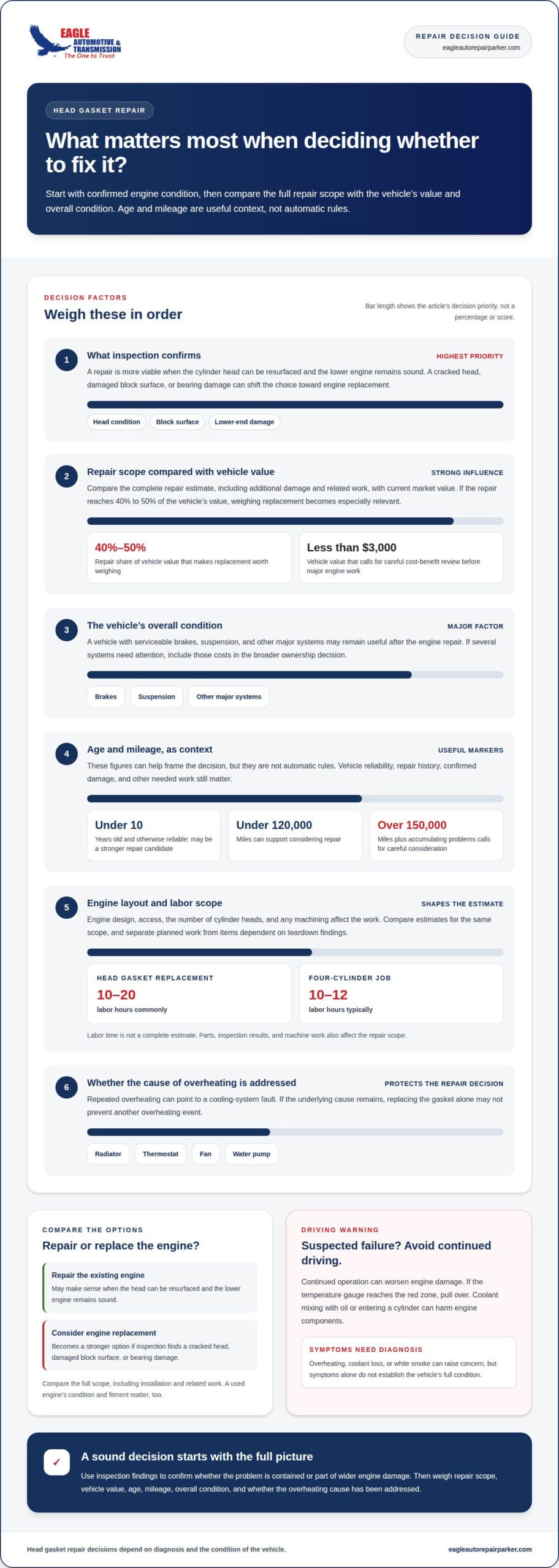
A head gasket repair replaces the seal between the cylinder head and engine block; engine replacement installs another engine. The distinction matters because the gasket may not be the only damaged part. If the head can be resurfaced and the lower engine remains sound, repairing the existing engine may make sense.
Engine replacement becomes a stronger option if inspection finds a cracked cylinder head, damaged block surface, or bearing damage. Compare the full repair scope with replacement, including installation and related work. A used engine’s condition and fitment matter, too. Compare what each option addresses and what could remain unresolved, not just the gasket price against the price of an engine.
If you’re asking whether it is worth fixing a head gasket in 2026, start with those inspection findings. They show whether the repair targets a contained failure or a wider engine problem.
Costs by Engine Type
Repair cost varies with engine design, access, and the number of cylinder heads involved. A four-cylinder engine can require a different amount of teardown than a V6 or V8. The engine layout affects labor, while the condition of the head and block determines whether machining or additional parts enter the estimate.
Head gasket replacement commonly takes 10 to 20 labor hours, while a four-cylinder job typically requires 10 to 12 labor hours. These figures describe labor time, not a complete estimate. Parts, inspection results, and machine work also shape the repair scope. Ask for the estimate to distinguish the planned work from additional work that depends on what disassembly reveals.
The question of whether it is worth fixing a head gasket in 2026 also depends on whether the engine type and damage make a repair feasible. A more involved engine layout alone doesn’t prove replacement is the better choice.
Reliability After Replacement
A vehicle can remain reliable after head gasket replacement when the repair addresses the cause of failure and related engine damage is limited. The cylinder head and block surfaces need inspection, and the head must be suitable for reuse or repair. Those findings help establish whether replacing the gasket can restore a sound seal.
Repeated overheating can point to a cooling-system fault, such as a failed radiator, thermostat, fan, or water pump. If the underlying issue remains, the engine may overheat again. Before deciding whether to keep the vehicle, consider its overall condition, the repair findings, and whether the cause has been addressed.
Repair-worthiness by vehicle age, mileage, and value
Age, mileage, market value, and the vehicle’s broader condition all affect whether a head gasket repair makes financial sense. A vehicle with a repairable engine and few other major problems is generally a stronger candidate.
Insurance and vehicle warranty coverage depend on the applicable terms and the cause of failure. Review the relevant documents to see whether the repair is covered and what exclusions apply.
Weigh age, mileage, and market value
A vehicle under 10 years old and otherwise reliable may be a stronger repair candidate. Mileage under 120,000 miles can also support repairing it. By contrast, consider carefully before repairing a vehicle over 150,000 miles when other problems are accumulating. These mileage markers are useful decision factors, not automatic rules.
Compare the repair estimate with the vehicle’s current market value and overall condition. If the repair reaches 40% to 50% of that value, weighing replacement becomes especially relevant. A vehicle worth less than $3,000 also deserves a careful cost-benefit review before major engine work.
Consider what the vehicle will need after the engine repair. A car with serviceable brakes, suspension, and other major systems may remain useful. If several systems also need attention, the head gasket is only one part of a broader ownership decision.
Consider vehicle type and repair scope
Vehicle type changes the repair scope because engine layout and access differ. A four-cylinder sedan, V6 crossover, V8 truck, or performance car may require different disassembly and parts. Compare estimates for the same repair work, not simply the total amounts, and account for whether inspection has found additional damage.
Assess the cylinder head and the engine’s lower end separately. A repair may make sense if the head can be resurfaced and compression remains reasonable. Bearing damage, a cracked head, or a damaged block surface can shift the decision toward engine replacement or another vehicle.
Include cooling system condition
Repeated overheating can stem from a cooling-system fault, including a failed radiator, thermostat, fan, or water pump. If the cause isn’t addressed, replacing the gasket alone may not prevent another overheating event. Include the cooling-system findings when evaluating the repair scope.
White smoke or coolant loss can raise concern, but neither symptom establishes the vehicle’s full condition. A sound decision considers confirmed engine damage, the repair estimate, market value, mileage, and other needed work. This broader view helps determine whether repairing the vehicle makes sense given its likely remaining usefulness.
Can You Keep Driving With a Blown Head Gasket?
No. A vehicle with a suspected blown head gasket generally shouldn’t be driven because continued operation can worsen engine damage. If the temperature gauge reaches the red zone, pull over safely, switch off the engine, and let it cool. Never open a hot radiator cap.
Symptoms That Deserve Attention
A blown head gasket can allow coolant, oil, and combustion pressure to leak between passages that should remain separate. Watch for white exhaust smoke that continues after warm-up and smells sweet, coolant disappearing without an obvious external leak, or bubbles in the coolant reservoir while the engine runs.
These signs suggest a possible fault, but they don’t diagnose it on their own. A cooling-system leak, failed radiator, or another problem can also cause coolant loss or overheating. For example, a vehicle losing coolant without white smoke still needs investigation before anyone concludes that the gasket has failed.
How Diagnosis Confirms the Cause
A technician can combine tests to assess the engine’s condition. A cooling-system pressure test checks whether the system holds pressure, while a combustion-gas test looks for exhaust gases in the coolant. Compression and leak-down tests help identify whether a cylinder is losing pressure.
Together, these checks provide stronger evidence than any one symptom. For example, bubbles in the reservoir alongside abnormal combustion-gas test results can support a head-gasket diagnosis. The findings can also help distinguish gasket failure from another cooling-system problem.
Why Continued Driving Can Make Damage Worse
Coolant entering the engine oil can reduce its ability to protect bearings. Coolant entering a cylinder can also damage oxygen sensors and the catalytic converter. If the engine keeps overheating, damage may spread beyond the original leak and change the repair needed.
Stop driving if the gauge reaches the red zone, steam appears, or the engine runs roughly while losing coolant. Shut it off in a safe place and let it cool. Adding coolant repeatedly and restarting the engine won’t fix the leak or prevent internal damage.
Temporary Head Gasket Sealers
Bottled sealers are sold as a temporary measure and may help with a small external seep, but they don’t replace inspection or repair. The main risk is relying on a temporary result while the underlying leak or overheating cause remains. Continued driving can still harm bearings, sensors, or the catalytic converter.
A sealer also can’t repair a cracked cylinder head or damaged engine-block surface. If overheating or coolant loss continues after use, stop driving and arrange proper diagnosis rather than treating the product as a lasting fix.
Labor rates and regional pricing
Labor and machine work make up much of a head gasket repair because the cylinder head must be removed and inspected. Regional labor rates vary, so the same repair may produce different estimates across the United States.
Labor and Machine Shop Expenses
Labor covers engine disassembly, inspection, gasket installation, and reassembly. A head gasket replacement commonly requires 10 to 20 labor hours, while a four-cylinder job typically takes 10 to 12 hours. Engine layout and access affect the time involved, so two vehicles with similar symptoms can require different labor.
Machine-shop work may be needed if inspection finds a cylinder head surface that requires resurfacing. The shop checks whether the head and block surfaces can seal properly after reassembly. A failed head or damaged block can change the repair scope, so an estimate should separate inspection findings from work that may be needed after disassembly.
Parts and Labor Breakdown
Parts may include the gasket set, fluids, coolant, and related seals. Depending on the inspection and vehicle design, the work may also involve components that must be removed for access. The gasket itself is only one part of the job; labor covers engine disassembly and careful reassembly.
Ask for the estimate to separate labor, parts, and machine work. That breakdown helps explain why the gasket’s purchase price does not represent the full repair. For example, a four-cylinder engine may need fewer labor hours than a V6 or V8 with two cylinder heads, while machine work depends on the head’s condition.
Why Location and Inspection Matter
Regional labor rates reflect local operating costs and vary between urban and rural areas. A shop’s hourly rate alone doesn’t show the full repair cost; required labor hours, engine design, parts, and machine work all matter. Compare estimates by checking whether they include the same repair scope and inspection steps.
Milky oil, white exhaust, or a rising temperature gauge can guide diagnosis, but none confirms a failed head gasket on its own. A combustion-gas test or cooling-system pressure test can help identify the cause before repairs begin. That distinction matters because an external coolant leak may require a different repair from internal engine damage.
For a clear comparison, review the parts, labor hours, and machine-shop work together. A detailed estimate should explain which findings support the repair and what additional work depends on inspecting the cylinder head. The engine type and extent of damage determine the scope, not the gasket price alone. Online automotive service platforms such as My Auto Shop can also help vehicle owners connect with qualified mechanics and compare repair assessments transparently.
Risks of driving with a suspected head gasket failure
A suspected gasket failure is a reason to stop using the vehicle until its condition is assessed. Each trip keeps heat, combustion pressure, coolant, and engine oil moving through a system that may no longer keep them separate. Even a short drive can turn a limited leak into broader engine damage.
The damage depends on where the leak leads. Coolant entering the oil can thin its protective film and expose bearings to harmful contact. Coolant entering a cylinder can affect combustion and damage oxygen sensors or the catalytic converter as exhaust passes through. If the engine overheats, the cylinder head can distort and make the original sealing problem worse.
Pay attention to how symptoms change, not just whether one warning appears. A rising temperature gauge, persistent coolant loss, rough running, or ongoing white exhaust smoke signals a problem that needs prompt attention. No single sign proves gasket failure: a leaking radiator, failed thermostat, cooling fan, or water pump can also cause overheating or coolant loss.
- Temperature rises: pull over safely and shut off the engine instead of continuing toward a destination.
- Coolant level drops: repeated topping up cannot repair an internal leak or identify its cause.
- Oil looks milky: coolant contamination can compromise lubrication and threaten engine bearings.
- Exhaust smoke persists: white smoke after warm-up needs investigation, especially alongside coolant loss.
These signs matter even if the vehicle still starts and moves. An engine can keep running while coolant contaminates the oil or enters a cylinder. Continued operation adds heat and pressure, potentially damaging components beyond the original gasket. The resulting repair may involve more than restoring the seal.
Do not open the radiator cap while the engine is hot. Hot coolant can escape under pressure and cause burns. If the temperature gauge reaches the red zone, move out of traffic safely, switch off the engine, and let it cool. Don’t restart it just to see whether the gauge settles.
The practical takeaway is clear: avoid driving with a suspected gasket failure, especially if there is overheating, coolant loss, milky oil, or exhaust smoke. Arrange diagnosis that checks both the suspected gasket and cooling-system components. Finding a failed thermostat or radiator changes the repair path; confirming internal leakage shows why continued driving puts the engine at risk.
Eagle Automotive: Head Gasket Repair
Eagle Automotive & Transmission provides head gasket repair for drivers facing coolant loss, overheating, or other signs of engine trouble. Its engine repair and service helps assess the problem and determine whether the head gasket or another engine issue needs attention.
A sound repair decision depends on the engine’s condition and the cause of overheating. If the check engine light is on or warning signs persist, diagnosis can clarify what is happening before repairs begin. If the temperature gauge reaches the red zone, stop driving and let the engine cool to avoid risking further damage.
For a suspected head gasket problem, contact Eagle Automotive & Transmission in Parker to discuss the symptoms and next steps.
Make Your Next Step a Clear Diagnosis
Deciding whether fixing a head gasket in 2026 is worthwhile starts with understanding what the engine needs now, not guessing from one symptom. A useful next step is to discuss what you’ve noticed, such as coolant loss, overheating, or a check engine light, and use that information to guide the inspection.
Eagle Automotive & Transmission offers Check Engine Light service and Engine Repair & Service to address warning signs and engine concerns. Brake Repair is also available if the vehicle needs attention beyond the engine. Free computer diagnostics help inform your decision, alongside an assessment of the vehicle’s condition and repair needs.
Share your symptoms and arrange an inspection with Eagle Automotive. A clear assessment can help you choose a practical path forward and move ahead with confidence.
Frequently Asked Questions
How do shops confirm it is really the head gasket?
Shops combine test results with symptoms and inspection findings. A cooling-system pressure test checks for pressure loss, while a combustion-gas test looks for exhaust gases in the coolant. Compression or leak-down testing can help locate cylinder sealing problems. Eagle Automotive & Transmission provides free computer diagnostics in Parker, but a computer scan alone does not confirm head gasket failure.
When Is It Worth Fixing, and When Do You Walk Away?
Repair makes sense when the engine can be properly fixed and the vehicle will remain useful afterward. Consider moving on if inspection finds extensive engine damage or the car needs several other major repairs. Look beyond the current estimate: if the repair restores normal use, would you keep the vehicle, or would its overall condition still lead you to replace it soon?
How much does head gasket repair cost in the U.S. in 2026?
There is no single repair bill that fits every U.S. vehicle. The total depends on engine design, labor required, machine-shop work, and damage found after disassembly. A four-cylinder engine and a V8 can require different labor and parts. For a useful decision, compare an estimate based on your vehicle’s actual findings rather than relying on a broad national figure.
What factors affect the cost of replacing a head gasket?
Engine layout and access affect the amount of disassembly and labor the job requires. The estimate may also change if inspection finds a warped cylinder head, damaged surfaces, or related parts that need replacement. Machine-shop work adds another variable. Check that the estimate separates labor, parts, and machining, and identifies required work versus work conditional on inspection.
How much is a car worth with a blown head gasket?
A car with a blown head gasket has no universal as-is value. Its make, model, age, overall condition, title status, and whether it runs all affect what someone may pay. The engine’s condition matters, too: damage beyond the gasket makes the vehicle a different proposition from one with a repairable engine. Any valuation should reflect that specific vehicle and its condition.
When is it worth fixing a blown head gasket versus replacing the car?
Compare the likely repair result with the vehicle’s value and usefulness afterward. Repair is more compelling if the rest of the car is in good shape and the engine remains repairable. Replacing the vehicle may be more practical if substantial engine damage comes with other pending repairs. Include the cost and effort of finding another suitable vehicle in your decision, not just the repair estimate.
How can you confirm a head gasket is blown, and what does diagnosis cost?
Confirmation usually combines cooling-system pressure, combustion-gas, compression, or leak-down tests with inspection findings. A single symptom or dashboard code cannot establish the failure by itself. Eagle Automotive & Transmission provides free computer diagnostics, but confirming a mechanical head gasket problem may require additional testing. Diagnostic charges depend on the tests needed and are provided after a quote request.
What happens if you keep driving with a blown head gasket?
Continued driving can let coolant contaminate engine oil and threaten bearings, or allow coolant into a cylinder. It can also damage oxygen sensors and the catalytic converter. If the temperature gauge reaches the red zone, pull over safely and switch off the engine. Don’t open a hot radiator cap or keep restarting the vehicle to see whether it runs normally.