

How to Find an Honest Mechanic in Parker, Colorado
What if the best sign of an honest mechanic isn’t a glowing review, but a clear explanation of what your car needs and why? If you’re looking for an honest mechanic Parker Colorado drivers can count on, it’s reasonable to want to understand the diagnosis before approving a repair. Nobody wants to feel pressured into work they don’t understand or pay for a fix that wasn’t needed.
A dependable repair process makes the diagnosis, estimate, and recommended next steps easy to follow. You should have room to ask questions, understand which repairs need attention, and decide what to authorize. Clear communication matters when a warning light, unusual noise, or shifting problem leaves you unsure what’s happening.
This guide covers practical signs of transparent service, what to review in an estimate, and questions to ask before work begins. You’ll also learn how to look beyond broad marketing claims when choosing a Parker shop for your vehicle’s needs. Eagle Automotive provides diagnostics and repairs for all makes and models, helping Parker drivers address a range of mechanical concerns.
Key Takeaways
- Learn how an honest mechanic Parker Colorado drivers can evaluate explains findings, repair options, and approval before work begins.
- Understand why a diagnostic trouble code can point to an issue without proving which part has failed.
- Compare local shops by the clarity of their diagnosis and estimate, not just by the final amount.
- Record when symptoms occur and bring relevant maintenance or repair history to help the shop investigate the problem.
- See how a shop serving all makes and models can connect diagnostic findings with practical repair recommendations.
What an Honest Mechanic in Parker, Colorado Should Make Clear
An honest mechanic explains what they found, which repair options make sense, and gets your approval before starting the work. The explanation should connect your concern to evidence from an inspection or diagnostic process, not rely on pressure or vague warnings. You can evaluate that process without knowing how to repair a vehicle yourself.
Transparent auto repair means the shop explains how its findings support a recommendation, describes your options in plain language, and waits for your approval before doing the work. A confident diagnosis is not a guarantee. A noise, warning light, or change in how the car drives can have several possible causes. A careful mechanic explains what the evidence suggests and what remains uncertain, rather than treating one symptom as proof that a specific part has failed.
What does transparency look like during an auto repair?
Look for a clear connection between what you reported, what the mechanic checked, and what they recommend. If you mention a vibration while braking, for example, the explanation should describe the inspection findings and how they relate to that symptom. If a warning light brought you in, ask what the diagnostic results indicate and how they support the next step.
Good explanations use familiar language or define unfamiliar terms. You don’t need a technical lecture, but you should understand why the repair is recommended, what it is intended to address, and whether there are other options. Asking questions is a normal part of deciding what to authorize. Clear answers help you make a decision based on information rather than confusion.
Why a trustworthy impression is not enough on its own
Friendly service can make an appointment more comfortable, and advertising can describe a shop’s values. Neither tells you by itself how a particular diagnosis was reached or whether the recommendation fits your vehicle’s symptoms. Reviews can provide context, but a single review or interaction can’t establish how a shop handles every vehicle and concern.
Instead, focus on steps you can observe: Does the explanation address your concern? Can the mechanic describe the findings without scare tactics? Are the proposed work and your approval discussed clearly? Those details give you something concrete to evaluate, beyond a slogan.
Vehicle repairs involve systems and components most owners rarely encounter. The broader automotive industry overview provides context about the range of businesses and technologies involved, but your decision should rest on the specific inspection and recommendation for your car. Before approving work, make sure you understand what the shop found, what it proposes to do, and how that work relates to your concern.
How to Judge a Mechanic’s Diagnosis, Estimate, and Repair Recommendations
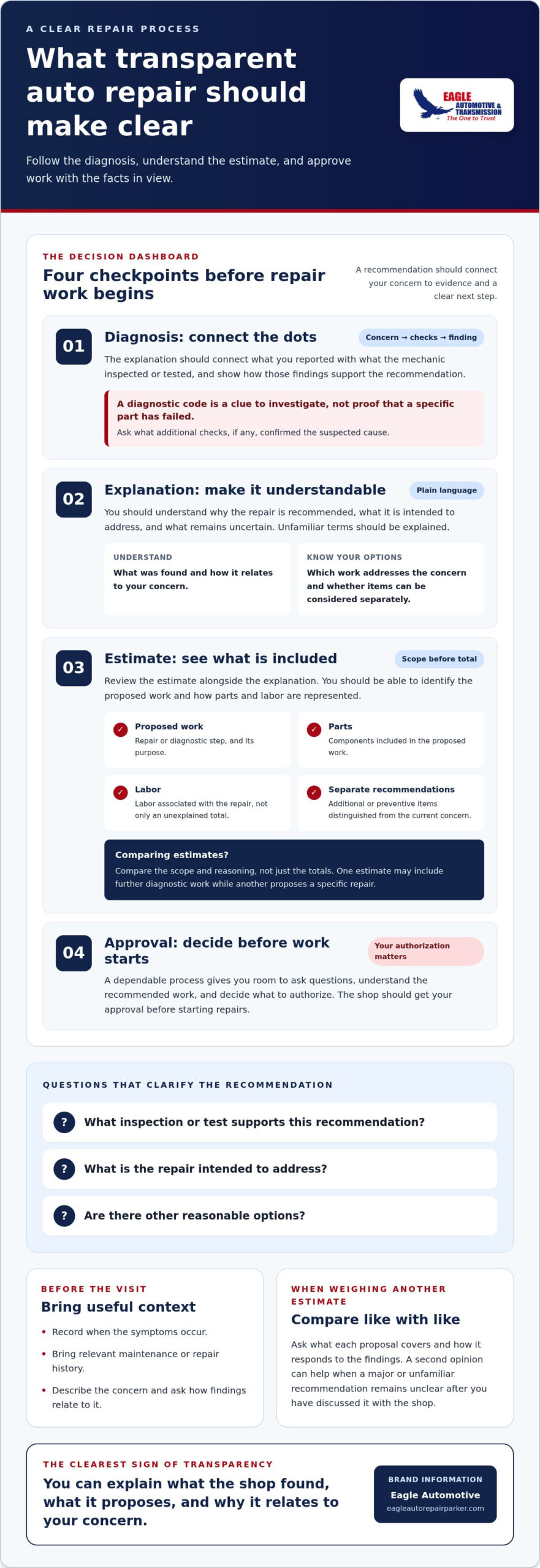
A sound diagnosis connects your description of the problem to what the mechanic inspected or tested, then explains how those findings support the recommended work. Diagnostic trouble codes can point to a system or condition that needs attention, but they don’t always identify a failed part. A diagnostic code is a clue to investigate, not proof that a specific component has failed.
For example, a warning light may produce a code that narrows down where to look. The mechanic may need to perform additional checks to identify the cause. Ask how the test results connect to the proposed repair. If the explanation moves directly from a code to replacing a part, ask what confirmed that part is the cause. This helps you understand the recommendation without assuming it’s dishonest.
Questions that make a repair recommendation easier to understand
Focused questions can make technical details easier to follow. Ask, “What inspection or test supports this recommendation?” “What is the repair intended to address?” and “Are there other reasonable options?” These questions aren’t accusations. They help you understand the issue, the purpose of the work, and your choices before authorizing a repair.
If the answer includes unfamiliar terms, ask for an explanation in everyday language. You should be able to describe the basic reason for the repair in your own words. If the recommendation includes several items, ask which one addresses your immediate concern and whether other work can be considered separately.
Review the estimate for the work being proposed
Read the estimate alongside the explanation. Check that you can identify the proposed work and understand how parts and labor are represented. Look for:
- Proposed work: A description of the repair or diagnostic step and its purpose.
- Parts: The components included in the proposed work.
- Labor: The labor associated with the repair, rather than an unexplained total.
- Separate recommendations: Additional or preventive items distinguished from work addressing your current concern.
When estimates differ, compare their scope and reasoning before comparing totals. One may include further diagnostic work while another outlines a specific repair. Those aren’t necessarily equivalent proposals. Ask what each estimate covers and how it responds to the findings. This gives you a fairer basis for comparing options than choosing by the lowest amount alone.
How to consider a second opinion fairly
Another assessment can help if a major or unfamiliar recommendation remains unclear after you’ve discussed it with the shop. Share your symptoms, estimate, and any diagnostic findings you have. Ask the second mechanic to explain their reasoning and proposed scope, too. Comparing the evidence and recommended work can clarify whether the difference is in the diagnosis, repair approach, or items included in each estimate.
When evaluating a mechanic in Parker, focus on whether you can understand the recommendation and connect it to the vehicle’s findings. Ask questions, review the written work, and decide only after the proposed repair makes sense to you.
Compare Parker Mechanics by Process, Not Promises
To compare shops fairly, look past polished claims and focus on what happens between your first explanation and repair approval. A repair process is easier to assess when the shop explains its reasoning, outlines the proposed work, and makes the estimate understandable. A calm, specific conversation gives you more useful information than a slogan or a low total alone.
Use this framework after speaking with shops or reviewing estimates. Note what each one explains, then follow up on anything that remains unclear.
| What to compare | What to look for |
|---|---|
| Explanation quality | Does the explanation address your reported concern in clear, direct language? |
| Diagnosis | Can the shop describe the inspection or findings that support its recommendation? |
| Estimate clarity | Can you understand the proposed work and how parts and labor are represented? |
| Approval | Is it clear which work you’re being asked to authorize before repairs begin? |
What to compare when reviewing repair estimates
First, check whether each estimate addresses the same reported problem and proposes comparable work. One shop may recommend further inspection before a repair, while another estimates a specific repair. Those are different scopes, so the totals aren’t directly comparable until you understand what each includes.
Review whether parts and labor are explained, and whether follow-up work is part of the current recommendation or a separate consideration. If an item is unclear, ask what it covers and how it relates to your concern. The lowest estimate isn’t automatically the best choice if it leaves out work another estimate includes. For a broader perspective on comparing repair options, focusing on the quality of service provided by an established shop like Eagle Automotive can help you weigh the proposed work and its reasoning alongside the total.
How to read local reviews without overrelying on ratings
Reviews can offer useful details about communication. Look for descriptions of whether a shop explained its findings, answered questions, and discussed the work before proceeding. Those specifics provide more context than a rating alone, although one person’s experience can’t predict how every repair will go.
Use reviews to decide what you want to ask, not to skip the conversation. Describe your concern and notice whether the response is focused, understandable, and relevant to your vehicle. If a shop’s online reputation sounds reassuring but its explanation leaves you uncertain, ask for clarification before deciding. A clear process should hold up in a direct discussion, not just in advertising or review language.
A Practical Checklist Before Choosing or Visiting a Parker Mechanic
A little preparation can make a repair visit clearer without turning it into homework. You don’t need to identify the failed part or request extensive testing. Focus on describing what you noticed, sharing useful history, and understanding the proposed work before approving it. Use this checklist to assess a repair shop’s process before and during a visit.
- Record the symptoms and when they happen. Note warning lights, unusual sounds, changes in handling, or other behavior. Include the conditions, such as whether a noise happens during a turn, after the vehicle warms up, or only on certain roads.
- Describe when the concern began. Say whether it started suddenly or gradually, and whether it happens every time or comes and goes. Specific observations help the mechanic understand the concern without treating your description as a diagnosis.
- Bring relevant vehicle history. If available, share maintenance records or information about earlier repairs related to the current issue. Mention when the work was done and what changed afterward. A complete file isn’t necessary to have a useful conversation.
- Explain what you’ve already noticed. Tell the shop about changes in performance or circumstances that seem connected. Separate what you observed from what you suspect. “The engine sounds rough at startup” is more useful than declaring that a particular part has failed.
- Review the findings and proposed work. Ask what the inspection showed, what the recommended repair is meant to address, and which items are preventive rather than related to the immediate concern.
- Understand the estimate before authorizing repairs. Make sure you can follow the proposed work and the parts and labor categories. If an item is unclear, pause and ask for an explanation before deciding what to approve.
What information to share about your vehicle concern
Be specific, but don’t worry about using technical terms. A note such as “the steering feels different during low-speed turns” gives the mechanic a useful starting point. If the symptom is intermittent, say so and describe when you last noticed it. Earlier repair history can add context, but don’t assume an earlier repair must be related. The shop can assess how that information fits the current concern.
What to do before approving a repair
Once the findings are explained, ask which recommendation addresses the problem you brought in and which work is suggested to help prevent future issues. These can be separate decisions. Understand the proposed work and estimate before giving approval. If the explanation feels rushed or incomplete, ask for clarification.
Preparation helps you focus on what matters: what you observed, what the inspection found, and what the proposed work is meant to address. Keep your notes handy and ask the mechanic to clarify anything that isn’t clear. A calm, informed conversation makes it easier to decide what to approve.
How Eagle Automotive Helps Parker Drivers Make Informed Repair Decisions
Finding a mechanic in Parker you can speak with starts with more than a name or rating. It means choosing a shop that can evaluate the vehicle, explain what the findings indicate, and connect recommended work to your concern. Eagle Automotive is a mechanical repair shop in Parker serving all makes and models, with diagnostic and repair services for a range of vehicle needs.
Mechanical services for different vehicle concerns
A vehicle can show symptoms involving different systems, and a symptom alone doesn’t identify the cause. Engine diagnostics and check engine light troubleshooting help investigate warning lights and related concerns. An in-person evaluation provides information an online description can’t, and the findings can be considered alongside the issue you reported.
Eagle Automotive also handles engine repair, brake repair, transmission work, steering and suspension concerns, heating and air conditioning, and preventative maintenance. These services are relevant when a driver notices a noise, warning light, change in handling, or shifting concern without knowing which system is involved. The shop can assess the reported issue and discuss recommendations based on the vehicle’s condition rather than assuming the cause from a short description.
Ask how the recommendation relates to the findings. For example, a check engine light is a reason to investigate, not proof by itself that a particular component has failed. Diagnostic findings can help distinguish the initial clue from the repair decision, so you can understand what the shop recommends and why.
The same principle applies across mechanical concerns. A brake noise, steering change, or transmission symptom can have more than one possible explanation. The useful next step is an assessment of the vehicle, followed by a plain-language discussion of the findings and proposed work. You don’t need to arrive with a diagnosis. Share what you’ve observed and let the inspection guide the conversation.
Take the next step with Eagle Automotive in Parker
If you’ve noticed a new sound, warning light, or change in how your vehicle drives, describe when the issue occurs and share any relevant repair or maintenance history. An in-person evaluation can help clarify what’s happening and what repair options may address the concern. You can ask questions before deciding whether to authorize the proposed work. Learn about Eagle Automotive’s repair services in Parker.
Take the Next Step With Clear Information
Choosing a mechanic in Parker you feel comfortable talking with doesn’t mean having every answer before you arrive. Start with a straightforward conversation, share what you’ve noticed, and make decisions with the information in front of you. Bring your notes, ask for unfamiliar terms to be explained, and take time to consider the recommendation before approving work.
If your vehicle has a warning light, unusual sound, or change in how it drives, an evaluation can help clarify the next steps. A clear discussion can turn a confusing concern into practical options, whether the shop needs to investigate a symptom or address a repair need.
Ready to discuss your vehicle’s needs? Contact Eagle Automotive about your repair needs and take the next step with clear information.
Frequently Asked Questions
How can I tell if a mechanic is being honest about a repair?
Look for an explanation that stays consistent as you ask reasonable follow-up questions. Ask what finding supports the recommended work and what may happen if you wait. A mechanic in Parker should be able to discuss those points without pressure or treating uncertainty as proof of a failure. Notice whether the explanation addresses your specific concern rather than relying on broad claims about the vehicle.
Can a mechanic diagnose a problem without replacing parts first?
Often, yes. A mechanic can start with your description of the symptoms, a visual inspection, or diagnostic testing, then decide whether further checks are needed. The right approach depends on the concern. A warning light, for example, may provide a useful starting clue, while additional testing helps narrow down the cause. Replacing a part is not itself a diagnostic test, and a code alone may not identify the failed component.
What should I do if I do not understand a mechanic’s estimate?
Pause before approving the work and ask the shop to explain each unclear line in everyday language. Ask which parts are included, what the labor covers, and whether each item is needed to address your concern. If the estimate changes after the discussion, request the updated version so you can review the proposed work before deciding.
Is a second opinion worth getting for a major car repair?
It can be useful if the proposed repair is substantial, unfamiliar, or still confusing after you’ve discussed it with the first shop. Bring the estimate and any diagnostic information you received to the next assessment. Explain the symptoms in your own words, too. This gives the mechanic context and helps you compare the reasoning and scope of each recommendation, rather than judging by totals alone.
Can Eagle Automotive work on different makes and models?
Yes. Eagle Automotive serves all makes and models at its Parker shop. When discussing a concern, have the vehicle’s year, make, and model ready, along with any warning lights or recent changes you’ve noticed. That information helps frame the conversation, but an online description can’t establish the cause of a problem. A vehicle-specific evaluation is needed to assess what’s happening.