

Ford F-150 Check Engine Light Service in Parker: How Far Can You Drive
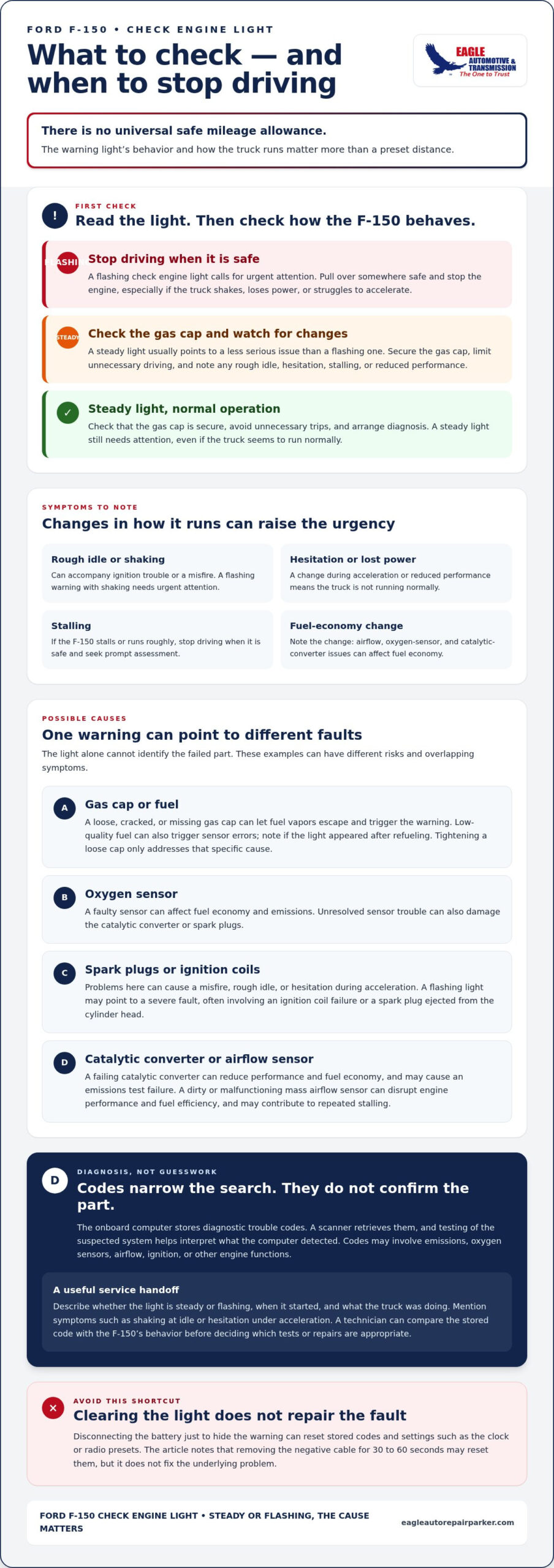
A check engine light does not come with a safe mileage allowance. With Ford F-150 check engine light service in Parker, the key distinction is whether the light is steady or flashing: a steady light usually points to a less serious issue, while a flashing light calls for urgent attention. The underlying problem, not a preset distance, determines whether it’s safe to keep driving.
It’s understandable to wonder whether you can finish your trip or need to pull over. If the light is flashing, don’t continue driving; arrange service promptly. If it’s steady, check that the gas cap is secure and watch for rough idling, hesitation, or reduced performance. These symptoms can help show how urgently the truck needs attention.
This guide explains how the warning light and diagnostic codes help narrow down the cause, which symptoms matter, and when continued driving could risk further damage. You’ll also learn how professional diagnosis and repairs address the fault behind the warning, rather than simply clearing the light.
Key Takeaways
- There’s no universal safe mileage for driving with the warning light on; the light’s behavior and how the truck runs matter.
- A flashing light calls for urgent attention. Stop driving and arrange service rather than risking further damage.
- If the light stays steady, check that the gas cap is secure and watch for rough idling, hesitation, or changes in performance.
- Diagnostic trouble codes help narrow down the cause, but they need to be interpreted alongside the truck’s symptoms.
- Address the underlying fault before clearing the warning, since turning off the light alone doesn’t fix the problem.
How many miles can you drive with the check engine light?
There’s no reliable mileage allowance for a Ford F-150 with its check engine light on. The warning can represent hundreds of diagnostic trouble codes, and the safe choice depends on the fault and how the truck behaves. A steady dashboard light with normal operation differs from a flashing light or an engine that stumbles.
Start with the light itself. A steady check engine light usually signals a less serious issue than a flashing one, but it still needs attention. If the light is flashing, don’t continue driving. If it’s steady, check the gas cap and watch for rough idling, hesitation, stalling, or changes in engine performance.
A loose, cracked, or missing gas cap can let fuel vapors escape and trigger the warning. Tightening a loose cap may address that specific cause, but it won’t fix a damaged cap or another fault. Low-quality fuel can also trigger sensor errors, so note whether the light appeared after refueling.
Other common Ford F-150 check engine light causes involve fuel control, ignition, and emissions components:
- A faulty oxygen sensor can affect fuel economy and emissions; unresolved sensor trouble can also damage the catalytic converter or spark plugs.
- A failing catalytic converter can reduce engine performance and fuel economy, and may cause an emissions test failure.
- Spark plug or ignition coil problems can cause a misfire, rough idle, or hesitation during acceleration.
- A dirty or malfunctioning mass airflow sensor can disrupt engine performance and fuel efficiency. A faulty sensor may also contribute to repeated stalling.
These examples show why the light alone can’t tell you how far to drive. A gas-cap problem and an ignition misfire carry different risks. A Ford’s exhaust readings can reveal a fuel-mixture problem, while a noticeable misfire signals that the engine isn’t running normally.
Use the symptoms to decide what to do next. With a steady light and no change in how the truck runs, limit unnecessary driving and arrange diagnosis. If the F-150 loses power, stalls, runs roughly, or hesitates, stop driving when it’s safe. A flashing warning requires urgent attention.
The onboard computer, sometimes called the board computer, monitors vehicle performance and stores trouble codes. Vehicle computers have monitored and controlled performance since the 1980s. Don’t disconnect the battery just to hide the dashboard warning: removing the negative cable for 30 to 60 seconds can reset stored codes and settings such as the clock or radio presets, without repairing the underlying problem.
Flashing check engine light and urgent service
A flashing check engine light signals a more urgent problem than a steady light. On a Ford F-150, it typically points to a severe fault, often involving an ignition coil failure or a spark plug ejected from the cylinder head. The light doesn’t identify the failed part by itself, but flashing means the engine needs prompt attention.
Don’t continue driving with the warning flashing. A misfire can send unburned fuel into the exhaust, where it can overheat and damage the catalytic converter. That damage can turn an ignition problem into a more extensive repair. If the truck shakes, loses power, or struggles to accelerate, pull over somewhere safe and stop the engine.
A steady warning is different. It usually indicates a less serious issue than a flashing light, but it still calls for diagnosis. Check that the gas cap is secure, then note any changes in idle, acceleration, or fuel economy. A steady light with rough running or stalling deserves more urgent attention than one with normal performance.
Use these distinctions to choose your next step:
- Flashing light: Stop driving when safe and arrange urgent service. Don’t treat the truck as suitable for a normal commute.
- Steady light, normal operation: Check the gas cap, limit unnecessary trips, and schedule diagnosis.
- Steady light with symptoms: Rough idle, hesitation, stalling, or lost power indicate the F-150 needs prompt assessment.
A sensor fault can affect airflow measurements or fuel delivery, while ignition trouble can cause a misfire. These possibilities may produce overlapping symptoms, so the dashboard warning alone can’t confirm the cause. A technician can read the stored code and compare it with the engine’s behavior before deciding which tests or repairs are appropriate.
When arranging service in Parker, describe whether the light is steady or flashing, when it started, and what the F-150 was doing. Mention symptoms such as shaking at idle or hesitation under acceleration. These details help the service center assess urgency and advise you about bringing the truck in. The most useful next step is a diagnosis that connects the warning and symptoms to the underlying fault, rather than simply clearing the light.
Diagnostic trouble codes
A Ford F-150 check engine light can represent hundreds of diagnostic trouble codes, each pointing toward a possible system or fault. The code narrows the investigation, but it doesn’t automatically identify the failed part.
Check Engine Diagnosis and Testing
Check engine diagnosis combines a scan of the onboard computer with tests of the suspected system. This matters because the same warning can have different causes, and replacing a part based on the light alone can miss the real problem.
A scanner retrieves stored codes, which may involve emissions, oxygen sensors, airflow, ignition, or other engine functions. A code identifies the condition the computer detected, not necessarily the component that caused it. For example, an oxygen-sensor code can point technicians toward exhaust readings, wiring, or another issue affecting the sensor’s signal.
Testing checks whether the suspected part and its connections behave as expected. The technician can compare the code with symptoms, inspect wiring and connectors, and test related components. A loose gas cap can trigger an emissions-related warning, while a sensor fault may need further investigation before a repair is appropriate.
A diagnostic scanner can also clear stored codes and reset the warning light. Clearing a code doesn’t repair the underlying fault, so the problem should be addressed first. If the light returns after clearing, the computer has detected the condition again.
Dealership and Independent Shop Diagnostics
Dealership and independent-shop diagnostics both use vehicle information and testing to investigate an F-150 warning. The choice matters because the useful result is a clear diagnosis, not simply a code readout.
At either type of shop, ask what the code indicates, what testing supports the diagnosis, and which repairs address the confirmed cause. A code reader can retrieve a code, but diagnosis requires interpreting it alongside symptoms and test results. Compare the explanation and repair plan, rather than assuming the code alone settles the decision.
Diagnostic and testing cost varies with the fault and the testing required; the price is given after a quote request. The work involved can depend on whether the issue points to a simple cap concern or requires tracing an electrical signal, airflow reading, or exhaust condition.
Seek professional diagnosis when the warning returns, the cause isn’t clear, or symptoms affect how the truck runs. A flashing light, stalling, rough operation, or hesitation calls for prompt attention. Bring useful details, including when the light appeared, whether you recently refueled, and any changes in fuel economy. These observations help direct testing and keep repairs focused on the actual fault.
Check engine light service and repairs
Once testing identifies the fault, the repair plan should name the affected system and the work needed. A check engine light can involve emissions controls, ignition, airflow, or another engine function, so the repair depends on evidence from that specific truck. Replacing a part simply because it’s near the suspected system can leave the original issue unresolved.
Before approving work, review the estimate line by line. It should distinguish the diagnosed problem from recommended repairs and identify any additional work found during inspection. For example, if testing reveals damaged wiring alongside a sensor concern, ask how each item affects the repair plan. Clear details help you understand what needs attention and what is a separate recommendation.
Repair order matters. A technician may need to correct an electrical connection before evaluating the component it serves. If another fault is affecting a sensor’s signal, replacing the sensor first may not solve the problem. Repairs should follow the test findings, with related components checked when they could affect the same system.
After the work, ask how the shop will verify the repair. This may include checking the repaired system, reviewing relevant computer data, and confirming that the original symptom has changed. If the light returns or the same hesitation appears, note when it happens and whether it occurs at startup, during acceleration, or under another repeatable condition. Those details can help guide follow-up work.
Don’t treat the dashboard light going out as proof that the fault is fixed. A reset can remove a warning temporarily without correcting the cause. Keep the repair paperwork, including the identified problem, parts replaced, and checks performed. If the warning returns, those records give the next diagnostic visit a useful starting point.
- Before authorizing repairs: Confirm the diagnosed cause, proposed work, and estimate details.
- After service: Ask what checks were completed and what symptoms to monitor.
- If the issue returns: Record the driving condition and bring prior repair documents.
The cost to diagnose a Ford F-150 check engine light varies with the issue and testing required. The price depends on the case and is given after a quote request; factors include the system involved, diagnostic steps, and repair work needed. A written estimate helps distinguish testing from repairs before you authorize the work.
Choose a Ford dealership service department or an independent shop based on how clearly it explains the diagnosis and proposed repair. Either should connect the recommended work to the findings, rather than treating a warning as an automatic parts order.
Is a Ford dealership or independent shop better for Ford F-150 engine diagnostics?
Neither a Ford dealership nor an independent shop is automatically the better choice for every F-150. Compare the diagnostic plan, the shop’s familiarity with your truck’s concern, and how clearly it explains the work. The right fit is the one that can investigate the specific issue and show how its findings support the recommended next step.
A dealership may suit owners who prefer a Ford-focused facility or whose concern involves a Ford-specific procedure. An independent shop can be a practical option for engine diagnosis and repair. Neither label alone proves that the cause has been identified. Ask how the shop will approach your truck’s symptoms and what information it will provide before you approve work.
Make the comparison specific to your F-150. A warning that appeared after recent service may call for reviewing the work performed. A concern that returns after an earlier repair may need a different diagnostic direction. In either case, bring maintenance and repair records, describe when the issue occurs, and ask whether the proposed plan accounts for that history.
- Diagnostic scope: Ask what systems the shop plans to examine and whether it can investigate the symptoms you reported.
- Explanation: Look for a plain-language account of the findings, the recommended repair, and why that repair fits the evidence.
- Estimate: Request written details that separate diagnostic work from proposed repairs, so you can understand what each charge covers.
- Follow-up: Ask how the shop will assess the truck after the repair and what to do if the same concern returns.
These questions help compare the actual service rather than choosing by shop type alone. You can also consider convenience, communication, and whether the facility can handle related engine work if diagnosis uncovers a mechanical fault. Eagle Automotive offers complete full-service care in Parker, CO that illustrates how engine and drivetrain concerns can fit within broader vehicle repair.
Before authorizing a repair, make sure you understand the diagnosis, the proposed work, and the estimate. If two shops recommend different repairs, compare the reasoning and supporting findings, not just the part names. A clear explanation gives you a sound basis for choosing where to proceed with your Ford F-150.
Eagle Automotive: Check Engine Light
Eagle Automotive can diagnose a Ford F-150 check engine light and handle engine repair when testing identifies a fault. For Ford F-150 check engine light service in Parker, bring the truck in when the warning returns, the cause remains unclear, or engine performance changes. A flashing light or rough running calls for urgent attention, not routine driving.
Share when the light appeared and any changes you noticed, such as hesitation or stalling. If you need Ford F-150 check engine light service in Parker, scan results and repair records can also help guide the next diagnostic step.
Contact Eagle Automotive to discuss service for your F-150.
Move Forward With a Clear Repair Plan
The next step is to turn a warning into a documented repair plan. Keep the diagnostic findings and completed work with your F-150’s maintenance records. If the light returns later, that history can help distinguish a recurring fault from a new issue and give the technician a useful starting point.
For Ford F-150 check engine light service in Parker, Eagle Automotive offers Check Engine Light diagnosis and Engine Repair & Service to address problems identified during testing. Eagle Automotive also offers Brake Repair for separate braking concerns. The focus should stay on the repair your truck actually needs, supported by the diagnostic results.
Bring along any scan results or repair records you already have. A clear conversation about the truck’s history helps guide the next diagnostic step without guessing at parts.
Contact Eagle Automotive for service and take the next step toward a clear plan for your F-150.
Frequently Asked Questions
What does a check engine light mean on a Ford F-150?
It means the truck’s computer has registered a condition that needs attention, but the warning alone doesn’t identify a failed part. For a useful diagnostic visit, write down any other dashboard messages and when the light first appeared. For example, note whether it came on after refueling, during a cold start, or while towing. These circumstances give the technician helpful context beyond the warning itself.
What should I do if my Ford F-150 check engine light is flashing?
Stop driving as soon as you can pull over safely and arrange urgent service. If you’re already off the road, note whether the truck was shaking, losing power, or making unusual sounds before you stopped. Share those details when arranging service, along with whether the light flashed continuously or intermittently. Don’t try to diagnose an ignition fault by replacing parts yourself; stored codes and testing should guide the repair.
What are common causes of a Ford F-150 check engine light?
Common causes fall into several groups, including fuel-vapor sealing, engine sensors, airflow measurement, ignition, and emissions control. Timing can provide useful context: record recent refueling, maintenance, or work under the hood. If the warning began after a repair or fuel stop, mention that sequence during diagnosis. It helps connect the truck’s history with the test results without assuming that one event proves the cause.
How much does Ford F-150 check engine light diagnosis cost in Parker, Colorado?
Eagle Automotive provides free computer diagnostics in Parker. If the initial scan leads to additional testing, ask what it covers and how it relates to the stored code. Diagnostics and repairs are separate decisions: the scan points to a possible issue, while further checks may establish what needs correction. Before authorizing repairs, request an estimate based on the findings and clarify which parts and labor it includes.
Can I drive my Ford F-150 with the check engine light on?
There’s no single safe distance that applies to every F-150 warning. Consider the light’s behavior and whether the truck’s handling or engine operation has changed. If you’re unsure about driving to a service location, call ahead, describe the warning and symptoms, and follow the guidance you receive. Avoid planning a long trip before the cause is understood, especially if the truck’s performance has changed.
What is the average cost to repair common Ford F-150 check engine light problems?
Repair costs depend on the confirmed fault, parts required, and labor involved, so one average wouldn’t reliably describe every repair. A gas-cap issue and an ignition-system repair involve different work. Ask for an estimate that names the diagnosed cause and proposed repair. When comparing estimates, check that each addresses the same fault and includes the same work, rather than comparing totals without the details.