

Flashing Check Engine Light Repair in Parker: When to Stop Driving
A flashing check engine light means stop driving as soon as you can do so safely. It signals a potentially serious engine fault, while a solid light generally calls for service soon rather than an immediate stop. If you need flashing check engine light repair in Parker, knowing which warning you’re seeing helps you make a safer next move.
A flashing warning can be unsettling, especially if your car still seems able to move. Don’t rely on how it feels alone. Note what changed and use the light’s behavior to guide your response. Acting promptly can help limit further trouble.
This article explains how flashing and solid check engine lights differ, what faults may trigger a flashing light, and why the catalytic converter can be at risk. You’ll find practical steps for stopping safely, deciding whether to drive or arrange a tow, and preparing useful details for diagnosis in Parker.
Key Takeaways
- A solid check engine light generally calls for prompt service, while a flashing light signals a more urgent problem.
- If the light flashes, pull over somewhere safe and avoid driving the vehicle onward; arrange a tow for diagnosis.
- A misfire can send unburned fuel into the exhaust, putting the catalytic converter at risk of overheating and damage.
- Possible causes include ignition, fuel, engine, or drivetrain faults, so a trouble code alone may not reveal the underlying problem.
- Even if the flashing stops or changes to a solid light, have the vehicle checked because the original fault may still be present.
Differences between solid and flashing check engine lights
The key difference is urgency. A solid check engine light generally doesn’t indicate an emergency, while a flashing light signals a more immediate concern. A solid warning means the vehicle computer has detected a fault. A flashing warning can accompany an active misfire, so don’t treat the two patterns as interchangeable. For flashing check engine light repair in Parker, recognizing the pattern is an important first step.
A solid light calls for service soon, especially if the vehicle starts, idles, and accelerates normally. Note any changes as they happen. For example, if the light stays solid but the engine begins stumbling at a stop, record that symptom and when it started. The warning alone can’t tell you which component needs repair, and normal-feeling operation doesn’t explain why the light came on.
A flashing warning is more urgent because a misfire can allow unburned fuel into the exhaust. That fuel can overheat and damage the catalytic converter. If the engine shakes or loses power while the light flashes, pull over safely and stop driving. A steady idle is useful information for diagnosis, but it doesn’t cancel the risk indicated by the flashing pattern.
The warning’s timing can affect what information remains. If a misfire doesn’t recur during the next ignition cycle, the pending fault may go away and be erased. A brief flash is still worth reporting. Note whether it occurred during startup, acceleration, or steady travel, and whether the engine felt different at that moment.
The PCM, or powertrain control module, manages fault information and warning lights. When the fault is no longer present, the PCM may turn off the light after two passed tests in two consecutive drive cycles. That change doesn’t establish that a previous flashing episode was harmless or that the vehicle is repaired.
Use the light pattern and the vehicle’s behavior to guide your response:
- Solid light, normal operation: Arrange service soon and record when the warning appeared.
- Solid light, changed operation: Note symptoms such as stumbling at idle or reduced acceleration.
- Flashing light: Stop driving at a safe location and arrange a tow.
- Flashing becomes solid or turns off: Report the original flashing episode and its timing during inspection.
Think of the light as an urgency signal, not a diagnosis. A solid warning gives you time to arrange service soon; a flashing one means stop driving safely. For flashing check engine light repair in Parker, share the exact sequence you observed, including whether the warning changed during the same trip. That timeline helps distinguish a steady fault from an intermittent event without guessing which part failed.
First steps when the check engine light comes on
Start by noting whether the warning is steady or flashing. Then observe how the vehicle behaves without pressing the accelerator to test it. Record details such as rough idling, delayed starting, or reduced power. These observations give a technician useful context beyond the dashboard warning alone.
If the light flashes, prioritize a safe stop and avoid restarting the engine. If it stays solid, note whether other dashboard warnings appear and whether the vehicle’s behavior changes. Don’t open hot engine components or reach near belts, fans, or other moving parts. Keep clear of traffic and the engine bay.
Write down what happened immediately before the warning appeared. For example, note whether the engine was starting, idling at a stop, or accelerating onto a road. Include any recent changes you noticed, such as harder starting or an uneven idle. A short, factual timeline is more useful than guessing that a particular part failed.
A code reader may display a fault code, but a code isn’t a repair instruction. If you already have a code, record its full letters and digits. Don’t replace a component based only on that result or clear the code before diagnosis.
Use this sequence to preserve useful information:
- Note whether the light is steady, flashing, or changes during the same trip.
- Record the moment it appeared, such as startup, idle, or acceleration.
- Describe specific symptoms, including shaking, hard starting, or reduced power.
- Save any displayed code exactly as shown, without clearing stored information.
- Share the observations when arranging inspection, and follow the safe-driving decision for the warning pattern.
Keep your notes on your phone or paper instead of relying on memory. If another person was present when the light appeared, ask what they noticed, too. Separate observations from guesses: “engine shook while stopped” is clearer than “the coil is bad.” This helps diagnosis start with symptoms rather than an assumed repair.
If the vehicle is already stopped, leave it off while arranging the next step. Don’t repeatedly start it to see whether the warning returns. When describing the event, include whether the warning changed, what the engine did, and any code you recorded. Those details help the technician decide where testing should begin, since a dashboard message alone isn’t a complete diagnosis.
Potential causes including misfires and drivetrain faults
An active engine misfire is a common reason for a flashing check engine light. One or more cylinders may fail to burn their air-fuel mixture properly, causing rough running, shaking, or reduced power. The cause could involve ignition, fuel delivery, or another engine condition, so the warning alone can’t identify the failed component.
The PCM can record a pending fault during the first misfire event, which may cause the light to flash. It may store a misfire fault only when the problem occurs on two consecutive ignition cycles. This helps explain why a brief episode and a recurring fault can leave different records.
Ignition coils are one possible source. A weak coil can interrupt spark to its cylinder, while removing and reinstalling old coils may cause one or more coils to fail. Spark plugs, wiring, fuel delivery, or an air leak can also contribute. A code may point toward an affected cylinder or system, but testing is needed to identify the actual cause.
How can an OBD-II scan identify the cause of a flashing check engine light? An OBD-II scan retrieves stored and pending trouble codes from the vehicle computer, pointing toward a misfire or another powertrain system. The code narrows the diagnostic direction but doesn’t prove which part failed. A technician compares the code with symptoms and test results.
Not every powertrain warning comes from an ignition fault. Transmission or other drivetrain problems can also trigger check engine codes, depending on the vehicle and fault. A shifting concern alongside a warning code may call for checking both engine and transmission systems, rather than assuming the light identifies one component.
Diagnostic clues include how the engine runs, when the light flashes, and whether shifting changes. Rough idling may point toward an engine performance concern, while delayed or harsh shifting adds a drivetrain symptom. Neither example confirms the cause; both help guide inspection.
Diagnosis combines scan results with targeted checks. A technician may inspect ignition parts, wiring connections, fuel delivery, and related engine components. If codes or symptoms point toward the drivetrain, testing can focus there. Replacing a coil or transmission part based on a code alone risks missing the underlying fault.
Keep the exact code and describe the conditions when the warning appeared. Note whether the engine shook, power dropped, or shifting changed. Those details give diagnosis a clearer starting point and help distinguish a misfire from another engine or drivetrain fault.
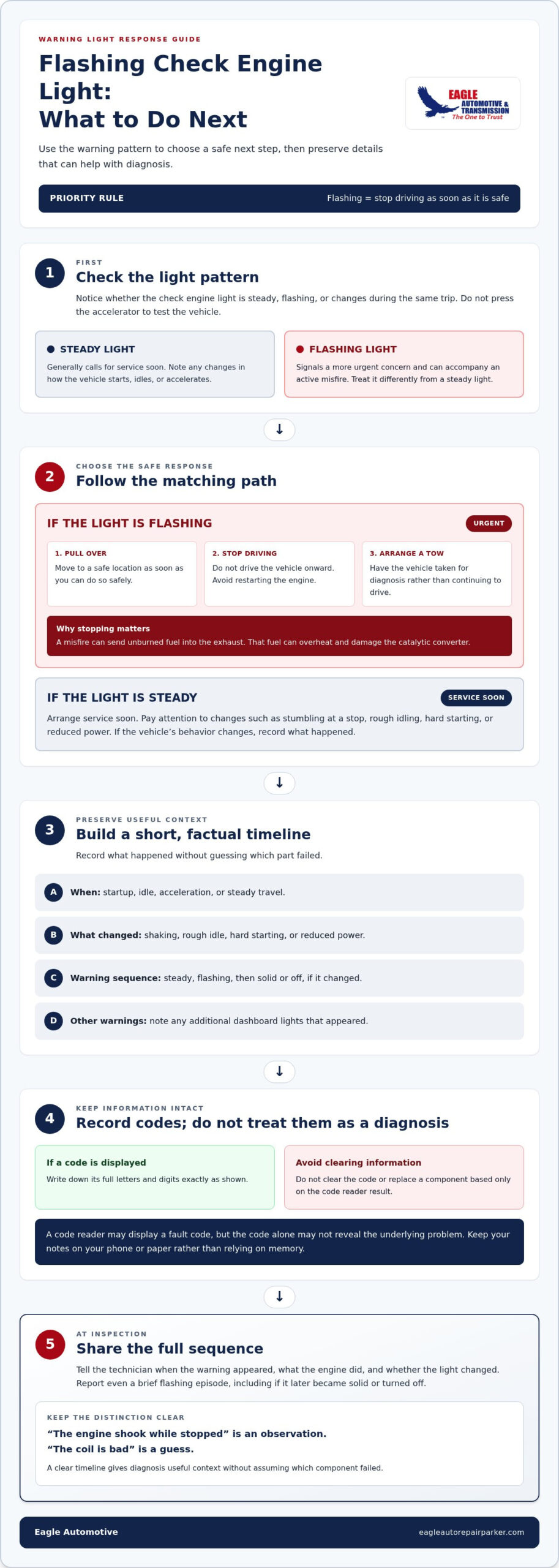
Urgent response to a flashing check engine light
A flashing check engine light calls for a controlled stop, not a drive to the repair shop. At the nearest safe place, signal, move out of traffic, and switch off the engine. A misfire can send unburned fuel into the exhaust, where heat may damage the catalytic converter.
The risk can build quickly. Driving 5 miles with the light flashing can overheat the catalytic converter to more than 1,200°F and create a fire risk beneath the vehicle. Don’t keep driving to see whether the light clears, even if the engine still runs.
Once stopped, choose your next step based on the vehicle’s condition and location. If you’re beside a busy road, prioritize getting yourself to a safe place away from traffic. Don’t inspect hot engine parts or stand near the exhaust. Arrange a tow rather than restarting the vehicle to reach a service center.
- Ease off the accelerator and avoid hard acceleration while moving toward a safe stopping place.
- Switch on the hazard lights if needed to alert nearby drivers.
- Stop away from moving traffic and turn off the engine.
- Arrange a tow for inspection instead of driving while the light continues flashing.
- Tell the repair technician when the flashing began and describe any rough running or power loss.
What if the flashing light changes to solid? The original fault may remain, so the change doesn’t mean the vehicle is repaired. Arrange prompt inspection and don’t treat the new pattern as permission for a normal trip. If you’re already stopped, keep the engine off and arrange safe transport.
Don’t clear the warning or restart the engine just to see whether the flashing returns. That can obscure useful information or expose the catalytic converter to more unburned fuel. Note when the warning appeared and any symptoms, such as shaking or unusual exhaust odor, then share those details during diagnosis.
A tow is especially important when the engine runs roughly, loses power, or continues flashing after a restart. A warning that disappears after stopping still deserves attention because the underlying fault may remain. Avoid unnecessary starts while waiting for transport.
The takeaway is direct: stop safely, shut off the engine, and arrange a tow while the check engine light flashes. The 5-mile example illustrates why continuing a trip can risk heat damage and a fire beneath the vehicle. Keep clear of the exhaust, preserve your observations, and leave diagnosis to an inspection.
What does a flashing check engine light mean, and is it safe to drive?
A flashing check engine light can indicate an active misfire, with unburned fuel entering the exhaust. That fuel can overheat and destroy the catalytic converter, or contribute to permanent engine failure within minutes. The practical answer is clear: don’t continue driving while the warning flashes.
You may notice the vehicle behaving differently during the warning. For example, the engine may run roughly, shake, or lose power. Those symptoms reinforce the need to stop, but their absence doesn’t make a flashing warning safe to ignore.
Move to the nearest safe spot, switch on the hazard lights if needed, and turn off the engine. Choose a place away from moving traffic, then arrange a tow rather than continuing toward a service center. Avoid restarting the engine just to see whether the warning returns.
The catalytic converter sits in the exhaust system and helps process exhaust gases. Unburned fuel from a misfire can burn inside it, raising its temperature and risking internal damage. A converter damaged this way may no longer perform its intended function, so stopping early can help prevent a severe fault from becoming more extensive.
Use the warning’s behavior to guide your next move:
- Light flashing: Stop at the nearest safe location, switch off the engine, and arrange a tow.
- Engine running differently: Treat shaking, rough running, or power loss as added warning signs, not as a reason to test-drive the vehicle.
- Light becomes solid: The underlying fault remains; proceed directly to a service center only if the vehicle is no longer blinking and can be driven safely.
- Light turns off: Record when it flashed and arrange inspection, since the episode still needs an explanation.
A change from flashing to solid doesn’t mean the fault has been repaired. If that happens after you’ve stopped, get the vehicle assessed promptly. The earlier flashing remains important, even if the engine now seems smoother.
Keep your next step simple: stop safely, shut down the engine, and arrange help while the light flashes. If it becomes solid, the fault still needs attention and the vehicle should go directly to a service center when safe to drive. Describe any rough running or power loss, and tell the technician when the warning changed. That timeline can help connect the dashboard warning with the vehicle’s behavior.
A change in performance is worth noting alongside the flashing warning. Unburned fuel may enter the exhaust, potentially destroying the catalytic converter or causing permanent engine failure within minutes.
Eagle Automotive: Check Engine Light
Eagle Automotive can diagnose a flashing warning through its Check Engine Light service. The process retrieves vehicle error codes and uses live data, road tests, and part inspections to investigate the cause.
A code is a starting point, not a diagnosis by itself. Testing helps distinguish an ignition misfire from another engine fault and guides any needed Engine Repair & Service. If the light is flashing, stop driving and arrange safe transport before seeking inspection.
Bring the exact code if you have it, and describe when the warning appeared, how the engine ran, and whether the light changed. Those details help focus the diagnostic process. Contact Eagle Automotive & Transmission in Parker to discuss check engine light diagnosis.
Move from warning light to a clear repair plan
Once the vehicle is ready for inspection, keep your notes and any scan codes together. Ask for a clear explanation of what testing found, which repair addresses the cause, and how the result will be verified. A clear diagnostic path helps you understand the work before approving it.
For flashing check engine light repair in Parker, useful details include when the warning appeared and what changed in the vehicle’s operation. Share those observations so diagnosis can start with the right context, not guesswork. Include any warning or symptom that appeared afterward.
Eagle Automotive & Transmission offers Check Engine Light service and Engine Repair & Service to investigate warning-light concerns. It also provides Brake Repair for separate brake-system needs. Choose your next step based on the vehicle’s condition, and contact the Parker shop to discuss your concern.
Contact Eagle Automotive for help and take the next step toward a clear diagnosis.
Frequently Asked Questions
What should I do immediately when the check engine light is flashing?
Move out of traffic to a safe stopping place, switch on your hazard lights if needed, and turn off the engine. Don’t stand behind the vehicle or near moving traffic while arranging help. If you have a scan code from an earlier check, save it for the technician, but don’t restart the car just to collect a new one. Your priority is staying safe and limiting further engine operation.
What are the most common causes of a flashing check engine light?
An active engine misfire is a common cause, often involving ignition parts such as a coil or spark plug, or a problem with fuel delivery. A fault elsewhere in the engine system can produce similar symptoms. Some drivetrain faults can also trigger check engine codes. A code helps identify the system to investigate, but inspection and testing are needed before naming a failed part.
Which auto repair shops in Parker, Colorado diagnose flashing check engine lights?
Eagle Automotive & Transmission in Parker diagnoses check engine light concerns, including flashing warnings, and provides free computer diagnostics. A scan retrieves codes to guide further checks; additional testing helps identify what caused the warning. When contacting the shop, describe any rough running, power loss, or change in the warning pattern. If the light is flashing, arrange safe transport rather than driving there.
Should I tow my car or drive it to a mechanic with a flashing check engine light?
Have the vehicle towed rather than driving it to a repair shop while the check engine light is flashing. Even a short trip can keep an active fault operating and increase the risk of damage. Tell the towing operator that the engine warning is flashing and mention any shaking or power loss. If the warning stops, still report that it occurred before deciding how the vehicle should reach inspection.
Can driving with a flashing check engine light damage the catalytic converter?
Yes. A misfire can send unburned fuel into the exhaust, where it may overheat and damage the catalytic converter. The warning signals a problem that needs prompt attention, even if the vehicle still moves under its own power. Continued driving can make the original engine fault more costly to address if exhaust components are also damaged. Stop operating the vehicle and arrange diagnosis.