

Engine Repair Shop Near Me for Diagnostics and Repairs
A warning light or rough-running engine calls for a clear diagnosis, not a guess. Finding an engine repair shop near me can help you get professional attention for trouble starting, stalling, or concerns tied to ignition or fuel delivery.
It’s understandable to worry that an engine problem could lead to a major repair. A thorough diagnostic process helps narrow down possible causes before repair decisions are made. Warning signs such as a check-engine light deserve attention rather than guesswork.
This article explains what engine diagnostics can reveal, which symptoms matter, and how ignition or fuel-system repairs may address certain problems. It also covers how technician credentials fit into choosing a repair professional, so you can better understand the next steps for your vehicle.
Key Takeaways
- Learn how scan results, electrical checks, and professional evaluation work together to narrow down engine concerns.
- Understand how to verify technician credentials and why a single symptom does not identify a specific engine fault.
- See which engine components may be inspected and how repair options depend on the cause of the problem.
- Compare nearby shops by looking for clear review details about communication, diagnosis, and repair work.
- Explore how check-engine-light service, engine repair, brake repair, and transmission service can address different vehicle needs.
Engine diagnostics and check-engine-light scans
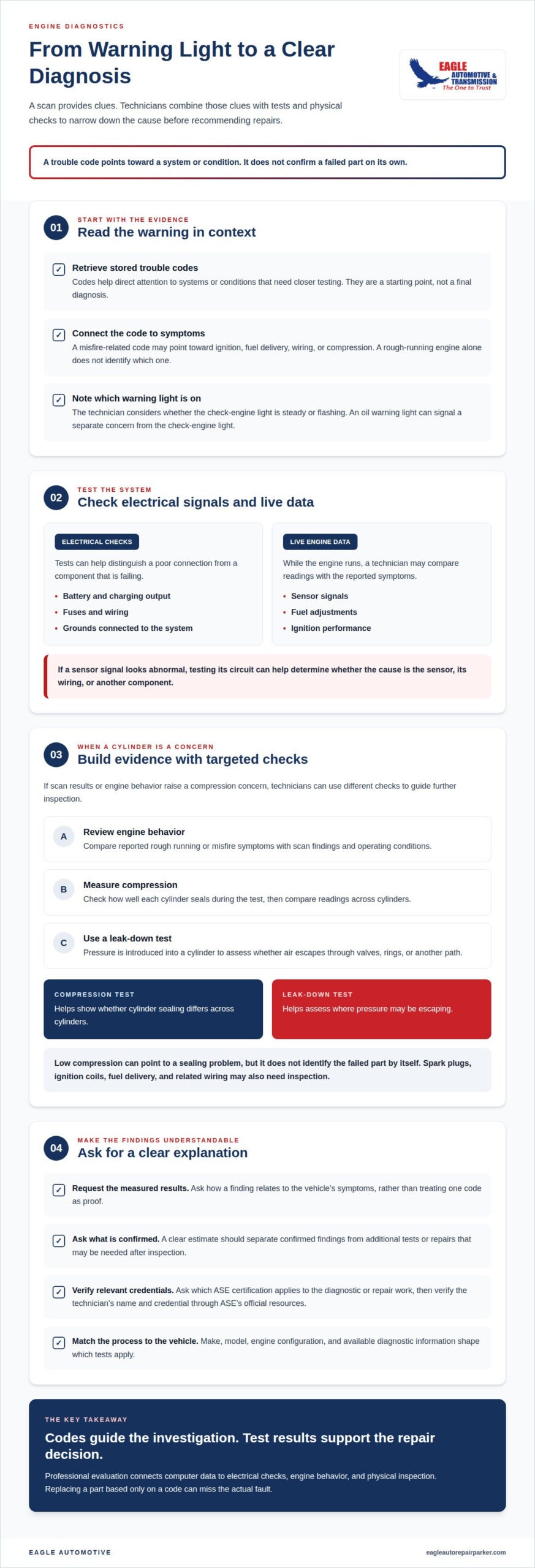
A check-engine light means the vehicle’s computer has detected a problem, but it doesn’t identify a failed part by itself. A diagnostic scan retrieves stored trouble codes that point technicians toward systems or conditions requiring closer testing. For example, a code involving an engine misfire directs attention toward ignition, fuel delivery, wiring, or compression.
A scan is one step, not the whole diagnosis. A technician considers the codes alongside your description, checks whether the light is steady or flashing, and examines relevant engine data. An oil warning light also deserves prompt attention because it can signal a separate concern from the check-engine light.
Electrical checks can help distinguish a bad connection from a failing component. A technician may test the battery, charging output, fuses, wiring, and grounds connected to the affected system. If a sensor signal appears abnormal, testing its circuit helps determine whether the sensor, its wiring, or another component is responsible.
Computer diagnostics can show live readings while an engine runs. A technician may compare sensor signals, fuel adjustments, and ignition performance with the symptoms. The computer provides evidence, but professional evaluation connects that evidence to physical checks. Replacing a part based only on a code can miss the actual fault.
Do local engine repair shops specialize in my vehicle make and engine type? Some work across multiple makes and engine types, while others focus on particular vehicles. The make, model, engine configuration, and available diagnostic information shape which tests apply.
Do nearby shops offer free estimates, warranties, financing, or payment plans? Those terms vary by shop and repair; they are separate from the diagnostic scan itself. A written estimate should explain the proposed work, while warranty and payment details depend on the shop’s stated terms.
How soon can a nearby shop diagnose and repair an engine problem? Timing depends on the fault, the testing required, and the shop’s workload. Repair time also depends on which component failed and whether parts are available. A wiring fault may require different testing than a cylinder-head concern, so diagnosis establishes the next step.
A cylinder contains pistons that move up and down as the engine operates. If test results point toward compression or internal engine concerns, a technician can evaluate the relevant components rather than treating one code as a final answer. Comparing compression across cylinders can help identify where further inspection is needed.
ASE-certified technicians
ASE certification can help you assess a technician’s training, but the credential should match the work. Ask which ASE certification applies to engine diagnostics or repair. Then check the technician’s name and credential through ASE’s official verification resources. A shop’s general claim is less useful than details you can connect to a specific technician.
Credentials are one part of the decision. Ask how the technician will test the fault, what results support the diagnosis, and which components need inspection. For example, a misfire may involve ignition, fuel delivery, wiring, or cylinder compression. A sound explanation connects test findings to the proposed repair instead of treating one symptom as proof.
For a cylinder concern, technicians can use several checks to build evidence:
- Review engine behavior: Compare the reported misfire or rough running with scan findings and operating conditions.
- Measure compression: Check how well each cylinder seals during the test, then compare readings across cylinders.
- Use a leak-down test: Introduce pressure into a cylinder and assess whether air escapes through valves, rings, or another path.
These tests answer different questions. Low compression can point to a sealing problem, but it doesn’t identify the failed part by itself. A leak-down test can help locate where pressure escapes. Technicians may also inspect spark plugs, ignition coils, fuel delivery, and related wiring before recommending internal engine work.
Ask for the measured results and a plain-language explanation. If one cylinder differs from the others, the technician should explain how that finding relates to the vehicle’s symptoms. A clear estimate should distinguish confirmed findings from additional tests or repairs that may be needed after inspection.
Experience with the vehicle’s make and engine type also matters. A technician working on a Ford four-cylinder engine may use different service information than one assessing a Chevrolet V8. Ask how the shop identifies the engine configuration and applies the correct testing procedure. That detail helps connect certification to the actual vehicle, not just a credential on display.
ASE credentials can support confidence in a technician’s qualifications, while test results show how the diagnosis was reached. Consider both. A careful cylinder evaluation, documented measurements, and a clear explanation provide a stronger basis for repair decisions than a warning light or symptom alone.
Car and engine repair
Engine repair depends on the failed component, test results, and vehicle design. Rough running alone cannot show whether the cause is a spark plug, fuel injector, valve, or internal engine problem. A technician combines inspection and test findings before recommending a repair, replacement, or further evaluation.
Repair work may involve external parts or deeper engine components. A worn ignition coil, for example, may need replacement, while damaged wiring may need repair. If testing points toward low compression, technicians may inspect the cylinder, piston rings, valves, and cylinder head. Each finding shapes the repair plan.
A cylinder head sits above the engine block and contains passages and parts that support combustion. If inspection indicates a head concern, technicians assess the head and related components before deciding whether repair or replacement is appropriate. A damaged head gasket can affect sealing between the head and block, but overheating or rough running alone doesn’t prove gasket failure.
Engine repair can include work on components such as:
- Ignition parts: Spark plugs, coils, and wiring that help create the spark needed for combustion.
- Fuel-system parts: Injectors and related components that deliver fuel to the engine.
- Internal parts: Valves, pistons, rings, and the cylinder head, when test results indicate deeper damage.
The vehicle’s make, model, and engine configuration shape the work. A Ford four-cylinder and a Chevrolet V8 differ in layout, access, and component arrangement. Technicians use the vehicle information and inspection findings to identify the parts involved, then explain why a particular repair fits the evidence.
Some repairs involve replacing a single accessible component. Others require disassembly to inspect internal engine parts and decide whether repair or replacement is appropriate. The condition of the cylinder head, block, valves, and surrounding components can affect that decision. A clear explanation should distinguish confirmed damage from parts that still need evaluation.
Repair timing varies with the diagnosis, work involved, and parts needed. Some repairs may be completed the same day, while internal engine work can require additional inspection and labor.
Before approving engine work, review the findings and proposed repair scope. A written explanation should connect each recommended part to a test result or visible condition. This helps you understand whether the repair addresses the cause or only one symptom.
Regular preventive maintenance, including oil changes, can help support engine longevity. Maintenance for diesel engines may include oil and filter changes, air and fuel filter changes, fuel-system bleeding, water-separator draining, and urea injection system refilling. A timing belt synchronizes camshaft and crankshaft rotation so engine valves open and close at the correct times.
The shop describes its Toyota 7M-GE service as rebuilding an 86-92 3.0-liter inline-six engine, and lists a 1978 GM Chevy 305 rebuild for a 5.0L, 16-valve V8.
Common engine warning signs
Starting trouble, rough idling, and stalling can point to engine concerns, but each symptom has several possible causes. Slow cranking may involve the battery or starter, while an engine that turns over without starting may involve fuel delivery, ignition, or another system.
Notice when the symptom appears. An engine that idles unevenly just after starting differs from one that loses power during acceleration. A fluctuating tachometer, shaking at a stop, or hesitation on a hill gives technicians useful context about the conditions involved.
Some clues come through sound or smell. A new knocking, rattling, or tapping noise may come from different engine components, while an unusual exhaust odor can point to a running or fuel concern. Neither clue identifies a specific fault, but changes from the vehicle’s usual operation deserve attention.
Watch the temperature gauge and exhaust, too. A rising temperature reading, visible steam, or unusual exhaust smoke can accompany problems in different systems. Coolant loss and an engine running poorly, for example, may need to be considered together rather than treated as unrelated observations.
Keep track of symptom combinations:
- Hesitation and loss of power: Possible areas include ignition, fuel delivery, or air intake.
- Uneven idle and vibration: Engine operation or its supporting components may need inspection.
- Temperature change and steam: Cooling-system concerns may affect engine operation.
Professional diagnosis is appropriate when symptoms repeat, worsen, or occur together. A car that stalls at intersections needs assessment because the cause could involve more than one system. A technician can evaluate the engine and related components without treating one symptom as a definitive diagnosis.
Vehicle design also matters. A Ford, Toyota, or Chevrolet may show similar shaking or hesitation, yet have different engine layouts and component arrangements. The make, model, and engine type help technicians interpret the behavior and select relevant checks.
Describe what happens before the symptom, such as whether it follows a cold start, a long drive, or a stop. Note changes in sound, vibration, temperature, or power. These details help distinguish a recurring pattern from a one-time event and give the inspection a useful starting point.
Some changes in how a vehicle moves may point to a transmission concern rather than an engine problem. Grinding or unusual transmission noises, shifting problems, slipping gears, surging, and delayed movement are possible signs of a transmission issue. These symptoms are useful to report, but don’t identify a specific fault on their own. Note whether they happen when shifting, accelerating, or starting to move, and whether they occur alongside engine symptoms.
Describe these changes to a technician along with any rough idling, stalling, hesitation, or loss of power. Keeping the observations together can help the inspection consider both engine operation and transmission behavior instead of assuming that every movement or performance change has the same cause. If unusual sounds or shifting behavior repeat, worsen, or appear with delayed movement, arrange an assessment. A clear account of when the vehicle responds differently gives the technician useful context and helps distinguish the reported pattern from a single isolated event.
Which nearby engine repair shops have the best ratings and reviews?
A high star rating offers a quick snapshot, but review details reveal more. When comparing an engine repair shop near me in Parker, look for specific descriptions of diagnosis, communication, and completed work. A review explaining how a shop handled an engine misfire offers more useful context than a rating alone.
Read positive and critical feedback together. One complaint may describe a one-time delay, while repeated comments about unclear estimates or unexplained repairs may point to a pattern worth considering. Detailed praise for clear explanations can show how a shop communicates during a complicated repair.
Use the same questions for each listing so your comparison stays fair:
- Review detail: Do customers describe the vehicle concern and the shop’s response?
- Communication: Do comments mention explanations, updates, or repair approvals?
- Repair process: Do reviews describe diagnosis before parts replacement?
- Response to criticism: Does the business address concerns calmly and specifically?
Imagine two nearby listings with similar average ratings. One has recent comments describing a clear explanation of an engine concern; the other has brief ratings without details. The first provides more information about customer experience, though reviews can’t predict how a particular vehicle will be handled.
Look at review dates as well as overall ratings. Older feedback may describe a different team or service process than recent comments. A range of dates and specific repair examples gives better context than relying on one glowing or critical post.
Compare how businesses explain diagnostic findings and repair recommendations. Engine problems can involve different components, so useful reviews describe how a shop approached testing and shared its conclusions. Generic praise such as “great service” offers less detail than a comment describing an understandable explanation.
Ratings are one decision aid, not a technical assessment. Reviews reflect individual experiences and may not cover the same vehicle make, model, or engine concern as yours. An engine repair shop near me may have strong ratings, but review patterns and clear information about its diagnostic approach both matter.
Keep a short comparison list with each shop’s rating, review themes, and examples of engine work mentioned. This makes it easier to distinguish recurring patterns from isolated comments. The strongest choice isn’t automatically the listing with the highest score, but the one whose available information best addresses your concerns.
Eagle Automotive
For drivers in Parker facing engine concerns, warning lights, or related repair needs, the right starting point depends on what the vehicle is doing. A check-engine light, trouble starting, rough operation, or stalling may each call for a different evaluation.
When discussing a warning light or broader engine concern, ask what evaluation may be appropriate for the symptoms. The goal is to connect symptoms and test findings with an appropriate repair plan, not to guess at a failed part from one sign.
Useful details help establish a clear starting point. Share the vehicle’s make, model, and engine type, along with when the concern began. Mention whether the engine stalls at idle, struggles to start, or runs roughly under particular conditions. If a warning light appeared, say whether it remains on or flashes.
Engine trouble can overlap with other vehicle concerns. Braking performance, shifting, or movement concerns may involve systems other than the engine. Explaining what happens during acceleration, stopping, or gear changes can help distinguish these systems during an evaluation.
Before agreeing to work, review the diagnosis and proposed repair scope. Ask which findings support the recommendation, which components need attention, and whether more inspection is needed. A useful explanation connects the evidence to the repair, such as a tested component that relates to a starting or running concern.
For a serious internal engine concern, an assessment may include components such as the cylinder head or head gasket. Symptoms can overlap with other faults, so test results and inspection findings matter. Understanding what has been identified helps you make an informed decision about the next repair step.
Bring any relevant diagnostic information and describe the conditions accurately. A clear account of the vehicle’s behavior can help focus an evaluation. Whether the concern involves a warning light, engine operation, brakes, or shifting, the first step is identifying which system and components need attention.
For help discussing your vehicle concern, contact Eagle Automotive.
Frequently Asked Questions
What engine repair shops are near me?
Near Parker, Eagle Automotive & Transmission is a local option to ask about engine diagnostics and repair. Contact the shop to confirm whether it can evaluate your vehicle and address Check Engine Light concerns or engine repair needs. Share your vehicle’s make, model, engine type, and symptoms so the concern can be directed to an appropriate evaluation. For example, note whether a warning light stays on or flashes.
Are local engine repair shops ASE-certified and properly licensed?
Ask whether the technician who will assess your vehicle holds an ASE credential relevant to the engine work involved. Technician credentials and business licensing are separate questions. Consider both when evaluating a shop, and understand which technician will assess your vehicle and what credentials apply to that work.
What symptoms mean my car needs immediate engine repair or should not be driven?
Treat an oil warning light, overheating, loud knocking, smoke, or sudden loss of power as reasons to stop driving as soon as it’s safe. A flashing check-engine light also calls for prompt attention. Don’t keep driving to see whether the symptom disappears. Repeated stalling, hard starting, or rough running needs professional diagnosis, since symptoms alone can’t identify the cause or establish whether continued driving is safe.
What should I check before choosing an engine repair shop near me?
Review whether the shop explains its findings, proposed work, and approval process before repairs begin. Ask what the diagnostic process covers and read the written estimate for the work’s scope. Understand the applicable warranty terms before authorizing service. For example, confirm whether the estimate covers identified repairs or also describes additional inspection that may be needed. Clear documentation makes repair decisions easier to follow.