

Engine Misfire: Symptoms, Causes, and What to Do
If you searched “engine misfire car,” the shaking or hesitation you’re noticing may be a sign of uneven combustion. A misfire can feel like a rough idle, hesitation when accelerating, or a loss of power. It’s unsettling, especially if the check engine light comes on, but a symptom alone doesn’t identify the failed part.
A diagnostic code can point to a misfiring cylinder or a random misfire. It can’t prove that a particular spark plug, ignition coil, or fuel injector needs replacement. The cause may involve the ignition, fuel, or air systems, so guessing can lead to unnecessary repairs while the underlying problem continues.
This guide explains common misfire symptoms, possible causes, and what to do next. You’ll also learn why a flashing check engine light calls for prompt action: an active misfire can send unburned fuel into the exhaust and damage the catalytic converter. If your car is running rough, Eagle Automotive in Parker can investigate the cause with engine diagnostics and recommend repairs based on test results, not just symptoms.
Key Takeaways
- A misfire occurs when combustion fails in one or more cylinders, but similar rough-running behavior can have other causes.
- Compare possible ignition, fuel, air-intake, and mechanical issues without treating any symptom as a diagnosis.
- Note whether the problem happens at startup, idle, or acceleration to help guide diagnosis.
- Start with the car’s drivability and warning lights, then arrange diagnosis based on its symptoms and test results.
- Codes and targeted inspections help narrow down the cause before repairs are recommended.
What an Engine Misfire Feels Like: Symptoms Drivers Should Recognize
An engine misfire occurs when combustion fails in one or more engine cylinders. Instead of running smoothly, the engine may idle unevenly, shake, hesitate, or lose power. The change can feel mild at first, then become more noticeable during acceleration or when the engine is under load.
Drivers often describe a misfire as a sputter, stumble, or uneven rhythm. You might feel vibration through the steering wheel or seat while stopped, then notice a pause or jerk when pressing the accelerator. The engine may also sound different, including an irregular exhaust beat. These clues can suggest a misfire, but they don’t confirm one or identify the faulty part.
How can you tell if your car is misfiring?
Pay attention to when the roughness occurs and whether it changes. A vibration at idle, stumbling during acceleration, slower response, or reduced power can all fit a misfire. An unfamiliar exhaust sound may be another clue. But similar symptoms can come from other engine or vehicle problems, so don’t treat any single sensation as a diagnosis.
The pattern matters. A car that runs smoothly most of the time but stumbles occasionally may have an intermittent problem. Symptoms that persist or worsen also deserve attention. Note whether they appear during startup, at idle, or under acceleration. These details help distinguish what you’ve experienced from what testing confirms.
Can a car misfire without a check engine light?
Yes. A warning light may not appear immediately, even if the engine feels rough. A symptom is your observation; a confirmed diagnostic finding comes from checking the vehicle’s systems and interpreting the results. A light that stays off doesn’t prove the engine is running correctly, just as a warning light alone doesn’t identify a failed part.
Keep track of recurring symptoms, including whether the engine is cold or warm, whether the vehicle is stopped or moving, and whether the issue comes and goes. This record can help guide a focused inspection instead of a parts guess. Ignition timing, which controls when a spark occurs in relation to the engine’s cycle, can also affect combustion. The Ignition Timing and Engine Misfire reference explains how it works.
What Causes a Car Engine Misfire? Compare the Main Possibilities
Misfire symptoms can come from several systems, not just a worn spark plug. Combustion depends on the right mix of air and fuel, a correctly timed spark, and sound engine mechanics. A fault in any of these areas may disrupt how one or more cylinders run. A code can help narrow the search, but it doesn’t identify the failed part by itself.
| Possible cause | How it may affect the engine | Clues to investigate |
|---|---|---|
| Ignition | A worn spark plug or faulty ignition coil may weaken or interrupt the spark needed for combustion. | Rough running or hesitation; inspection and testing are needed to confirm the source. |
| Fuel delivery | A clogged or malfunctioning fuel injector, or another fuel-delivery issue, may leave a cylinder with too little or inconsistent fuel. | Uneven running or reduced response; these clues can overlap with other faults. |
| Air intake | A vacuum leak can let unmetered air into the engine and upset the air-fuel mixture. | Rough idle may be one clue, but it does not prove there’s a leak. |
| Engine mechanics | Low compression or another internal engine concern can interfere with combustion in a cylinder. | Further testing is needed to assess mechanical condition. |
Can ignition or fuel problems cause an engine misfire?
Yes. Spark plugs and ignition coils are part of the system that creates and delivers the spark. If one isn’t working properly, the affected cylinder may not burn its air-fuel mixture consistently. Fuel problems can produce a similar result: an injector that isn’t delivering fuel as it should may disrupt combustion. These components are possibilities, not automatic replacements. Inspection and targeted testing help establish which system is actually at fault.
Can an air leak or engine problem cause a misfire?
Yes. Air entering through a leak can bypass normal measurement and upset the mixture, while compression problems can prevent a cylinder from sealing and working as intended. Internal concerns, including a head-gasket problem, may be considered if test results point that way. A misfire alone, however, doesn’t mean major engine damage. More evidence is needed before drawing that conclusion.
A misfire code guides testing; it isn’t a command to replace a particular part. A code associated with one cylinder helps focus inspection on that cylinder, while a random or multiple-cylinder code can point toward broader possibilities. Neither result proves whether the cause is ignition, fuel, air, or engine mechanics. Careful diagnosis separates a likely lead from a confirmed fault.
Misfire or Another Rough-Running Problem? Compare the Clues
Shaking or an uneven idle can fit a misfire, but it doesn’t prove one. Similar sensations may come from different faults in the engine or related systems. For a possible misfire, start by noting exactly when the roughness occurs and what changes alongside it.
What clues can help distinguish possible misfire causes?
Does the engine stumble at idle, hesitate during acceleration, or act up when engine load changes? The pattern can help a technician decide which systems to inspect and which tests to perform. It narrows the investigation, but it can’t identify a failed component by itself.
- Ignition: Roughness or stumbling may lead to checks of spark plugs and ignition coils.
- Fuel delivery: Hesitation or uneven response may prompt inspection of fuel delivery, including injectors.
- Air intake: Rough idling may be one clue to check for an air leak or another intake issue.
- Engine mechanics: Persistent uneven running may call for tests of cylinder compression or other mechanical conditions.
These clues overlap. A car that falters during acceleration, for example, could have an ignition, fuel, air, or mechanical problem. Note whether it happens at startup, at idle, during acceleration, or under a particular load. Also record whether it’s constant or intermittent. That practical detail helps diagnosis; replacing a part based on one driving symptom is guesswork.
How does a warning light affect what you should do?
A flashing check engine light can indicate an active problem that needs prompt attention. Don’t treat the light’s behavior as a diagnosis, but don’t ignore it either. A steady light also doesn’t tell you which component is at fault, so the vehicle still needs appropriate testing.
If severe shaking, major power loss, or unpredictable behavior makes the car unsafe to control, pull over somewhere safe and avoid continuing the trip. A flashing light is also a reason to stop driving as soon as it’s safe and arrange professional diagnosis. Don’t try to estimate a safe distance from symptoms alone. Record what you noticed and share those details during inspection.
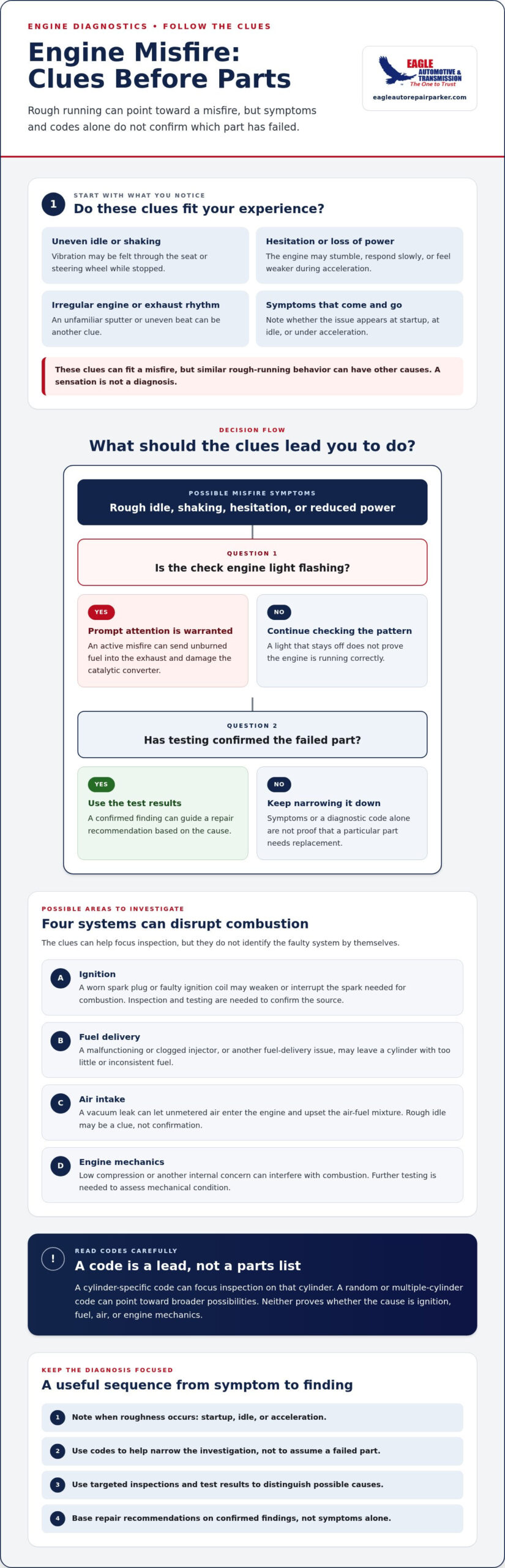
Car Misfire: A Safe Diagnostic Checklist
If you suspect a misfire, focus first on safety and useful observations, not repairs. A clear record of what the vehicle is doing can help diagnosis start with evidence instead of guesses.
- Assess drivability. Notice whether the car feels safe and predictable to control. If severe shaking, major power loss, or erratic behavior makes continued travel unsafe, pull over somewhere safe and arrange help.
- Check the warning lights. Note whether the check engine light is off, steady, or flashing. A flashing light calls for prompt attention, but its behavior alone doesn’t diagnose the problem.
- Record the symptoms. Write down when they began, whether they’re constant or intermittent, and whether they occur at startup, idle, acceleration, or under changing engine load. Include unusual sounds or changes in power.
- Arrange diagnosis. Share your observations and any code information you have. Avoid clearing codes or replacing parts before the diagnostic information is captured and assessed.
What should you record before getting the car checked?
Keep your notes specific. For example, record that the engine stumbles during acceleration or that shaking begins at idle and comes and goes. Include how the warning light behaved and any changes in engine response. If a scan tool displayed a code, write it down or take a photo. Share it as a clue, not proof that a particular part has failed.
Why is a trouble code not a complete diagnosis?
An OBD-II code reports a condition the vehicle’s computer detected. It may point toward a cylinder, system, or circuit, but further checks are needed to find the root cause. A technician can use the code and your observations to guide testing of ignition, fuel, air-intake, or mechanical systems. A code is useful evidence, not an automatic instruction to replace a component.
Clearing a code before it’s recorded can remove a useful lead. If it has already been cleared, tell the technician and describe what you noticed beforehand. For engine diagnostics and check-engine-light troubleshooting in Parker, Eagle Automotive provides diagnostic assessments.
Engine Misfire Diagnosis and Repair in Parker, Colorado
For drivers dealing with a misfire, the right next step is diagnosis, not a parts swap based on one symptom. Rough running can involve ignition, fuel delivery, air intake, or engine mechanics. Testing helps separate those possibilities and identify a repair that fits the actual fault.
What happens during professional engine-misfire diagnostics?
A technician starts with what you’ve observed: when the engine stumbles, whether symptoms are constant or intermittent, and how warning lights behave. Available diagnostic codes provide additional clues, but they aren’t proof that a particular part has failed. Inspection and follow-up tests depend on what the initial evidence shows.
That may mean examining ignition components, checking fuel delivery, looking for air-intake concerns, or testing engine condition. A code associated with one cylinder can help focus the investigation, while broader symptoms may call for checks across several systems. Not every vehicle follows the same sequence, and not every misfire needs the same repair. The goal is to verify the cause before recommending work.
When should Parker drivers arrange engine repair?
Arrange prompt assessment if the check engine light is flashing, shaking continues, or the vehicle has noticeable power loss. If the car shakes severely or becomes difficult to control, stop somewhere safe rather than continuing to drive. A warning light or symptom can signal urgency, but neither one alone reveals exactly what has failed.
In Parker, Eagle Automotive serves all makes and models and provides engine diagnostics and check-engine-light troubleshooting. Once testing identifies the cause, the repair recommendation can address the confirmed problem rather than assume a plug, coil, injector, or larger engine component is responsible. This evidence-first process helps avoid replacing parts that haven’t been shown to be faulty.
If misfire symptoms are recurring or getting worse, arrange an assessment so a technician can connect your observations with diagnostic results and determine the appropriate next step.
Take the Next Step Toward a Smooth-Running Engine
A misfire can feel like shaking, hesitation, or uneven power, but those symptoms don’t identify the failed component. Ignition, fuel delivery, air intake, or engine-mechanical issues may be involved. Diagnostic codes and your notes about when the problem happens can help guide testing, but they aren’t a reason to replace parts without confirming the cause.
If your symptoms keep returning or the check engine light is flashing, arrange a prompt assessment. Eagle Automotive in Parker serves all makes and models and provides engine diagnostics and check-engine-light troubleshooting to investigate the cause before repairs are recommended. For more on broad vehicle care, routine maintenance keeps your entire system running reliably for miles to come.
Ready to get answers based on testing, not guesswork for your engine misfire car? Arrange engine diagnostics with Eagle Automotive.
Frequently Asked Questions
What are the most common signs of an engine misfire?
Common signs include a rough or uneven idle, shaking, hesitation during acceleration, reduced power, or an irregular engine rhythm. You may also notice an unfamiliar exhaust sound or a check engine light. These symptoms can suggest a misfire, but they don’t confirm its cause, and other problems can create similar sensations. Note when the symptoms occur and whether they’re constant or intermittent to help guide diagnosis.
Can you drive a car with an engine misfire?
It’s best to limit driving and arrange diagnosis, especially if symptoms persist or worsen. If the check engine light is flashing, pull over safely and stop driving as soon as you can. An active misfire can send unburned fuel into the exhaust and damage the catalytic converter. Severe shaking, noticeable power loss, or unpredictable handling are also reasons not to continue driving the vehicle.
Can a bad spark plug cause a car to misfire?
Yes, a worn or faulty spark plug can prevent a cylinder from igniting its air-fuel mixture properly. That may cause rough running, hesitation, or reduced power. But those symptoms don’t prove the spark plug is bad. An ignition coil, fuel-delivery issue, air leak, or mechanical problem can cause similar behavior. Inspection and testing help establish whether the plug is responsible before parts are replaced.
Will an OBD-II code tell me exactly what caused the misfire?
No. An OBD-II code identifies a detected condition, such as a misfire associated with a particular cylinder, but it doesn’t necessarily reveal the root cause. A code may help direct testing toward ignition, fuel, air intake, or engine mechanics. Treat the code as useful evidence, not proof that a specific component has failed or needs replacement.
How is an engine misfire diagnosed at a repair shop?
A technician reviews the symptoms and any available codes, then uses that information to guide inspection and testing. Depending on the findings, checks may focus on ignition parts, fuel delivery, air intake, or engine condition. There isn’t one test sequence or repair for every vehicle. In Parker, Eagle Automotive provides engine diagnostics and check-engine-light troubleshooting for all makes and models, helping identify the cause before recommending a repair.