

Coolant Leak Repair in Parker, CO for Hoses and Radiators
A leaking radiator is not a problem to ignore. Driving can become risky when coolant is escaping or the engine temperature is rising, because continued coolant loss can lead to overheating. For coolant leak repair in Parker, Colorado, the first step is finding the source of the leak.
It’s understandable to hope a small puddle or falling coolant level can wait. But coolant may leak from a radiator, hose, or another part of the cooling system, and topping up the reservoir won’t fix the cause.
This article explains common signs of radiator and hose leaks, when coolant loss means you should stop driving, and how inspection, repair, and post-repair testing help confirm the cooling system is working properly. You’ll also learn what affects the repair approach so you can decide what to do next without guessing.
Key Takeaways
- Coolant escaping from a radiator or hose needs diagnosis at its source; a low reservoir alone won’t identify the failed component.
- Watch for a dropping coolant level, visible leaks, unusual coolant odor, or rising engine temperature, which can signal overheating risk.
- Hose replacement depends on the condition and fit of the affected hose and its connections, not just the location of a puddle.
- After a repair, testing helps confirm the leak is addressed and the cooling system is functioning as intended.
- A damaged radiator may be repairable or need replacement, depending on the leak location and the radiator’s overall condition.
Coolant leaks in radiators and hoses
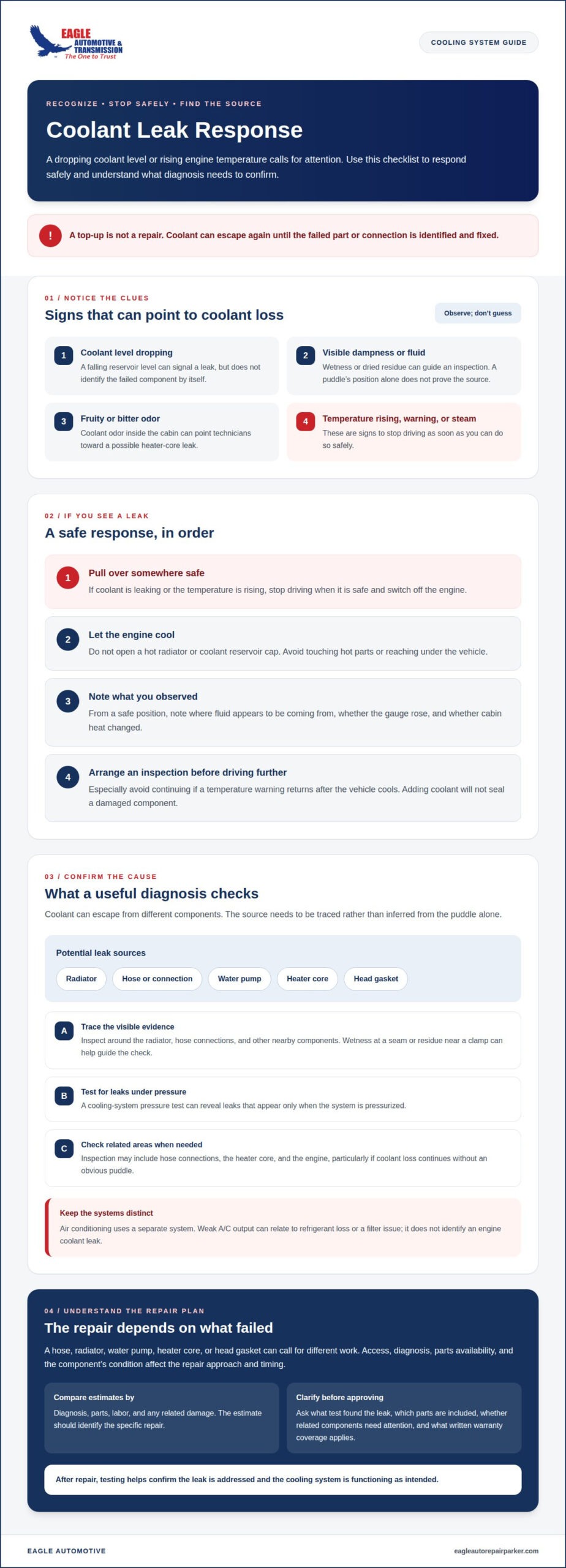
Coolant can escape through a radiator, hose, water pump, or head gasket, and the repair depends on the failed component. Air conditioning uses a separate system, so refrigerant loss should not be mistaken for engine coolant loss.
Comparing Repair Costs by Cause
Repair costs vary with the failed part, its location, and the labor needed to reach it. A hose repair may involve fewer steps than radiator replacement, while access to a water pump depends on the vehicle’s layout.
Head gasket work typically involves more extensive engine disassembly than replacing a hose. Compare estimates by checking the diagnosis, parts, labor, and any related damage. The estimate should identify the specific repair, since not every coolant leak requires the same work.
Locating the Coolant Leak
Diagnosis begins by tracing visible coolant and inspecting nearby components. Wetness at a radiator seam, dried residue around a hose clamp, or fluid near the water pump can guide the inspection, but a puddle’s position alone doesn’t prove the source.
A cooling-system pressure test can reveal leaks that appear only when the system is pressurized. The Centers for Disease Control and Prevention describes checking a radiator by pressurizing it and submerging it in a water-filled test tank. Inspection may also include hose connections, the heater core, and the engine, particularly when coolant loss continues without an obvious puddle.
Cabin heating symptoms can provide useful context. A fruity or bitter coolant odor inside the vehicle may point to a heater-core leak. Weak air-conditioning output is different: an A/C refrigerant leak or filter issue affects cabin cooling, not the engine’s coolant supply. The systems need separate diagnosis.
Repair Timing and Warranties
Repair time depends on the component, access, diagnosis, and parts availability. Replacing an accessible hose differs from reaching a water pump or performing head gasket work. Ask the mechanic to explain which steps affect the expected completion time.
In Parker, mechanics who diagnose and repair cooling systems can assess radiator, hose, water pump, and head gasket leaks. Warranty terms differ by repair and parts, so review the written coverage, duration, and exclusions before approving work.
Colorado weather and altitude can affect vehicle operating conditions, but they don’t identify a leak’s source by themselves. A mechanic should assess the symptoms and cooling-system condition. Before approving repairs, ask what test found the leak, which parts the estimate covers, whether related components need attention, and what warranty applies. These answers clarify the proposed work instead of relying on weather or a visible drip.
Coolant loss and overheating risks
A falling coolant level can signal a leak in the radiator or heater core, and continued loss raises the risk of overheating. Respond to temperature changes and coolant symptoms before continuing a trip.
Coolant Loss Risks
Coolant carries heat away from the engine, so a leak can interfere with temperature control. A water pump uses an impeller to circulate coolant through the system. If coolant drops too low, that circulation may not keep engine components at an effective operating temperature, and overheating can follow.
Look for more than a puddle. A dropping reservoir level, visible dampness, or a fruity or bitter coolant odor inside or outside the vehicle can point to a leak. A heater-core leak may leave an odor in the cabin, while a blocked heater core can also contribute to engine overheating.
Regularly observing the coolant level when the engine is cool can help reveal a change. It can’t identify the failed component by itself, though. Technicians diagnose the cause by inspecting the cooling system and its related components, rather than treating a low reservoir as proof of one specific fault. A “certified” label alone doesn’t explain which test supports the diagnosis.
Overheating can affect how the engine operates, but warning signs matter more than guessing at the cause. If the temperature gauge rises, a warning appears, or steam comes from under the hood, stop driving as soon as you can do so safely.
Immediate Steps for a Coolant Leak
If you see coolant leaking, pull over somewhere safe and switch off the engine. Don’t continue driving with a rising temperature gauge or an overheating warning. Let the engine cool before anyone inspects the cooling system, and don’t open a hot radiator or coolant reservoir cap.
Once parked, note the visible symptoms without reaching under the vehicle or touching hot components. For example, note whether the leak appears near the radiator, beneath a hose connection, or around the engine. A fruity or bitter smell inside the cabin is also useful information because it can point technicians toward the heater core.
Don’t rely on adding coolant as a repair. A top-up won’t seal a damaged hose, radiator, or heater core, and a continuing leak can lower the coolant level again. Arrange a professional inspection before driving further, especially if the temperature warning returns after the vehicle cools.
Share the sequence of events during diagnosis: when the level began dropping, whether the gauge rose, and whether heat from the cabin vents changed. Those details help technicians assess the leak and related components. A physical inspection is still needed to distinguish a coolant leak from another issue, such as an air-conditioning problem.
Radiator and heater hose replacement
Radiator hoses carry coolant between the engine and radiator, while heater hoses send coolant through the heater core. A split, softened, swollen, or poorly sealed hose can leak and reduce coolant circulation. Replacement starts by confirming which hose or connection is failing, not simply changing the part nearest a visible drip.
Hoses age through repeated heating and cooling, pressure, and contact with nearby components. A leak may appear at a clamp, along a hose bend, or where a hose meets the radiator or engine. A careful inspection checks the full hose, its ends, clamps, and adjacent parts for seepage or damage.
Vehicle manufacturers specify different recommended replacement intervals for belts and hoses, so maintenance timing varies by vehicle rather than following one interval for every model. Condition matters too: cracks, bulges, soft spots, or dried coolant residue can signal that a hose needs attention before it fails completely.
During replacement, the cooling system must be handled safely, and the correct hose selected for its position and fit. The repair generally involves draining coolant as needed, removing the failed hose and clamps, fitting the replacement, and securing its connections. The system is then refilled and checked for leaks. Exact steps depend on the vehicle’s layout and the hose being replaced.
- Radiator hose: Connects the radiator with the engine’s cooling passages. A leak may leave coolant near the front of the vehicle or around a hose joint.
- Heater hose: Connects the engine’s cooling system with the heater core. A damaged section can leak near the firewall or affect cabin heating.
- Clamps and fittings: A loose or corroded connection can leak even when the hose itself appears intact.
Replacing one damaged hose doesn’t automatically mean every hose needs replacement. The inspection should identify the failed section and assess other hoses for visible deterioration. If more than one hose shows damage, the estimate should explain each recommended part and why it belongs in the repair.
Don’t treat a hose leak as a minor inconvenience if the coolant level is falling or the engine is overheating. Faulty hoses can contribute to engine overheating, and faulty belts or hoses can also cause loss of steering or vehicle electronics. Those symptoms call for prompt diagnosis before further driving.
After installation, the repair check should confirm secure connections, stable coolant circulation, and no visible leaks. If the coolant level changes or heating behaves differently after the work, those details can guide further inspection. A clear estimate should identify the hose, related parts, replacement steps, and final testing so you understand the repair before approving it.
Post-repair testing
A coolant repair isn’t complete when the replacement part is installed. Inspection and cooling-system checks help confirm that the leak is addressed, coolant circulates, and engine temperature behaves normally. Testing can also uncover a separate fault that could cause the same symptoms to return.
The first step is a visual inspection of the repaired area. A technician checks hose connections, clamps, radiator seams, and nearby components for fresh coolant. The system is then checked for pressure loss or visible seepage, which can reveal a loose connection or another leak beyond the original repair.
After inspection, the cooling system is filled to the appropriate level and the engine is run while its temperature is monitored. The technician observes whether the temperature rises normally and checks the repaired area again as the system operates. A new wet spot near a hose clamp, for example, may show that the connection needs further attention.
- Inspect the repair: Look for leaks around the replaced hose, radiator, or other repaired component.
- Check system behavior: Monitor coolant level and engine temperature while the engine runs.
- Reassess symptoms: Confirm whether overheating or other original symptoms remain.
Some tests can point beyond an external leak. According to the U.S. Government Publishing Office, bubbles or a sudden rise in liquid during testing indicate exhaust gas leaking into the cooling system. That finding can direct further diagnosis toward an internal engine problem, rather than another radiator or hose repair.
Testing also matters after head gasket work or when overheating continues despite an external repair. A technician considers the original symptoms, the repair performed, and the test results together. No single observation should be treated as a complete diagnosis. For example, bubbles during a test call for further evaluation of the cooling system and engine.
A final inspection should confirm that the repaired area remains dry and the coolant level is appropriate after testing. The technician can also explain what was checked and whether any additional concern appeared. Clear results help distinguish a completed repair from a cycle of replacing parts without finding the underlying problem.
If the temperature warning returns or coolant drops after service, stop driving when it’s safe and arrange another inspection. Those signs mean the cooling system needs attention, even if the original repair passed its checks. Sharing when the warning appeared, such as during idling or after driving, gives the technician a useful lead for the next diagnostic step.
Radiator repair and replacement
A radiator removes heat from circulating coolant, so damage can affect the entire cooling system. Repair or replacement depends on the leak’s location, the radiator’s condition, and whether coolant can circulate properly. A leaking connection may need a different fix than a cracked tank or damaged core.
Inspection starts with the radiator’s seams, tanks, core, cap, and hose connections. A technician looks for wet areas, dried coolant residue, corrosion, or impact damage. Pressure testing can help expose a leak that isn’t visible during a basic visual inspection, while further checks assess whether the radiator holds pressure.
Repair may be suitable when the leak is isolated and the radiator remains structurally sound. For example, a loose connection may need attention at the fitting rather than replacement of the entire radiator. A crack, extensive corrosion, or damage across the core can make replacement the more appropriate approach.
Restriction matters too. A radiator can leak and also struggle to move coolant through its passages. If inspection points to poor circulation or an internal blockage, sealing an external leak alone won’t resolve the whole cooling problem. Diagnosis should account for both the leak and the radiator’s ability to support normal engine cooling.
- Leak location: A seam, tank, core, cap, or hose connection directs the next inspection step.
- Overall condition: Corrosion or wider damage may make a localized repair unsuitable.
- Cooling performance: Restricted circulation can require attention beyond an external leak.
- Related components: Hoses and connections should be checked alongside radiator work.
Replacement involves removing the damaged radiator, transferring or replacing the required connections, and installing the correct unit for the vehicle. The system then needs coolant and a post-repair inspection. The repair plan should explain whether the radiator itself failed or another component caused coolant to collect nearby.
Air conditioning is a separate system, even when its components sit near the radiator. An A/C concern may involve refrigerant leakage or a filter that needs replacement, while engine coolant loss requires cooling-system diagnosis. Separating those checks helps avoid confusing weak cabin cooling with a radiator leak.
If coolant loss or rising temperature points to radiator trouble, arrange an inspection before approving parts replacement. A clear estimate from a trusted Parker automotive repair shop should state the diagnosed fault, proposed repair, and related components included, helping identify whether coolant leak repair Parker Colorado services address the actual cause.
Vehicle fluids can break down, become dirty or contaminated, or run low, and may need flushing or replacement. Eagle Automotive in Parker diagnoses and repairs heating and air-conditioning concerns, including refrigerant leaks and filter issues.
Eagle Automotive: Engine Repair & Service
Eagle Automotive & Transmission can diagnose engine concerns connected to coolant loss and overheating. Its Engine Repair & Service includes evaluating related symptoms, while Check Engine Light diagnostics can help investigate an illuminated warning. The shop provides free computer diagnostics.
If testing points to an internal engine leak, such as a head gasket concern, an accurate diagnosis helps determine the appropriate repair. Share details about coolant loss, temperature changes, warning lights, and any previous testing so the inspection has a clear starting point.
Contact Eagle Automotive to discuss your vehicle’s coolant or engine symptoms.
Take the Next Step Toward a Sound Repair
Knowing the system’s warning signs gives you a better starting point for your next repair decision. If coolant loss or overheating concerns you, share the symptoms you’ve noticed and any previous test results. That helps focus the conversation on what needs diagnosis rather than guesswork.
For coolant leak repair in Parker, Colorado, Eagle Automotive & Transmission can assess engine concerns through its Engine Repair & Service. The shop also provides Check Engine Light diagnostics when a warning appears and Brake Repair for separate braking concerns. Each issue deserves attention based on its own symptoms and inspection, not assumptions about what caused another problem.
Contact Eagle Automotive about coolant leaks to discuss the symptoms and a suitable next step. A clear diagnosis can help you move forward with more confidence and make an informed repair decision.
Frequently Asked Questions
Can I Drive With A Faulty Radiator?
Driving with a faulty radiator is risky if coolant is escaping or engine temperature is rising. A small leak can worsen under operating pressure, and a normal gauge reading at one moment doesn’t establish that the radiator is sound. Avoid a trip if the temperature warning appears, steam is visible, or the engine runs unusually hot. In Parker, Eagle Automotive offers free computer diagnostics, which can complement an inspection but doesn’t replace checking the cooling system itself.
What Are Common Signs That My Radiator Needs Repair?
Repeatedly needing to add coolant, temperature changes during a drive, or residue around the radiator can point to a problem. A radiator may also be damaged without leaving a large puddle, so look for signs after the vehicle has been parked. A warning light can provide another clue, but it doesn’t identify the failed part by itself. Diagnosis should connect the symptoms with a physical inspection before repair is approved.
What are common causes of coolant leaks in cars?
Coolant can escape through a weakened seal, a damaged radiator, or a connection that no longer holds securely. A water-pump seal or an internal engine issue, such as a head gasket problem, can also cause coolant loss. The visible location of a puddle may not match the leak’s source because coolant can travel across nearby parts. The leak pattern and inspection findings help narrow down the cause.
Is it safe to drive with a coolant leak?
It isn’t safe to keep driving if the engine is overheating, a warning appears, or coolant is escaping quickly. Pull over safely, turn off the engine, and let it cool; don’t open a hot radiator cap. If there’s no warning, the leak still needs prompt attention rather than repeated top-ups. For coolant leak repair in Parker, Colorado, arrange an inspection to find the source before deciding whether the vehicle should be driven.
Which Parker, Colorado mechanics repair coolant leaks and offer warranties?
Parker mechanics who diagnose and repair cooling systems can assess radiator, hose, water pump, and head gasket leaks. Warranty terms vary by repair and parts, so review the written coverage, duration, and exclusions before approving work.
How long does coolant leak repair usually take?
Repair time depends on the component, access, diagnosis, and parts availability. Replacing an accessible hose may take less time than reaching a water pump or performing head gasket work.