

Check Engine Light Diagnostic Pricing for Parker Drivers
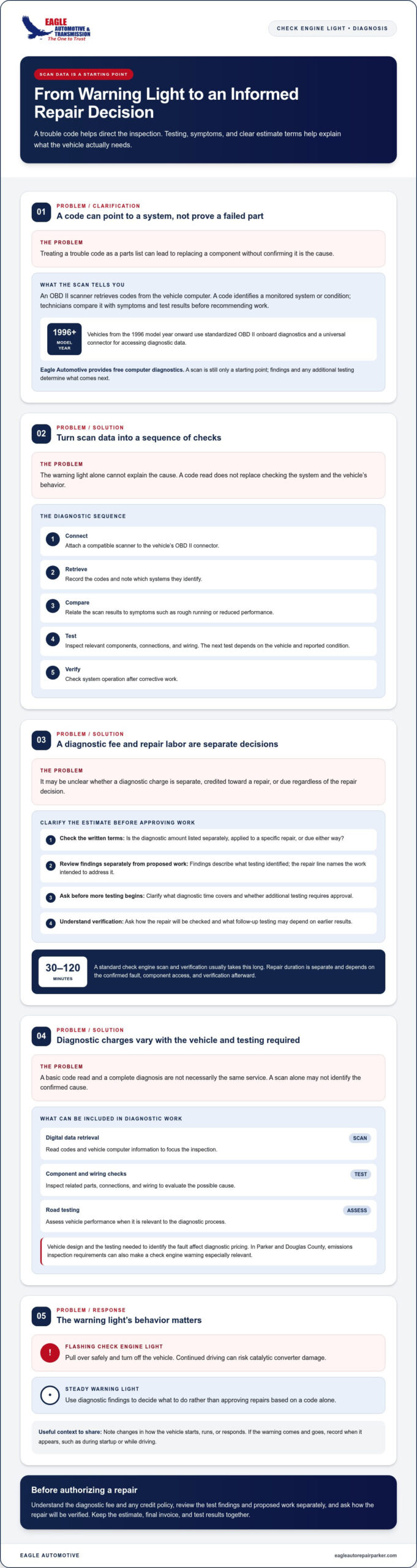
The cost to diagnose a check engine light in Parker, CO depends on the vehicle and the testing needed to identify the cause. Eagle Automotive provides free computer diagnostics, but a scan is only a starting point: the findings and any additional testing determine what comes next. Diagnosis and repair are separate decisions, so review the results before authorizing work.
A dashboard warning raises immediate questions: Is the problem urgent? Is a repair simple, or does the vehicle need closer attention? The light alone can’t answer those questions, and replacing parts based on a guess can lead you in the wrong direction. Note changes in how the vehicle starts, runs, or responds, and share them when arranging diagnosis.
This guide explains how technicians interpret scan results, what can affect diagnostic charges, and how to understand whether a fee applies to approved repairs. You’ll also learn what a diagnostic process can include and which practical questions to ask about an estimate. The goal is a clear path from warning light to informed repair decision, without mistaking a code read for a confirmed fix.
Key Takeaways
- Learn what to clarify about a diagnostic charge before authorizing repair work.
- See how technicians combine vehicle data with component and wiring tests to narrow down a fault.
- Understand why diagnostic labor can vary with vehicle design and the testing required.
- Find out how Douglas County emissions testing may affect the next steps for some vehicles.
Whether diagnostic fees are applied to repairs
A diagnostic fee covers finding the cause; repair labor covers correcting it. Whether the diagnostic charge is credited toward a repair depends on the estimate’s written terms. Before approving work, check whether the diagnostic amount is listed separately, applied to a specific repair, or due regardless of your repair decision.
Ask for the findings and proposed work as separate parts of the estimate. The findings should describe what testing identified, while the repair line should name the work needed to address it. A code by itself does not prove that a particular component has failed. For example, an oxygen-sensor-related code needs supporting checks before the sensor is confirmed as the cause.
When recommendations include several repairs, ask which one addresses the primary fault and what follow-up testing will show. That helps you understand whether additional work is necessary now or depends on the results of an earlier repair. Clear estimates make it easier to compare repair options and avoid authorizing work that the diagnostic findings do not support. Keeping these cost-conscious repair considerations in mind can help you evaluate the estimate at Eagle Automotive without treating the lowest total as the only factor.
Diagnostic time and repair time are different. A standard check engine scan and verification usually takes 30 to 120 minutes, while repair duration depends on the confirmed fault, component access, and any verification afterward. Ask the shop to explain what the diagnostic time covers and whether additional testing would require approval before it begins.
Repair expense depends on the parts and labor involved, so diagnosis alone cannot establish the final repair total. Correcting a gas cap issue differs from replacing an oxygen sensor or ignition coil. Catalytic converter replacement or substantial engine work can involve more extensive parts and labor. Review each estimate line item and ask how the recommended repair relates to the test results.
Warranty coverage is a separate question. Read the written repair terms for covered parts and labor, the coverage period, exclusions, and how to report a recurring concern. Don’t assume the diagnostic charge itself is covered or credited. Keep the estimate, final invoice, and test results together so you can compare the authorized work with what was completed.
If the check engine light is flashing, pull over safely and turn off the vehicle; continued driving can risk catalytic converter damage. For a steady warning, use the diagnostic findings to decide what to do rather than approving repairs based on a code alone. Before signing, make sure you understand the fee, any credit policy, the proposed work, and how the repair will be verified.
Diagnostic equipment and trouble codes
An OBD II scanner connects to a vehicle’s onboard computer through its diagnostic connector and retrieves trouble codes. For vehicles from the 1996 model year onward, automakers standardized onboard computers under OBD II, which requires a universal connector for accessing diagnostic data.
The scanner provides a starting point for inspection, not a complete repair instruction. Many diagnostic trouble codes can trigger a check engine light. Each code points to a monitored system or condition, so technicians consider the vehicle’s symptoms and test results to understand what it means in practice.
For example, an engine-performance code may lead technicians to assess how the engine runs and whether related systems respond as expected. An exhaust-related code calls for attention to exhaust components and their signals. The code helps focus the work, but the next test depends on the vehicle and the reported condition.
A useful diagnostic process turns scan data into a reasoned sequence of checks:
- Connect: Attach a compatible scanner to the vehicle’s OBD II connector.
- Retrieve: Record the codes and note which systems they identify.
- Compare: Relate those results to symptoms such as rough running or reduced performance.
- Test: Inspect the related components, connections, and wiring.
- Verify: Check system operation after corrective work.
This process matters because engine diagnostics can reveal concerns involving the engine, transmission, exhaust system, brakes, coolant, or overall vehicle performance. A dashboard warning may originate in one of these areas, and a scan tool helps direct attention. It does not replace testing the system itself.
When discussing findings, ask which system the code identifies and what inspection followed. For instance, if the scan points toward the exhaust system, ask which test linked the warning to the recommended repair. A clear explanation distinguishes the code’s direction from evidence gathered during hands-on testing.
Keep a record of the exact code and any symptoms you notice. If a warning comes and goes, note when it appears, such as during startup or while driving. This context can help technicians reproduce the condition and choose relevant checks. The goal is to understand how scan results relate to the vehicle’s actual behavior, not to treat a code as a parts list.
Diagnostic fees and price variation in Parker and Douglas County
Diagnostic prices vary with vehicle design and the testing needed to identify the fault. In Parker and Douglas County, emissions inspection requirements can also make a check engine warning especially relevant.
Typical Check Engine Diagnostic Prices
A professional diagnostic service covers more than reading a stored code. It may include digital data retrieval, physical checks of components and wiring, and road testing to assess performance. A basic code read and a complete diagnosis are different services, so compare what each estimate includes.
Look for a clear separation between diagnostic labor and proposed repairs. Ask whether the estimate covers only code retrieval or also the tests needed to trace the cause. This distinction matters because the same illuminated warning can come from different components, each requiring a different inspection.
Price Variation in Parker and Douglas County
Vehicle make and model, access to systems, and fault complexity can change the amount of diagnostic work. A code with a straightforward test path differs from an intermittent electrical problem that requires more tracing. Your diagnostic price depends on the vehicle, the system involved, and the testing needed; the exact amount should appear in a quote for your case.
Douglas County emissions inspections add a practical local consideration. Vehicles between 8 and 11 model years old are subject to a biennial OBD-II inspection through Air Care Colorado, while vehicles in their first seven model years are exempt from that inspection. A vehicle that fails because its check engine light is lit does not pass.
Free Scans at Nearby Auto Parts Stores
Don’t assume a scan at a parts store is free. A store may charge for a code read, and the scan itself is not a full diagnosis. Ask what the scan includes before agreeing, then distinguish code retrieval from physical testing and verification.
A code reader can show which system reported a fault, but it can’t explain why the problem occurred. For example, an emissions-related code may identify a system without confirming which component has failed. A technician needs to connect the code with inspection results before recommending repairs.
Factors Affecting Diagnostic Costs
Diagnostic cost depends on the vehicle’s computer system, access to affected components, and whether the fault appears consistently. A steady fault may be easier to reproduce than an intermittent issue that disappears during testing. Wiring condition and related symptoms can also determine how much inspection is needed.
Ask what the estimate includes: data retrieval, component testing, wiring inspection, and road testing. Then check whether the diagnostic charge is separate from repair labor. If the light is flashing, an active misfire can risk catalytic converter damage if you keep driving; pull over safely and turn off the vehicle.
Digital retrieval and analysis of vehicle computer data
For vehicles from the 1996 model year onward, OBD II provides a standardized way to access onboard computer data. A complete diagnosis uses that information alongside physical tests and vehicle behavior.
Gasoline and Diesel Vehicle Diagnostics
Gasoline and diesel vehicles both rely on onboard computers, sensors, and diagnostic data. The codes help identify which system needs attention, but they don’t confirm a failed component. Technicians interpret the code alongside the specific vehicle’s symptoms, then select tests suited to the system involved.
For example, a sensor-related code calls for checking its signal and related wiring, not automatically replacing the sensor. A rough-running engine or a warning that appears only while driving gives technicians additional clues. These clues help direct inspection toward the affected circuit or component rather than relying on the code alone.
What a Professional Diagnostic Includes
A thorough check engine light diagnosis can include digital data retrieval, physical component testing, wiring inspection, and road testing to assess performance. The sequence helps connect an onboard computer alert with a fault technicians can observe or measure. Each step adds evidence for identifying the cause and determining an appropriate repair.
Vehicle design can change the diagnostic process. A 2026 Honda Civic and a 2026 Volkswagen GTI may require different test procedures because their systems and component access differ. The model, fault location, and testing needed affect the time and work involved, so compare estimates by their included steps rather than treating every scan as equivalent.
Start with stored computer data, then compare it with current symptoms and sensor readings. Next, inspect related components and wiring for a physical cause. If the issue depends on driving conditions, a road test can help reproduce it and assess performance after corrective work.
OBD II requires a universal connector for accessing diagnostic data, but that standard connection doesn’t make every diagnosis identical. A code points to a system, while vehicle design determines which tests can confirm the fault. Ask which data and inspection steps support the conclusion, especially if the problem appears intermittently.
The diagnostic result should explain the fault in plain terms and connect it to test findings. It should also distinguish a confirmed cause from a code that merely identifies a system. That explanation gives drivers a clear basis for considering repair options without mistaking computer data for a complete diagnosis.
Check engine diagnostic cost
The diagnostic charge reflects the work needed to identify a fault, not simply the warning displayed on the dashboard. A scan retrieves signals, but additional testing may be needed to confirm why the check engine light appeared. Compare estimates by their diagnostic steps, not just their labels.
An oxygen-sensor-related code, for example, doesn’t automatically prove that the sensor has failed. Technicians may need to inspect its wiring, compare readings, and check related engine conditions. The charge can reflect that hands-on work, especially when a code has several possible causes.
Ask whether the estimate includes only code retrieval or a broader diagnosis. A thorough process may involve computer data, component testing, wiring inspection, and a road test. Each added test helps narrow the cause, but the actual scope depends on the warning and the vehicle’s symptoms.
Vehicle design matters, too. Accessing a sensor or tracing a circuit can involve different steps across makes and models. A fault that appears under certain driving conditions may also require technicians to reproduce those conditions before confirming the source.
Consider an oxygen-related warning. The sensor may be faulty, but an exhaust leak or wiring problem can also affect its signal. Replacing a component before testing may not resolve the warning, which is why an estimate should connect recommended work with diagnostic findings.
Intermittent problems can require more investigation than a fault that remains present. For example, a loose electrical connection may behave normally during one inspection and fail later. Technicians may need to examine connections and compare data while the vehicle operates under the conditions linked to the warning.
The repair itself is separate from diagnosis. A loose gas cap may need a simple correction, while a confirmed misfire can involve ignition components and further checks. If the warning flashes, continued driving can risk catalytic converter damage, so pull over safely and turn off the engine.
Use the estimate to understand what happens next. It should state the diagnostic work, suspected cause, and any proposed repair as distinct items. That breakdown helps you see whether a repair follows confirmed testing or is still a recommendation for further investigation.
Ask how the technician will verify the result after repairs. Clearing a warning without checking the original concern doesn’t establish that the fault is fixed. Follow-up testing should assess the affected system and confirm whether the warning or related symptom remains.
For your case, the quoted amount depends on the vehicle, the fault, and the testing required. Review the diagnostic scope before approving work, then compare any repair recommendation with the supporting evidence. A clear estimate makes the next decision easier to understand.
Eagle Automotive: Check Engine Light
Eagle Automotive provides Check Engine Light diagnosis when a warning needs more than a code read, along with free computer diagnostics. Its Engine Repair & Service can address engine faults identified during testing.
Bring the vehicle in when the light stays on, returns after a scan, or appears with rough running or reduced performance. If the light flashes, pull over safely and turn off the engine because continued driving can risk catalytic converter damage.
Clear test findings help distinguish an engine problem from a fault involving another system. Once the cause is identified, you can review the repair recommendation and decide how to proceed. Contact Eagle Automotive in Parker or visit eagleautorepairparker.com to take the next step.
Take the Next Step With a Clear Diagnostic Plan
Before approving work, note when the warning appears, how the vehicle behaves, and any recent changes. Those details give the technician useful context and help focus the inspection. The cost to diagnose a check engine light in Parker, CO depends on the vehicle and the testing needed, so look for a quote that clearly separates diagnosis from proposed repairs.
Eagle Automotive provides Check Engine Light diagnosis and Engine Repair & Service to help drivers move from a warning signal to a repair decision, with free computer diagnostics. Brake Repair is also available if inspection points to a brake concern. Bring your symptoms and any scan results so the discussion can start with what your vehicle is actually doing.
Take the next step with a clear description of the warning and its symptoms. Contact Eagle Automotive about diagnostics and move forward with a practical plan for your vehicle.
Frequently Asked Questions
Is it safe to drive with the check engine light on in Parker?
It depends on the light and how the vehicle behaves. A steady light signals a problem that needs attention, so arrange diagnosis rather than ignoring it. If the light flashes, pull over safely and turn off the engine because continued driving can risk catalytic converter damage. Don’t rely on the dashboard light alone to judge whether the vehicle can continue its trip.
How Much Does a Check Engine Diagnostic Usually Cost?
There isn’t one diagnostic amount that fits every vehicle and fault. A code read differs from a diagnosis that includes component testing, wiring checks, or reproducing a problem while driving. Compare estimates by the work they cover, not just by the phrase “check engine diagnostic.” Vehicle design and the steps needed to identify the cause shape the quoted amount.
Is the Diagnostic Fee Applied to the Repair?
That depends on the estimate’s terms. Check whether it lists diagnosis as a separate charge or says the charge will be credited toward approved repairs. Keep the estimate and final invoice together, then compare their line items. This helps you see whether diagnostic work and repair labor were billed separately as agreed.
What is the average cost to diagnose a check engine light in Parker, CO?
An average may not predict the quote for your vehicle, since diagnostic scope varies. To compare estimates, check whether each includes only a computer scan or also component testing, wiring inspection, and verification. A vehicle-specific quote is more useful than a broad average because it identifies the work planned for that warning and its symptoms.
Do auto repair shops in Parker charge a diagnostic fee, and how much?
Diagnostic policies and quoted amounts vary by shop and the work included. Eagle Automotive provides free computer diagnostics. A computer read and a complete investigation are not automatically the same scope, so review the estimate to see which diagnostic steps it covers and whether additional testing is listed separately.
How much does an OBD-II code scan cost in Parker, CO?
The scan retrieves a trouble code that points to a system, not necessarily a failed part or root cause. If you use a code reader, record the exact code and any dashboard message. Share those details during diagnosis instead of replacing a component based only on the code.
Does the diagnostic fee apply toward repairs at Parker auto shops?
There’s no automatic rule that a diagnostic charge becomes repair credit. The written estimate should state whether the fee is separate or applied when you approve the work. Before authorizing repairs, compare the estimate with the completed invoice and confirm that any promised credit appears. This simple paperwork check helps prevent confusion about what you approved.
How much do common check engine light repairs cost in Parker, CO?
Repair totals depend on the failed part, labor involved, and any testing needed to confirm the cause. A gas cap issue differs from replacing an oxygen sensor, ignition coil, or catalytic converter. Ask for an itemized estimate that identifies the recommended repair and its labor separately. That breakdown helps you understand what diagnosis found without treating a trouble code as a parts list.