

Causes and Fixes for a Car Losing Power When Accelerating in Parker
Power loss under acceleration is a warning sign, not a quirk to ignore. A fix for a car losing power when accelerating in Parker starts with identifying whether fuel delivery, ignition, engine sensors, or exhaust flow is disrupting performance. The symptoms can help narrow down what needs attention.
It’s frustrating when you press the accelerator and the car hesitates, surges, or struggles to gain speed. Learn the common causes, what symptoms to watch for, and how a mechanic can trace the fault instead of guessing at parts. We’ll also explain what to do if power drops suddenly and why a flashing check-engine light or repeated stalling calls for prompt attention.
Key Takeaways
- Power loss can stem from restricted fuel flow, weak fuel delivery, or injectors that aren’t supplying the engine properly.
- Pay attention to when the hesitation occurs and whether it comes with stalling, unusual sounds, or recurring warning lights.
- Sensor or engine-control faults can affect fuel mixture and timing; diagnostic codes help narrow down where to inspect.
- An exhaust restriction can limit engine performance, so persistent loss of power needs a proper diagnosis rather than a guessed parts replacement.
- If the power drop is sudden, ease off the accelerator and move to a safe place; treat a flashing check-engine light as a prompt to limit driving and seek diagnostics.
1. Clogged fuel filters, failing fuel pumps, and faulty injectors
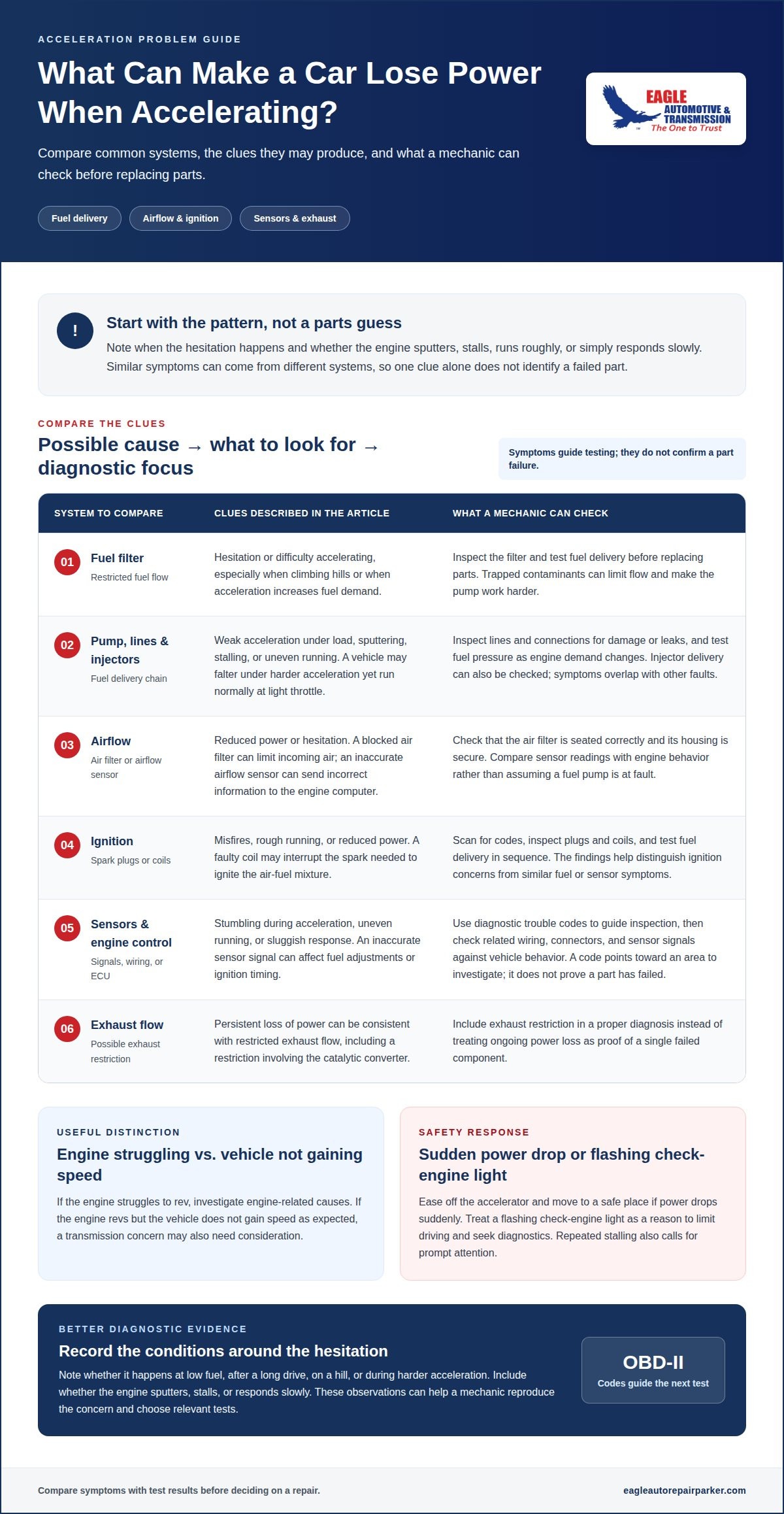
A clogged fuel filter can restrict the gasoline reaching the engine, especially when acceleration increases fuel demand. The filter keeps dirt and debris out of the fuel system, but trapped contaminants can limit flow over time and make the pump work harder. If the vehicle hesitates on hills or struggles to accelerate, a mechanic can inspect the filter and test fuel delivery before replacing parts.
A failing fuel pump may not deliver enough fuel for the engine to maintain power under load. Faulty fuel injectors can cause similar symptoms: they spray fuel into the engine, where it must mix with air for combustion. An injector delivering fuel unevenly can contribute to rough running or weak acceleration. These symptoms overlap with ignition and sensor faults, so they don’t identify the failed component by themselves.
An OBD-II scanner retrieves diagnostic trouble codes that may point toward fuel, ignition, or sensor problems. A code helps guide the next test, but it doesn’t prove that the named part has failed. A mechanic can compare the code with the vehicle’s symptoms and inspect the related wiring or system as part of a thorough engine and drivetrain diagnostic process. If the engine revs but the vehicle doesn’t gain speed as expected, a transmission concern may also need consideration. That behavior differs from an engine that struggles to rev.
Airflow matters too. A blocked air filter can limit air entering the engine, while a faulty airflow sensor can send inaccurate information to the engine computer. If power loss starts after an air-filter inspection or replacement, check that the filter is seated correctly and its housing is secure. A technician at Eagle Automotive can then compare sensor readings with engine behavior instead of assuming every hesitation means a failing fuel pump.
Ignition faults can also interrupt combustion. Spark plugs ignite the air-fuel mixture, while ignition coils provide the electrical charge needed to create that spark. A faulty coil may cause misfires and reduced power. A mechanic can scan for codes, inspect plugs and coils, and test fuel delivery in sequence. Injector work is technical, so it should be handled by a qualified professional at Eagle Automotive rather than attempted as a guesswork repair.
2. Fuel delivery problems
Fuel delivery is a chain, not a single part. Fuel moves from the tank through lines and a filter before the pump supplies it to the engine. A restriction, leak, electrical interruption, or weak pump can affect that path. The same car may accelerate normally at light throttle yet falter climbing a grade because the engine needs more fuel under load. That change is useful diagnostic evidence, not proof of one failed component.
Start by noting the conditions around the hesitation. Does it happen with a low fuel level, after a long drive, or only during harder acceleration? Record whether the engine sputters, stalls, or simply responds slowly. These observations help a mechanic reproduce the concern and check the fuel system under similar conditions. Avoid repeatedly pressing the throttle to force a response, especially if power loss is severe.
A mechanic can inspect fuel lines and connections for visible damage or leaks, then test whether fuel pressure remains suitable as engine demand changes. A pressure reading taken only while the vehicle is stationary may not explain a stumble that happens on the road. Testing under the conditions that trigger the symptom can help distinguish a delivery fault from a throttle or ignition concern.
Fuel quality and contamination can also affect engine operation. If hesitation began soon after refueling, note where and when the vehicle was filled, then share that detail during diagnosis. Don’t drain the tank or add random treatments based on a guess. A mechanic can inspect the fuel and delivery system before deciding whether contaminated fuel, a restriction, or another fault best fits the evidence.
Air, fuel, and compression must work together for the engine to produce power. A fuel problem may feel like restricted airflow or weak ignition, so the full set of symptoms matters. A vehicle that stumbles only under load gives the mechanic a different starting point from one that runs poorly at idle. Compare its behavior at startup, at idle, and during acceleration, without attempting a risky road test.
When choosing a mechanic for acceleration problems in Parker, Colorado, look for a clear explanation of the diagnostic steps and how test results support the recommended repair. Share your notes about when the symptom occurs, and ask how fuel delivery will be evaluated alongside other possible causes. That discussion helps you understand the diagnosis before authorizing parts replacement.
3. Engine control unit and sensor problems
The engine control unit, or ECU, coordinates engine operation using information from sensors. It adjusts fuel injection and ignition timing as driving conditions change. If a sensor signal is inaccurate, the ECU may make corrections that reduce smooth power delivery. A fault in the ECU itself can also disrupt those commands, although wiring, connectors, or a failing sensor can cause similar symptoms.
A camshaft position sensor reports camshaft-speed information to the engine control module, which uses that signal to manage fuel injection and timing. If the signal becomes intermittent, the engine may stumble during acceleration or run unevenly as conditions change. A technician can inspect the connector and wiring, then compare the sensor signal with engine behavior before deciding whether replacement is appropriate.
The oxygen sensor is usually located in the exhaust system. It measures exhaust gases so the engine control module can determine the engine’s real-time air-to-fuel ratio. A faulty reading can lead to incorrect fuel adjustments and sluggish response. If a warning light appears alongside inconsistent acceleration, the sensor circuit may need testing. A code related to that circuit does not, by itself, prove the sensor has failed.
Some vehicles enter limp mode after the control system detects a problem affecting engine operation. The vehicle may limit throttle response or power, making acceleration feel unusually weak. Note whether the reduced response starts suddenly, follows a warning light, or continues after restarting. That timeline helps a mechanic understand the fault without treating limp mode as a diagnosis on its own.
Intermittent electrical faults can be harder to find than a sensor that has stopped working completely. A loose connector may behave differently as the engine moves, while damaged wiring can interrupt a signal during vibration or heat. A mechanic can examine the wiring harness and connection points, then compare stored codes with live sensor readings. Those checks help distinguish a faulty sensor from a circuit or ECU concern.
Keep a record of which warning lights appear and when acceleration changes. Include whether the engine starts normally, idles smoothly, or loses power only while driving. These details help direct testing toward the camshaft signal, oxygen sensor circuit, or another control input. If an ECU-related issue continues after restarting, arrange an inspection rather than repeatedly cycling the ignition.
A sound diagnostic process checks the fault before replacing electronic parts. A mechanic can retrieve codes, inspect the affected circuit, and verify that the ECU receives plausible sensor information. If wiring and sensor signals are sound, further testing can focus on the control unit. This step-by-step approach helps avoid replacing a sensor when a damaged connector is causing the same warning.
4. Exhaust restrictions and catalytic converters
A blocked or damaged exhaust can cause a vehicle to lose power immediately. Exhaust gases need a clear route away from the engine; a restriction makes that route harder to use. A catalytic converter, crushed pipe, or damaged muffler may be part of the problem. The result can feel like sluggish acceleration, especially when the engine needs to work harder. That loss of power is frustrating, but the symptom alone doesn’t identify which exhaust component is restricted.
A catalytic converter helps treat exhaust gases before they leave the vehicle. If its internal passage becomes restricted or damaged, exhaust flow can be limited and the engine may struggle to build power as you press the throttle. A warning light or unusual exhaust smell may provide additional clues, but neither confirms a blocked converter. A mechanic can consider diagnostic codes alongside the vehicle’s symptoms.
Look for external damage as well. A crushed exhaust pipe or a section bent underneath the vehicle can narrow the passage. Loose or damaged exhaust components may also create unusual noise. Note where the sound comes from and whether power loss began after an impact or repair. Those details help narrow the inspection without assuming the catalytic converter is at fault.
Air intake restrictions can cause similar acceleration trouble, even though they occur before combustion rather than after it. A blocked intake path or an air filter packed with debris can limit airflow into the engine. Check that the intake opening is clear and the filter is seated correctly. Restricted airflow can affect engine operation; restricted exhaust flow can prevent spent gases from leaving freely. Both systems need consideration when several causes could explain the same symptom.
A practical diagnostic process starts with a visual inspection of the exhaust, from the engine toward the tailpipe. A mechanic can look for crushed sections, damaged joints, or a visibly compromised converter. Diagnostic codes and engine behavior can then show whether further testing is needed. A code may point toward an exhaust-related system, but it doesn’t establish that the converter itself has failed. Testing should distinguish an exhaust restriction from ignition or fuel delivery faults that cause similar power loss.
The repair depends on the failed part. A damaged pipe may require repair or replacement, while a confirmed converter restriction calls for addressing that component and its cause. Replacing parts before testing can leave the original problem unresolved. Record when the vehicle loses power, any new exhaust noise, and whether the check-engine light appears. That specific information gives the mechanic a useful starting point.
5. Warning signs and check-engine lights
A check-engine light can appear with power loss, but it doesn’t identify the failed part by itself. A steady light paired with mild hesitation still deserves attention, especially if the symptom returns during acceleration. Note when the warning appears, how the engine responds, and whether anything else changes. Those details help a mechanic connect the warning with the vehicle’s behavior instead of replacing a component based on the light alone.
A flashing check-engine light calls for more urgent action. It often signals a severe engine misfire, which can damage the catalytic converter. Limit driving and seek diagnostics immediately. If the engine shakes, runs roughly, or loses power sharply while the light flashes, move off the road when safe rather than continuing a normal trip.
Sudden power loss can make it harder to keep pace with traffic. Ease off the accelerator, move to a safe area if possible, and turn on the hazard lights. Stop when it’s safe to do so. Don’t force the vehicle to accelerate through the fault; a sudden stall or worsening power loss can make driving unsafe.
Persistent or severe power loss, stalling, unusual noises, recurring warning lights, or unsafe handling all warrant professional attention. A new loud pop or bang from the rear may indicate exhaust backfiring. Have it checked promptly because continued operation could lead to more serious damage. Note whether the noise happens during acceleration, deceleration, or startup.
Chugging is another clue. Worn spark plugs can cause rough running and keep the engine from functioning properly. Misfires may also arise from ignition components, fuel delivery, or sensor faults, so chugging alone doesn’t prove the plugs need replacement. A diagnostic scan and inspection can help distinguish these causes before parts are changed.
Pay attention to how several signs occur together. A flashing light, engine shaking, and a sharp drop in power call for a different level of urgency than a steady light with occasional hesitation. Record the warning-light behavior, sounds, and conditions, such as climbing a hill or accelerating from a stop. Share those details during diagnosis.
A technician can retrieve diagnostic codes and test the systems they indicate. Codes help narrow the search, but they don’t prove that a sensor, ignition part, or catalytic converter is faulty. If warning lights recur or the vehicle stalls, arrange prompt diagnostics. If driving feels unsafe, stop in a safe place and avoid continuing the trip.
Eagle Automotive: Check Engine Light
Eagle Automotive in Parker can investigate power loss when a check-engine light appears or acceleration trouble continues. The shop provides free computer diagnostics to help identify what may be triggering the warning, along with Engine Repair & Service for problems found during diagnosis.
Turn to a mechanic if the light returns, the engine runs roughly, or the vehicle struggles to accelerate. Share when the symptom happens and whether the warning light is steady or flashing. Those details give the diagnostic process a useful starting point and help distinguish an engine concern from an issue in another system.
For recurring warning lights or ongoing acceleration problems, contact Eagle Automotive in Parker to discuss the next step.
Take the Next Step Toward Reliable Acceleration
A practical fix for a car losing power when accelerating in Parker starts with a clear diagnosis, not a guess about which part to replace. Before your next drive, consider whether the vehicle feels safe and dependable enough for the trip. If power loss is severe or driving feels unsafe, don’t continue driving it.
Bring the symptoms and any diagnostic findings to the conversation. That gives the mechanic a useful starting point and helps you understand which repair addresses the underlying problem. Eagle Automotive provides free computer diagnostics and can help you move from uncertainty toward a clear repair plan.
Contact Eagle Automotive for help and take the next step toward getting back on the road with confidence.
Frequently Asked Questions
What causes a loss of power in a car?
A loss of power usually means the engine or drivetrain isn’t delivering the expected force to the wheels. Common systems to investigate include fuel supply, ignition, airflow, sensors, and exhaust flow. An engine that stumbles suggests a different diagnostic path from one that revs freely while the vehicle barely accelerates. Note the sound, warning lights, and driving conditions to help narrow the cause.
Why Address It Fast?
Address power loss promptly because a worsening fault could leave you unable to accelerate when traffic conditions change. A flashing check-engine light paired with rough running calls for immediate diagnostics, since a severe misfire can damage the catalytic converter. If the vehicle stalls, loses power sharply, or feels unsafe, ease off the accelerator and pull over somewhere safe before arranging help.
Why Is My Car Chugging and Losing Power?
Chugging with weak acceleration often means the engine isn’t producing smooth combustion. Worn spark plugs, a faulty ignition coil, uneven fuel delivery, or inaccurate sensor readings can each disrupt engine operation. Notice whether chugging happens at idle, only under acceleration, or while climbing a hill. That pattern, along with any warning light, helps a mechanic choose relevant tests instead of replacing parts based on sound alone.
What causes a car to lose power when accelerating?
Acceleration increases the engine’s demand for fuel, air, and reliable ignition, so a fault in any of those systems can become more noticeable under throttle. A restricted intake, weak fuel supply, misfire, or exhaust blockage may limit response. If the engine revs but road speed doesn’t rise in step, note that difference too. It can help distinguish an engine performance issue from a transmission concern.
What warning signs indicate a serious engine or transmission problem?
Take stalling, severe or repeated power loss, unusual banging or popping, and a flashing check-engine light seriously. Transmission clues include delayed engagement, slipping, or a noticeable mismatch between engine revs and vehicle speed. A single symptom doesn’t identify the failed part, but several changes appearing together are useful diagnostic details. If the vehicle feels unsafe or can’t move predictably, stop in a safe location.
How can I diagnose a car that loses power when accelerating?
Start by recording what happens: engine temperature, road conditions, warning-light behavior, and whether the issue occurs from a stop or during a hill climb. An OBD-II scan can retrieve stored trouble codes, while a mechanic can compare those codes with inspection and test results. Eagle Automotive in Parker provides free computer diagnostics and Engine Repair & Service for drivers dealing with warning lights or ongoing engine trouble.
Can a clogged fuel filter or failing fuel pump cause power loss under acceleration?
Yes. A restricted fuel filter or weak pump can limit fuel reaching the engine when acceleration increases demand. The same hesitation can also come from a blocked line, electrical fault, or ignition problem, so the symptom doesn’t prove the pump has failed. A useful diagnostic approach checks fuel delivery and related connections before replacing parts. Note whether power loss appears mainly under load, such as while climbing a grade.
Can a dirty MAF sensor, clogged air filter, or vacuum leak cause sluggish acceleration?
Yes. A dirty air filter can restrict intake flow, while a faulty mass airflow sensor may report inaccurate measurements to the engine computer. A cracked intake hose or loose clamp can also create an air leak after the sensor. Check that the airbox closes securely and the hoses remain attached. If sluggish acceleration continues, a mechanic can inspect intake connections and sensor readings before recommending a repair.