

Jeep Suspension Repair: Symptoms, Repair Options, and What to Expect
A rougher ride doesn’t automatically mean your Jeep needs a full suspension overhaul. A clunk, uneven tire wear, or wandering steering can have several possible causes, so replacing parts based on one symptom may not solve the problem. Good jeep suspension repair starts with an inspection, not a guess.
If you’re in Parker, Eagle Automotive provides steering and suspension inspection and repair for Jeeps and other makes and models. This guide explains what to watch for, how suspension components affect ride and handling, and what to ask about repair recommendations.
Key Takeaways
- Changes in ride, handling, tire wear, or noise can signal suspension trouble, but no single symptom identifies the failed part.
- Suspension components work together, so inspection findings should guide the repair plan.
- Jeep suspension repair may involve repairing a specific issue or replacing a worn or damaged component.
- Before an inspection, note what you’ve noticed and when it happens instead of trying to diagnose the part yourself.
- Eagle Automotive provides steering and suspension inspection, service, and component replacement for Jeeps in Parker.
Jeep Suspension Repair: Signs Your Ride Needs Attention
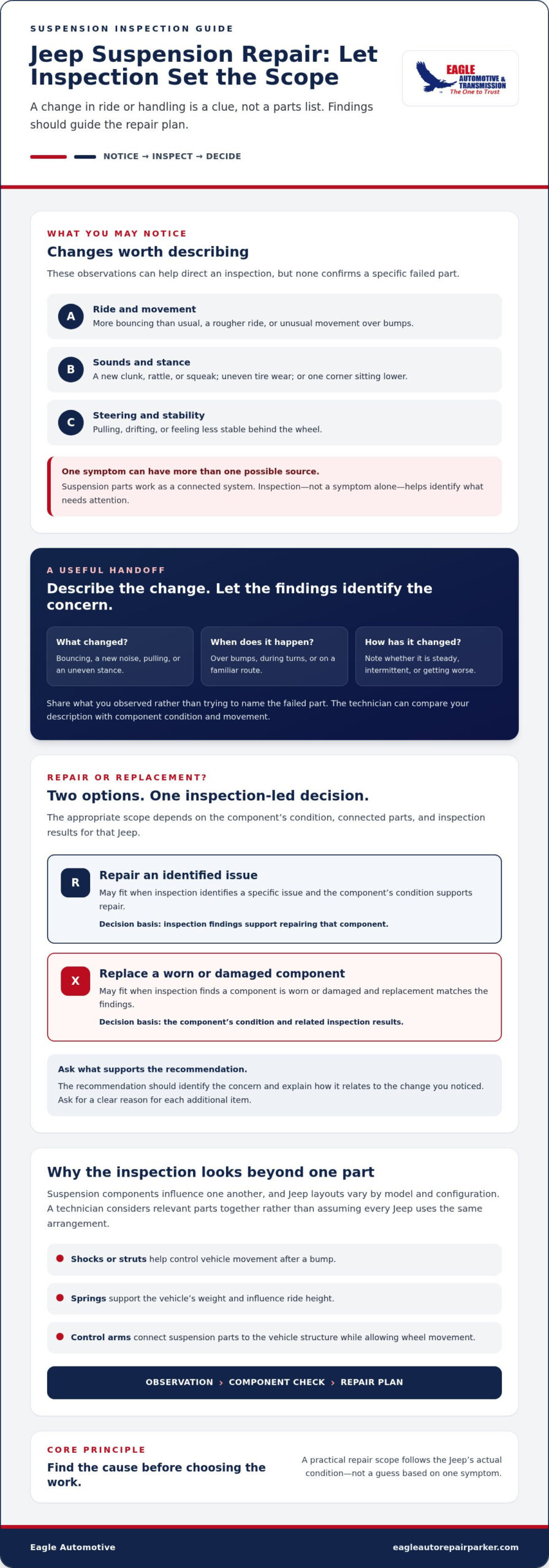
A change in ride or handling can point to worn or damaged suspension components, but inspection is needed to identify the cause. Your Jeep may bounce more than usual, feel rough over bumps, make a new clunking sound, show uneven tire wear, or sit lower at one corner. Each observation is useful, but none proves a specific part has failed.
A noise or steering change can have more than one possible source, and the suspension works alongside other vehicle systems. Replacing a part based on a symptom alone may miss the actual problem. An inspection compares what you notice with the condition and movement of relevant components.
What suspension symptoms might Jeep owners notice?
Pay attention to how the Jeep responds after a bump. Repeated bouncing, a rougher ride, or unusual movement may be worth checking. Clunks, rattles, or squeaks can also be clues, though sounds can come from different parts and may be difficult to pinpoint while driving.
When parked on level ground, look for uneven tire wear or a visible difference in ride height from one corner to another. These are observations to share during an inspection, not proof of a particular failure. Jeep designs have evolved over time; the Jeep Wrangler suspension history and design provides context on how suspension layouts have changed. Your Jeep’s specific setup and condition still need to be assessed individually.
When should a change in handling be checked?
Pulling, drifting, or feeling less stable behind the wheel deserves attention, especially if the change is new or getting worse. These sensations may involve the suspension or other systems, so steering feel alone cannot identify the cause. The same is true of tire wear and unfamiliar noises: they help describe the concern, but don’t complete the diagnosis.
If control feels affected, arrange a prompt professional assessment rather than waiting for the symptom to become more pronounced. Before the inspection, note:
- What changed, such as bouncing, a new noise, pulling, or uneven stance.
- When it happens, such as over bumps, during turns, or on a familiar route.
- Whether the symptom is steady, intermittent, or worsening.
Share what you’ve observed rather than trying to name the failed part. Those details give the technician a useful starting point. An inspection-led approach at Eagle Automotive helps connect a driving change to a practical next step instead of relying on guesswork.
How Jeep Suspension Components Affect Diagnosis and Repair
A Jeep’s suspension is a group of connected parts that supports the vehicle and helps its tires stay in contact with the road over bumps and uneven surfaces. The exact arrangement varies by model and configuration, so one Jeep’s components or specifications shouldn’t be assumed to match another’s.
Suspension parts work as a connected system, so a symptom is a clue, not a parts list. A technician considers the condition and movement of relevant components together, then compares the findings with what you’ve noticed behind the wheel. This helps determine which parts need attention and whether related components should also be assessed.
What do shocks, springs, and control arms do?
Shocks or struts help control vehicle movement after a bump, reducing continued bouncing. Springs support the vehicle’s weight and influence ride height. Control arms connect parts of the suspension to the vehicle structure while allowing movement as the wheels travel over the road. Their design and arrangement can vary across Jeep models.
These parts affect one another. A change in ride height, for example, can make it useful to inspect the springs and nearby components. Unusual movement over bumps may lead a technician to assess how the damping components are performing. These are directions for inspection, not diagnoses. A visible change or driving sensation alone can’t confirm which part is worn or damaged.
Suspension design involves tradeoffs among vehicle movement, control, and intended use. SAE International’s automotive engineering resources provide broader technical context on vehicle design and performance. For a specific Jeep, the technician needs to evaluate its actual configuration and condition rather than assume every model uses identical parts.
Why can one symptom point to more than one component?
A clunk might lead an inspection toward several moving or connected parts. Uneven tire wear can have more than one possible explanation, and a rough ride may involve components beyond the shocks or struts. A technician compares your complaint with visible condition, component movement, and other related findings before recommending work.
A part that looks worn may not explain every symptom. A sound or handling change can direct attention to an area without proving a failure. The findings should support the repair decision, and the recommendation should identify the concern and explain how it relates to the change you noticed.
If your Jeep’s ride or control has changed, note what you’ve observed and have the suspension assessed. Eagle Automotive provides steering and suspension inspection and service in Parker. The diagnosis is the starting point for choosing the right scope of work, rather than replacing parts simply because they’re nearby.
Jeep Suspension Repair Options: Component Repair or Replacement?
After an inspection identifies a concern, the repair decision should match the findings. A specific issue may be addressed by repairing a component if its condition supports that approach. A worn or damaged part may instead need replacement. The appropriate scope depends on the component’s condition, the state of connected parts, and the inspection results for that Jeep.
Replacing more parts isn’t automatically the safer or more complete choice, and repair isn’t always appropriate. For jeep suspension repair, ask whether the proposed work addresses a confirmed condition and whether each additional item has a clear reason.
| Approach | When it may fit | What supports the decision |
|---|---|---|
| Repair an identified issue | The inspection identifies a serviceable concern and supports repairing it. | The component’s observed condition and whether the repair addresses the finding. |
| Replace a component | Findings show a part is worn or damaged and replacement is appropriate. | The part’s condition and the assessment of related components. |
When might a component repair be considered?
Repair may be an option if inspection identifies a specific issue and the component’s condition supports that work. It isn’t a universal fix for every part or type of damage. A sound recommendation explains what was observed, what the proposed repair addresses, and why that approach fits. If the findings don’t support repair, replacement may be more suitable.
When might replacement be recommended?
Replacement may be recommended when inspection shows that wear or damage makes repair unsuitable. That doesn’t automatically mean every nearby part needs replacement. Experienced full-service auto and truck facilities, such as ontopdieselauto.com, emphasize that related components should be evaluated individually, ensuring any additional work is tied directly to their observed condition rather than included by default.
Ask for a plain explanation of the finding, the proposed work, and why the scope addresses it. Automotive repair information and service resources are available through organizations such as NASTF, but the recommendation for your Jeep should be grounded in its inspection findings. A clear explanation helps you understand what needs attention and what doesn’t.
If you’re ready to move from a suspected problem to a repair decision, discuss your Jeep’s suspension concern and the findings behind the recommended work. A focused plan distinguishes repairable issues from parts that need replacement and gives you a reason for each item in the proposed scope.
Preparing for Jeep Suspension Repair in Parker, Colorado
A few practical notes can make your appointment more productive. Before arranging jeep suspension repair in Parker, recall how the change began and whether anything else about the Jeep’s use or condition changed around the same time. You don’t need to identify a part or explain the mechanics. A clear account of what you noticed gives the technician a useful starting point.
Use this simple preparation sequence:
- Describe the change in your own words. Note what feels or sounds different without labeling it as a failed component.
- Record the circumstances. Include when you first noticed it and whether it happens consistently or only under particular driving conditions.
- Gather relevant observations. Mention visible tire wear, an uneven stance, or any recent change in how the Jeep responds.
Keep your notes factual. “A knock over bumps” is more useful than guessing that a particular part is loose. If the change is getting worse or affecting your ability to control the Jeep, make that clear when arranging an assessment. A local Parker appointment lets you have the concern evaluated without trying to diagnose it yourself.
What information helps during a suspension inspection?
Patterns can help the technician focus the evaluation. Note whether a sound appears during turns, over bumps, or in another repeatable situation. If the symptom comes and goes, record the conditions you associate with it. Mention visible tire wear or a change in stance, too. These details help guide the assessment, but they are observations, not proof that a specific part has failed.
What happens after the technician evaluates the Jeep?
After evaluating the vehicle, the technician can explain what the findings indicate and how they relate to your concern. The assessment may identify a suspension issue or suggest that another system needs attention. Before authorizing work, make sure you understand the proposed scope, what each recommendation addresses, and how it follows from the findings.
If something is unclear, ask for the explanation in everyday language. You should understand what was observed and how the proposed work responds to it. To arrange an assessment, schedule a Jeep suspension evaluation and bring the observations you’ve collected.
Jeep Suspension Repair at Eagle Automotive in Parker
A Jeep that rides or handles differently needs a clear assessment, not a parts guess. Eagle Automotive is a Parker shop serving all makes and models, including Jeeps. The team provides steering and suspension inspection, service, and component replacement, with recommendations guided by the vehicle’s condition.
Tell the technician what changed and when you notice it, whether that’s a new sound, a rougher ride, or a shift in steering feel. Those details help direct the inspection, but they don’t establish a failed part. The findings do.
How Eagle Automotive helps assess Jeep suspension concerns
During an inspection, the vehicle’s condition is evaluated alongside the concern you describe. A symptom that feels like suspension trouble may involve another system, so the assessment considers evidence rather than assuming the first suspected cause is correct. Jeep models can differ in configuration, making the specific vehicle and its condition central to the recommendation.
Once the findings are understood, the proposed work can be explained in straightforward terms: what area or component needs attention, what the inspection revealed, and how the recommended service addresses it. If more than one component is included, each recommendation should have a reason tied to its condition. You don’t need to arrive knowing a part’s technical name. Clear observations are enough to begin.
What is a practical next step for a Jeep owner?
If you’re in Parker and have noticed a change in your Jeep’s ride, steering, or suspension, share those symptoms with Eagle Automotive and arrange an inspection. A useful repair conversation connects your concern with the inspection findings and explains the proposed scope. Eagle Automotive provides steering and suspension inspection, service, and component replacement for Jeeps and other makes and models.
Before moving ahead with recommended work, make sure you understand what the technician found and how the proposed repair responds to it. Ask for a plain-language explanation, especially if the plan includes related components. A sound jeep suspension repair decision starts with the diagnosis and follows the evidence.
Take the Next Step Toward a Confident Repair Decision
You don’t need to know which part is at fault before moving forward. Bring your observations and questions to the conversation, then let the inspection findings guide the repair plan. This helps tie recommended work to your Jeep’s actual condition.
If a change in ride or handling has you considering jeep suspension repair, start with a clear assessment. Contact Eagle Automotive to discuss your Jeep’s suspension concerns and arrange an inspection in Parker.
Frequently Asked Questions
What are the most common signs that a Jeep needs suspension repair?
Common signs include repeated bouncing after bumps, a rougher ride, a new clunk or rattle, pulling or drifting, uneven tire wear, or one corner sitting lower. These clues help describe a concern but don’t identify its cause. Tire wear, for example, can have several possible explanations. Have the Jeep inspected before choosing repair work.
Can I drive my Jeep if the suspension is making a clunking noise?
Whether it’s safe to drive depends on what’s causing the noise and whether the Jeep’s handling has changed. A clunk alone can’t establish the risk remotely. If steering feels unstable, the Jeep is difficult to control, or the sound is worsening, avoid unnecessary driving and arrange a prompt assessment. If you can’t maintain control, stop somewhere safe and seek assistance rather than continuing the trip.
How does a mechanic diagnose Jeep suspension problems?
A mechanic considers your description of the concern alongside visual and functional checks of relevant areas. They may look for visible wear or damage and assess component movement, then compare those findings with the symptoms. Details such as whether a noise appears during a turn can help focus the evaluation. The inspection findings, rather than one symptom, guide whether the suspension or another system needs attention.
Should Jeep suspension parts be repaired or replaced?
The inspection findings and the component’s condition determine whether repair or replacement is appropriate. If a specific issue is serviceable, repair may be considered. If a part is worn or damaged, replacement may be recommended. Nearby components shouldn’t be included automatically. Ask what the inspection found, why the proposed work fits that condition, and whether related parts need attention based on their own condition.
Where can I get Jeep suspension repair in Parker, Colorado?
Eagle Automotive provides Jeep suspension work in Parker, Colorado. The shop serves all makes and models and provides steering and suspension inspection, service, and component replacement. Share what you’ve noticed and let the inspection guide the discussion. A useful recommendation explains what the evaluation found and how the proposed work addresses it.
2 Comments. Leave new
[…] issue occurs and whether fan or temperature settings change it. Sharing those observations with an automotive shop in Parker that also provides Jeep suspension repair gives the inspection a practical starting point while leaving diagnosis to […]
[…] Use the manual’s applicable guidance as a starting point for discussing engine maintenance, fluids, brakes, tires, steering, and suspension. These are areas to review, not a universal replacement schedule. A change in braking feel, tire condition, or steering response should be considered in light of what inspection shows. For more detail on suspension symptoms and possible repair approaches, see this Jeep suspension repair guide. […]