

Toyota Head Gasket Service in Parker: Repair or Replacement
A head gasket failure doesn’t automatically mean your Toyota needs a replacement engine. A Toyota head gasket specialist in Parker can assess symptoms such as overheating, unexplained coolant loss, white exhaust smoke, rough idling, or contaminated coolant to determine whether the gasket can be repaired or engine damage changes the options.
Those warning signs can also come from other engine or cooling-system problems, so guessing can lead to the wrong repair. Repeated overheating, even after adding coolant, needs prompt attention because continued heat can worsen engine damage.
This guide explains what a head gasket does, which symptoms to watch for, and how technicians diagnose a suspected failure. You’ll also learn what affects the choice between head gasket repair and engine replacement, and what to expect from Toyota engine repair in Parker. The right recommendation depends on test results and the condition of the gasket, cylinder head, and engine.
Key Takeaways
- Overheating, coolant loss, white exhaust smoke, or rough idling can point to a head gasket problem, but one symptom alone can’t confirm the cause.
- Professional diagnosis helps distinguish a head gasket failure from other engine or cooling system faults before repair decisions are made.
- The right repair approach depends on the extent of damage to the gasket and surrounding engine components.
- Replacement timing and repair warranty terms can vary, so understand the factors involved before approving the work.
- Toyota owners facing suspected engine trouble should seek a professional diagnosis before deciding on repairs.
Common Head Gasket Failure Symptoms and Possible Causes
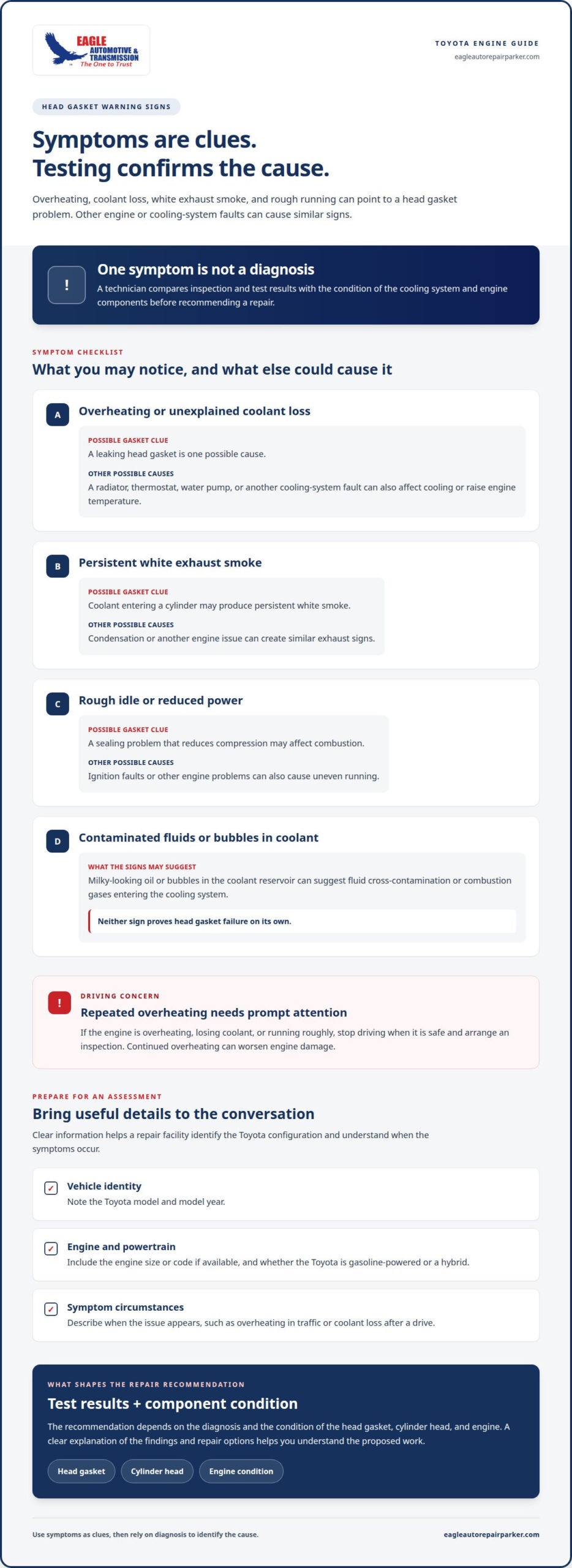
A Toyota head gasket can fail in several ways, and symptoms often overlap with other engine faults. Watch for overheating, unexplained coolant loss, white exhaust smoke, rough idling, reduced power, or a check engine light. Repeated overheating after adding coolant is another warning sign, not a diagnosis.
The gasket sits between the cylinder head and engine block. It seals coolant, oil, and combustion-gas passages while maintaining compression. Damage can allow fluids or gases to cross paths, but symptoms alone can’t confirm the cause. Testing helps distinguish gasket failure from other engine and cooling-system problems.
- Overheating or coolant loss: A leaking gasket is one possibility. A radiator, thermostat, water pump, or another cooling-system fault can also reduce cooling or raise engine temperatures.
- White exhaust smoke: Coolant entering a cylinder may produce persistent white smoke. Condensation or another engine issue can create similar exhaust signs.
- Rough idle or reduced power: Lost compression from a sealing problem may affect combustion. Ignition faults or other engine problems can also cause uneven running.
- Contaminated fluids or bubbles: Milky-looking oil or bubbles in the coolant reservoir can suggest cross-contamination or combustion gases entering the cooling system. Neither sign proves gasket failure alone.
Is it safe to drive a Toyota with a suspected head gasket leak? If the engine is overheating, losing coolant, or running roughly, stop driving when it’s safe and arrange an inspection. Continued overheating can worsen engine damage.
Diagnosis should consider the Toyota’s cooling system, cylinder head, engine block, and other relevant components. A qualified Toyota head gasket specialist Parker can compare inspection and test results to identify the likely source before recommending comprehensive engine and drivetrain repair. Describe when symptoms appear, such as overheating in traffic or coolant loss after a drive, to provide useful context for the assessment by Eagle Automotive.
Which Toyota Head Gasket Specialists Near Parker Have the Best Reviews and Ratings?
A high star rating can help narrow your options, but it doesn’t prove head gasket experience. Compare Toyota repair reviews that describe diagnosis, repair explanations, and follow-up rather than relying on a score alone.
Compare each shop’s rating and review count on the same platform. Google ratings, for example, may differ from scores elsewhere because platforms collect different reviews. Check review dates and details, too. Comments about Toyota engine work offer more relevant context than general praise.
Look for specific accounts of complex repairs. A useful review might describe how a shop investigated a suspected gasket leak, explained repair choices, or communicated about cylinder-head damage. Details about the process say more about experience than a star score without a repair example.
- Diagnosis: Does the reviewer describe testing before a repair recommendation?
- Clear communication: Do customers mention understandable explanations of findings and options?
- Repair follow-through: Do reviews describe updates and how concerns were handled after service?
- Toyota relevance: Do comments name Toyota models or engine repairs similar to yours?
Read critical reviews alongside positive ones. Focus on specific details, such as whether the shop explained a revised diagnosis or responded to a concern. One complaint or glowing review can’t establish a shop’s overall performance.
No rating alone identifies the best choice. Look for consistent review patterns showing clear communication about the repair process and customer concerns. As you compare Parker shops, give more weight to detailed accounts of Toyota engine work than generic praise. Reviews can help you form a shortlist, while a clear explanation of the proposed work helps you judge whether a shop’s approach suits your situation.
Which Toyota Models and Engines Do Parker Repair Shops Service for Head Gasket Problems?
Toyota head gasket work can involve sedans such as the Camry and Corolla, SUVs such as the RAV4 and Highlander, or trucks such as the Tacoma and Tundra. Those model names alone don’t identify the engine or confirm a shop’s service scope. A model can have different engine configurations across years and trims.
The gasket must match the specific engine, not just the Toyota badge. To assess the repair, a technician can use the vehicle identification number, model year, and engine details to identify the correct configuration. That distinction matters when comparing a Camry with a Tacoma, or two versions of the same model.
- Model: Record whether it’s a Corolla, RAV4, Tacoma, or another Toyota.
- Year: Include the model year because configurations can change between years.
- Engine: Note the engine size or code if available on the vehicle’s records.
- Powertrain: Mention whether the Toyota is gasoline-powered or a hybrid.
These details help a repair facility determine whether its equipment, parts information, and repair process suit that vehicle. They also prevent assumptions based on familiar model names. For example, a Highlander and a Corolla may both show overheating, yet their engine layouts and access requirements can differ.
Shop reviews or general statements about Toyota service don’t establish capability for every engine. Look for information that specifically addresses engine repair and head gasket diagnosis, then provide the exact Toyota model and engine details. A Toyota head gasket specialist in Parker should base the assessment on the vehicle’s configuration and test results, not a model name alone.
Understanding the part’s role helps explain why identifying the engine matters. A Toyota head gasket sits between the engine block and cylinder head and seals passages for engine oil, coolant, and combustion gases while maintaining compression. The repair question is not only whether a familiar Toyota model is involved, but whether the problem concerns this seal on that vehicle’s particular engine. Model and engine details give the shop a starting point, while test results establish the condition.
Toyota head gaskets are designed to withstand years of high temperatures and pressure, but they can wear over time or be damaged by engine overheating. The page advises addressing head gasket problems early to help limit additional engine damage and avoid more costly repairs. This is another reason not to rely on the model badge alone: provide the shop with the vehicle’s configuration and ask about head gasket diagnosis for that engine. Early attention does not establish that a gasket has failed; the vehicle’s actual condition still needs assessment.
How Is a Toyota Head Gasket Problem Diagnosed?
A reliable diagnosis combines the Toyota’s symptoms with test results. Overheating, coolant loss, or rough running can point to several engine or cooling-system faults, so a technician checks the evidence before recommending head gasket work.
The inspection typically begins with the vehicle’s history and a visual check. A technician may examine coolant and oil, inspect for external leaks, and scan the engine computer for relevant trouble codes. A code can guide testing, but it doesn’t confirm a failed gasket by itself.
- Inspect the cooling system: Check the radiator, hoses, reservoir, and related components for leaks or damage that could explain coolant loss.
- Test system pressure: A pressure test can help identify leaks in the cooling system. Results are considered alongside other findings.
- Check for combustion gases: A test of the coolant can help identify gases entering the cooling system from the engine.
- Assess engine operation: Compression or cylinder leak-down testing may help identify a cylinder-sealing problem. A technician interprets results with the other evidence.
No single test answers every question. For example, an external coolant leak may explain falling coolant levels without proving head gasket failure. If testing points to internal engine damage, further inspection may be needed to assess the cylinder head and engine block.
That distinction matters before major disassembly or repair decisions. A Toyota head gasket specialist in Parker can combine inspection, cooling-system tests, and engine findings to identify the likely cause and explain the next step. Describe when symptoms occur, such as overheating in traffic or coolant loss after driving, to give the technician useful diagnostic context.
Toyota Head Gasket Repair or Replacement: What Are the Options?
A confirmed head gasket failure doesn’t automatically call for a replacement engine. The repair choice depends on the damage: technicians assess the gasket, cylinder head, engine block, and related components before recommending work.
For a repair, the cylinder head is removed to reach the gasket. The mating surfaces and head are inspected for damage, and the head may need machining if it is warped and can be restored safely. The technician installs a suitable replacement gasket and addresses related problems found during inspection.
- Gasket replacement: Considered when the damage is limited and the cylinder head and engine block remain serviceable.
- Cylinder-head work: Machining or replacing the head may be needed if inspection finds distortion or damage.
- Additional engine repair: Related damage to components or sealing surfaces can expand the work beyond the gasket itself.
- Engine replacement: Considered when internal damage is extensive or the existing engine cannot be restored effectively.
These are different scopes of work, not interchangeable fixes. A new gasket won’t correct a damaged head or block, and replacing an engine may be unnecessary if the damage is confined and repairable. The inspection findings and the condition of the rest of the engine guide that decision.
Ask for a clear explanation of what testing showed, which parts need repair, and why the proposed option fits the Toyota’s condition. A written estimate should distinguish required work from additional recommendations. That gives you a concrete basis to compare gasket repair with engine replacement, without treating either option as automatic.
Head gasket repair is appropriate when the engine’s sealing surfaces and surrounding components can support a sound repair. If overheating has caused broader damage, engine replacement may be the more practical path. The decision should follow inspection findings, not a symptom or assumption alone.
How Long Does Toyota Head Gasket Replacement Take at Shops in Parker?
There isn’t one fixed completion time for every Toyota head gasket replacement. The schedule depends on the model, engine layout, access to the cylinder head, inspection findings, and any additional repairs needed. A Toyota Corolla and a Toyota Tacoma, for example, may require different disassembly steps.
The work involves more than installing a gasket. Technicians remove components to reach the cylinder head, inspect the head and engine block, prepare the sealing surfaces, then reassemble and test the engine. If inspection reveals damage requiring additional work, the repair plan and completion estimate can change.
- Engine access: The vehicle’s layout affects how much must be removed before the head can be reached.
- Condition of the head: Inspection may show that the cylinder head needs additional evaluation or machining.
- Related damage: Overheating may affect other engine or cooling-system components that need attention during the repair.
- Parts and scheduling: Parts availability and the shop’s current workload can affect when work proceeds.
These factors explain why a quick estimate based only on “Toyota head gasket” can be misleading. The model year, engine configuration, test results, and condition of removed parts all help shape a realistic schedule. If the cylinder head is sound and parts are readily available, the work may follow a simpler path than a repair involving additional damage or parts delays.
A useful estimate separates diagnosis, repair, and final testing rather than treating the job as one uninterrupted task. Before work begins, the shop can explain which steps are included and what findings could extend the schedule. That gives you a clearer expectation without relying on a guaranteed timeframe that ignores the specific Toyota’s condition.
What Warranties Do Parker Mechanics Offer on Toyota Head Gasket Repairs?
Warranty terms for Toyota head gasket repairs vary by repair shop and job scope. One shop may cover parts and labor together, while another may describe them separately. The written agreement, not a general claim about coverage, explains what applies to your repair.
Before approving a Toyota repair, ask for the warranty terms in writing. Check whether coverage applies to the replacement gasket, labor to access it, and related parts included in the job. If the repair expands after inspection, ask how the revised work affects the written coverage.
- Covered work: Identify the parts and labor included in the specific head gasket repair.
- Coverage period: Find the stated time or mileage limit, if the shop uses one.
- Exclusions: Check how the document treats overheating, unrelated engine faults, or newly discovered damage.
- Follow-up process: Understand who to contact and what records to provide if a concern arises.
- Repair changes: Confirm whether added cylinder-head work changes the covered scope.
Warranty language matters because a gasket replacement and broader engine repair are different jobs. For example, a repair that includes cylinder-head machining may list different covered work than a gasket-only job. Ask the shop to connect each written term to the work shown on your estimate and final invoice.
Keep the estimate, invoice, and warranty document together after the Toyota leaves the shop. Those records show which parts were installed, what labor was performed, and what terms apply. If any wording is unclear, ask the repair shop to explain it before authorizing the work. A clear written answer helps you understand the coverage without assuming every Parker shop offers identical protection.
Toyota Head Gasket Concerns
If a Toyota is overheating, losing coolant, or running poorly, the cause should be assessed before deciding which repair is appropriate. These symptoms can have several causes, and an inspection can help determine whether the head gasket is involved.
Head gasket symptoms can overlap with other cooling-system or engine problems. A check engine light may also signal an issue that needs investigation, but it doesn’t identify a failed gasket by itself. Share when symptoms began, whether they recur, and any recent overheating or coolant loss. Those details help put the concern in context.
The appropriate repair depends on the inspection findings. The issue may involve the gasket, or the evidence may point to other engine concerns. Ask the repair facility to explain what was found and whether any additional engine work may be needed before deciding how to proceed.
- Describe the symptoms: Note changes in engine temperature, coolant level, exhaust, or how the Toyota runs.
- Bring vehicle details: Provide the model and model year to help identify the correct engine configuration.
- Review the findings: Discuss the cause, proposed repair, and any related engine work before authorizing it.
Clear findings matter. Replacing a gasket without addressing related damage may leave the original problem unresolved, while assuming the engine needs replacement could overlook a repairable fault. The recommendation should be based on the Toyota engine’s condition and the evidence gathered during inspection.
If your Toyota has signs of a possible head gasket problem, arrange an inspection with a qualified repair facility.
Make Your Next Engine Decision With Clear Information
Before approving major work, make sure the proposed repair matches your priorities for the Toyota and the inspection findings. A clear explanation of the options can help you decide how to move forward without rushing your choice.
For Parker owners comparing repair paths, look for a recommendation grounded in the vehicle’s condition. Use that conversation to understand the proposed work and what it is intended to address.
Review Eagle Automotive as you consider your next step. A thoughtful decision starts with clear information and keeps you in control.
Frequently Asked Questions
Which auto repair shops in Parker, Colorado specialize in Toyota head gasket repairs?
When reviewing a head gasket repair recommendation for a Toyota, look for an explanation of the findings and a clear outline of the proposed work. That helps you understand whether the estimate addresses the diagnosed issue and any related engine repairs.
What are the symptoms of a failing head gasket in a Toyota?
Overheating, coolant loss, white exhaust smoke, rough idling, or reduced engine power can signal a possible head gasket issue. Pay attention to how symptoms develop: for example, note whether engine temperature rises during a drive or coolant loss returns after a refill. Those observations give the technician useful context, but testing is needed because other engine or cooling-system faults can produce similar signs.
Are there Toyota dealerships or independent specialists near Parker that repair head gaskets?
Toyota owners in Parker can consider independent repair shops or a Toyota dealership. The relevant choice depends on the repair approach and findings you need addressed. Compare the written diagnosis, proposed work, and explanation of engine condition before deciding where to proceed.