

Head Gasket Repair Cost in Parker, CO: Parts and Labor
A head gasket repair cost in Parker, CO depends on the work the engine needs, not just the gasket. Engine layout, access, labor, teardown findings, and any required cylinder-head or timing work all affect the estimate. The exact cost is specific to your vehicle and repair plan.
It’s reasonable to want a clear figure before committing to a major engine repair. Start by understanding what drives the estimate and which findings could change the scope after the engine is opened.
This guide explains how parts and labor affect the total, why teardown matters, when timing components may be included, and what can affect the repair schedule. You’ll also learn what diagnosis can reveal before the repair plan is set.
Key Takeaways
- Use engine layout and repair scope to understand why estimates can differ from one vehicle to another.
- Look beyond the gasket itself: labor, timing components, and teardown findings can all affect the repair plan.
- Compare a gasket repair with engine or vehicle replacement by weighing the vehicle’s condition and overall value.
- Ask how long the repair may take and what work could extend the timeline, including cylinder-head inspection.
- A suspected blown head gasket can lead to further engine damage if you keep driving, so prompt diagnosis matters.
How Much Does Head Gasket Repair Cost in 2026?
In Parker, a head gasket estimate depends on the engine, access to the cylinder head, and what teardown reveals. Gasket repair, engine replacement, and replacing the vehicle are different decisions, not interchangeable quotes.
Warranty and financing terms vary by repair plan. Eagle Automotive & Transmission offers multiple warranty options and financing. Review the warranty applicable to your repair alongside the written plan.
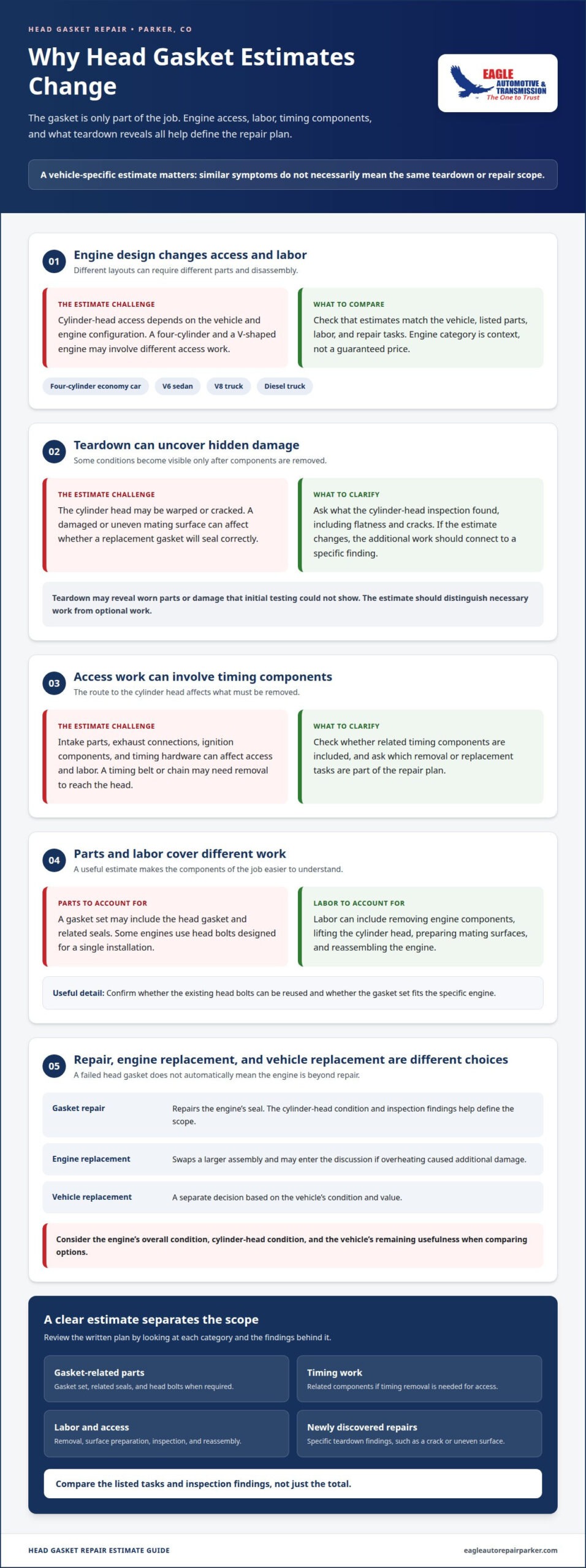
The head gasket repair cost in Parker, CO depends on the vehicle, engine configuration, cylinder-head condition, and any additional work identified during teardown. A vehicle-specific quote is the way to understand the work and cost for your case.
Comparing Repair and Replacement Options
A gasket replacement repairs the engine’s seal, while engine replacement swaps a larger assembly and vehicle replacement changes the whole investment. A failed head gasket does not automatically mean the engine is beyond repair.
Compare the engine’s overall condition, the cylinder head’s condition, and the vehicle’s remaining usefulness. If overheating caused additional damage, engine replacement may enter the discussion. Replacing the vehicle is a separate decision based on its condition and value.
Vehicle and Engine Pricing Factors
Vehicle and engine factors are the design and condition details that determine the labor and parts involved. They matter because two vehicles with similar symptoms can require different teardown work.
Engine layout affects access to the cylinder head, while the head’s condition determines whether a gasket replacement will address the problem. Teardown can reveal damage that changes the scope. A history of overheating matters, but a suspected gasket failure should be diagnosed rather than assumed from one symptom.
Some engines have reputations for head gasket trouble, but a model name alone cannot establish the cause or repair plan. Use symptoms, test results, and inspection findings to determine whether the gasket has failed. That keeps discussion of a known issue from being mistaken for a diagnosis.
Price Ranges by Engine Type
Broad engine-type categories cannot replace a vehicle-specific estimate. Engine size and configuration affect access, parts, and labor, so the repair scope can differ.
A four-cylinder economy car, V6 sedan, V8 truck, and diesel truck may involve different repair demands. Larger or more complex configurations can require more disassembly, while vehicle-specific parts and head condition also shape the job. For owners navigating complex diesel powertrains, specialist providers like diegosshop.com demonstrate how dedicated diesel vehicle repair requires tailored diagnostics and warrantied service. Treat engine category as context, not a guaranteed price for an individual vehicle.
Before choosing between repair and replacement, review what the inspection found and which work is essential. A written estimate can separate gasket work from related repairs, making it easier to understand the proposed scope. Compare repair estimates by matching the listed tasks and inspection findings, not by looking at the total alone.
Parts, labor, timing components, and teardown costs
A head gasket estimate includes replacement parts, substantial labor, and findings made after disassembly. Understanding these parts of the job helps explain why its scope can change.
Parts and Labor Costs
Parts and labor are separate parts of the repair plan, and each affects the total differently. This distinction helps show whether the main work involves components, access, or both.
A gasket set may include the head gasket and related seals, and some engines require new head bolts. Labor covers removing engine components, lifting the cylinder head, preparing mating surfaces, and reassembling the engine. A four-cylinder and a V-shaped engine can require different access work, so the same parts list does not mean the same labor.
Timing Components and Teardown Costs
Timing components connect the repair to the system that synchronizes engine operation. Teardown costs reflect inspection and additional work required once parts are removed, so both can change the job’s scope.
If the timing belt or chain must be removed to access the cylinder head, related components may be included in the estimate. Teardown can reveal worn parts or damage that initial testing could not show. The estimate should distinguish necessary work from optional work, rather than bundling every possible repair together.
Head bolts deserve specific attention because some engines use bolts designed for a single installation. The repair plan should state whether the existing bolts can be reused or new ones are needed. Gasket sets also vary by engine, so the correct fit matters more than choosing a generic kit.
Labor time depends on what must be removed before the head can be lifted. Intake parts, exhaust connections, ignition components, and timing hardware can all affect access. After removal, the cylinder head needs inspection for flatness and cracks before a replacement gasket is installed. These checks help distinguish a straightforward reseal from work requiring machine-shop attention.
Teardown lets a technician inspect surfaces and components hidden during an external diagnosis. A warped head, for example, can prevent a new gasket from sealing correctly. If inspection finds damage, the estimate may need revision to include corrective work. The reason should be tied to a specific finding, such as a crack or uneven mating surface.
Review the estimate by separating gasket-related parts, timing work, labor, and newly discovered repairs. This breakdown makes it easier to understand what each operation addresses and which findings changed the original scope.
Average head gasket replacement cost
There is no useful average for every vehicle because the engine and required work determine the estimate. For a meaningful comparison, match estimates by vehicle, repair scope, parts, and inspection findings.
Multiple quotes can show how estimates vary, even in the same city. Compare the included work, not just the bottom line. One estimate may include cylinder-head inspection, while another may describe gasket replacement without clearly listing that step.
For example, a Toyota 80-Series and a four-cylinder economy car have different engine layouts and access requirements. Even two vehicles with the same cylinder count can differ in labor, parts, and the condition of their cylinder heads. An average can offer context, but it cannot account for those vehicle-specific details.
Use this checklist to compare estimates consistently:
- Diagnosis: Check that each estimate identifies the evidence supporting a head gasket failure.
- Repair scope: Compare the listed gasket work and any cylinder-head inspection or resurfacing.
- Parts: Review whether the estimate includes a gasket set and replacement head bolts.
- Related work: Note whether timing components or other teardown findings are included.
- Labor: Compare which removal, inspection, and reassembly tasks the labor covers.
Separate required work from conditional work. A cracked cylinder head, for example, changes the plan because installing a gasket alone would not address the damage. Each additional operation should be linked to a specific inspection finding.
The vehicle’s value and condition also shape the decision. Compare the proposed repair with the car’s broader mechanical needs, not a generalized average. A vehicle needing several major repairs presents a different choice from one with a confirmed gasket problem and otherwise serviceable systems.
When estimates differ, identify exactly why before deciding. One plan may include timing components, while another may recommend them only if inspection shows they need replacement. A written explanation helps you compare equivalent scopes rather than unlike totals.
Finally, use the three-quote process to clarify uncertainty, not to select the smallest number automatically. Confirm that each estimate addresses the same symptoms, tests, and repair tasks. The most useful comparison shows what the technician found, what the proposed work corrects, and which findings could change the scope.
Repair duration
Most head gasket repair jobs take 2 to 4 days, though hands-on replacement can take about five hours. Those figures describe different parts of the process: wrench time is not the same as total shop time. Diagnosis, teardown, cylinder-head inspection, parts needs, reassembly, and final checks all affect how long the vehicle stays in the shop.
The five-hour figure describes replacing the gasket itself, not every task surrounding the repair. Before installation, the technician must access the cylinder head and inspect its surface. If inspection finds cracks or warping, further work may be needed before reassembly. That explains why the core repair time does not necessarily mean the vehicle will be ready the same day.
A typical sequence includes several distinct stages:
- Diagnosis: Test results help identify whether the head gasket is the source of the problem.
- Disassembly: Remove components blocking access to the cylinder head.
- Inspection: Check the removed head and related surfaces for damage.
- Repair and assembly: Install the gasket and reassemble the engine.
- Final checks: Confirm the engine operates correctly after the repair.
Each stage depends on the previous one. The cylinder head, for example, cannot be meaningfully inspected until it is removed. If inspection shows that further repair is needed, reassembly must wait for that work. A clear estimate should explain the planned sequence and identify findings that could change it.
Parts availability also affects the schedule. A gasket set and head bolts must match the engine; an incorrect part cannot be used simply to keep the job moving. If teardown reveals damaged components, the repair plan may need revision before installation. These are practical reasons a repair can take longer than the hands-on replacement work alone.
Ask whether the stated timeframe means technician labor or total shop time. That distinction helps you plan transportation and daily routines. A vehicle needing only the planned gasket work follows a different timeline from one requiring cylinder-head correction or additional parts.
Before authorizing the work, have the repair sequence and expected completion window explained together. The 2-to-4-day general timeframe gives a planning reference, while inspection findings and parts needs determine the actual schedule. Keep the engine off if overheating or coolant loss makes continued operation unsafe, since further engine damage can complicate the repair.
Is it safe to drive with a blown head gasket, and what damage can result?
Driving with a blown head gasket can cause further engine damage because coolant, oil, and combustion gases may cross paths. Continued operation can worsen overheating and turn a gasket failure into cylinder-head or engine damage. If the temperature gauge climbs or coolant disappears, stop driving and arrange an inspection rather than testing whether the vehicle can make another trip.
Overheating is a central concern. Aluminum cylinder heads can begin warping permanently after sustained internal temperatures above approximately 240-260°F. A warped head may no longer seal against a replacement gasket, adding corrective work before reassembly. Continuing to run an overheating engine can therefore affect more than the original failed seal.
A leaking gasket can also let combustion gases enter the cooling system or coolant enter a cylinder. According to the U.S. Government Publishing Office, even a small exhaust-gas leak into the cooling system should be corrected immediately because liquid may eventually enter the engine. Coolant entering a cylinder can disrupt combustion, while coolant mixing with engine oil can compromise lubrication.
Watch for warning signs, but do not treat any single symptom as proof of a blown gasket. Examples include:
- Rising temperature: The gauge moves toward hot, or an overheating warning appears.
- Coolant loss: The reservoir level drops without an obvious external leak.
- Unusual exhaust: Persistent white vapor may occur when coolant reaches a cylinder.
- Rough running: A misfire or uneven idle can have several causes, including engine sealing problems.
- Fluid changes: Coolant or oil may show signs of contamination.
These clues call for testing, not guesswork. A mechanic may use a cooling-system pressure test, inspect fluids, and check for combustion gases in the coolant. Compression testing can help identify a cylinder that is not sealing correctly. Consider the findings together because overheating, rough running, and coolant loss can have other causes.
If the vehicle overheats, shut the engine off as soon as it is safe. Do not remove a hot radiator cap, since pressurized coolant can cause severe burns. Let the engine cool and arrange professional diagnosis. Restarting it to drive farther can increase damage and complicate the repair.
Prompt inspection can clarify whether the problem is a gasket leak, another cooling-system fault, or resulting engine damage. If you notice overheating, coolant loss, or rough running, schedule a head gasket inspection before driving further.
Eagle Automotive: Head Gasket Repair
Eagle Automotive & Transmission performs head gasket repair when testing points to a leak or engine sealing problem. Careful diagnosis helps determine whether the gasket is the cause and whether overheating has affected the cylinder head or other engine components.
Free computer diagnostics are provided, and the findings help guide the repair plan. Eagle Automotive & Transmission handles head gasket concerns as part of its engine repair and service, and can diagnose a Check Engine Light when it is among the symptoms. The estimate should reflect the work your vehicle needs, not a guess based on one warning sign.
If you notice coolant loss, overheating, or rough engine operation, contact Eagle Automotive & Transmission in Parker to discuss the symptoms and next steps.
Make Your Next Repair Decision With Clarity
A major engine concern can make it hard to know what to do next. Start with diagnosis that connects symptoms to specific findings, then use the written repair plan to decide how to proceed. Understanding head gasket repair costs in Parker, CO is most useful when the estimate reflects your vehicle’s actual condition and explains the recommended work.
Eagle Automotive & Transmission can assess head gasket concerns through its engine repair and service work. If a Check Engine Light accompanies the symptoms, it can be evaluated too. Brake Repair is also available for separate braking concerns identified during vehicle maintenance.
Bring forward the symptoms you’ve noticed and any recent overheating or coolant loss. A focused conversation can help establish the next diagnostic step and what information the repair plan should address. Contact Eagle Automotive about your repair to discuss your vehicle and take the next step with a clearer plan.
Frequently Asked Questions
Is replacing the head gasket worth it?
Repair can be worthwhile if the rest of the vehicle is in sound condition and the work fits its value. One rule of thumb is that the vehicle should be worth at least double the repair cost. Also consider whether the transmission, brakes, and other major systems need work. A vehicle with several serious problems presents a different decision from one with an isolated engine issue.
What causes a blown head gasket?
Engine overheating is a common cause because excessive heat can strain the seal between the cylinder head and engine block. A cooling-system problem, such as coolant loss, can contribute to overheating. A gasket may also fail as an engine wears. Because symptoms can overlap with other faults, diagnosis should establish whether the gasket has failed and identify any underlying issue that could cause another failure.
What is the average head gasket repair cost in Parker, CO?
There is no single average that accurately describes every Parker repair, since the engine and required work determine the estimate. Your price depends on the vehicle, parts, labor, and inspection findings, and is provided in a vehicle-specific quote. Use an estimate that identifies the repair scope and any conditional work instead of relying on a general figure that may not match your engine.
What is the typical head gasket replacement labor cost in Parker, Colorado?
Labor depends on how much disassembly is needed to reach the gasket and what inspection reveals after the cylinder head is removed. Engine configuration, access, and corrective work can change the labor scope. Review whether the estimate includes removal, head inspection, surface preparation, reassembly, and final checks. These details make labor estimates easier to compare than a figure without a task breakdown.
How much do head gasket parts and machine shop services cost?
Parts and machine-shop work vary by engine and cylinder-head condition, so no single parts total applies to every vehicle. The estimate may include a gasket set and head bolts, while machine work depends on inspection results. Ask which parts are included and what inspection findings would require machining. This clarifies which work is planned and which depends on what inspection uncovers.
What factors affect head gasket replacement cost, such as engine type and vehicle make?
Engine layout, access to the cylinder head, vehicle-specific parts, and damage found during inspection all affect the repair scope. A V-shaped engine, for example, may require different disassembly from an inline engine. The make and model determine which parts fit, while overheating damage can add corrective work. A useful estimate connects these factors to specific operations instead of relying only on the vehicle’s make.
How can I tell if a car needs a head gasket replacement?
One symptom alone cannot confirm a failed head gasket. Overheating, unexplained coolant loss, rough running, or unusual exhaust can point to several possible faults. A technician can combine cooling-system testing, fluid inspection, and engine checks to determine whether the gasket is leaking. Share when the symptoms occur, such as at startup or after driving, as that context can help guide diagnosis.
Is head gasket repair worth it compared with replacing the engine or selling the car?
Compare the engine’s overall condition, the vehicle’s needs, and the repair plan before choosing. Gasket repair addresses the seal, while engine replacement addresses a broader engine problem. Selling the vehicle is another option, but its condition and likely repair needs matter. If the cylinder head or engine has extensive damage, weigh those findings against the vehicle’s value and remaining serviceability.